
The short answer
How do a2013gift, a reference to Clive Arlidge and Māori cosmological relationships meet in one painting?
Read the evidence
Sources, interpretation and production roles
The records answer different questions about this work. The final exercise is an original teaching model.
| Record or question | Supported reading | Boundary or contrast |
|---|---|---|
| Collection record | Documents the 2013 gift and material. | A gift’s occasion is not a literal key to every painted element. |
| Arlidge reference | Names a specific earlier maker within the work’s genealogy. | Reference is not the same as joint authorship. |
| Original network model | Separates occasion, reference and interpretive framework. | It reproduces no artwork or culturally specific motif. |
A gift with a specific setting
Dust, Smoke and Rainbows is a 2013 acrylic painting on linen, given by Shane Cotton to Christchurch Art Gallery. The gallery links the gift with the city’s earthquake experience and its continuing support for The Hanging Sky exhibition. The work’s institutional history is therefore part of its meaning as a gift, without requiring every painted form to illustrate a particular damaged building or moment in the disaster.
Sources for this section: [4]
Space as a network of relations
The collection labels connect the painting with te kore, a realm of potential in Māori cosmology, and with Cotton’s interest in relationships between matter and ideas. The Hanging Sky account locates this image within his move away from stable horizons towards expansive sky spaces. A useful reading asks how recognisable elements enter a shared field, rather than searching for a single conventional landscape viewpoint from which every form must be seen.
Acknowledging an earlier artist
The gallery identifies a reference to a modernist carving by Northland artist Clive Arlidge. That is a concrete example of artistic genealogy within the painting. It differs from treating an inherited image as anonymous cultural decoration. Naming Arlidge directs attention to a maker and to relationships between generations of artists. This does not establish that the two artists jointly produced the canvas; it identifies a reference within Cotton’s authored work. In the resulting account, a reference can connect generations without removing the earlier maker’s name. That specificity is more informative than treating every recognisable form as a timeless, anonymous cultural symbol.
Sources for this section: [4]
Original exercise: three kinds of connection
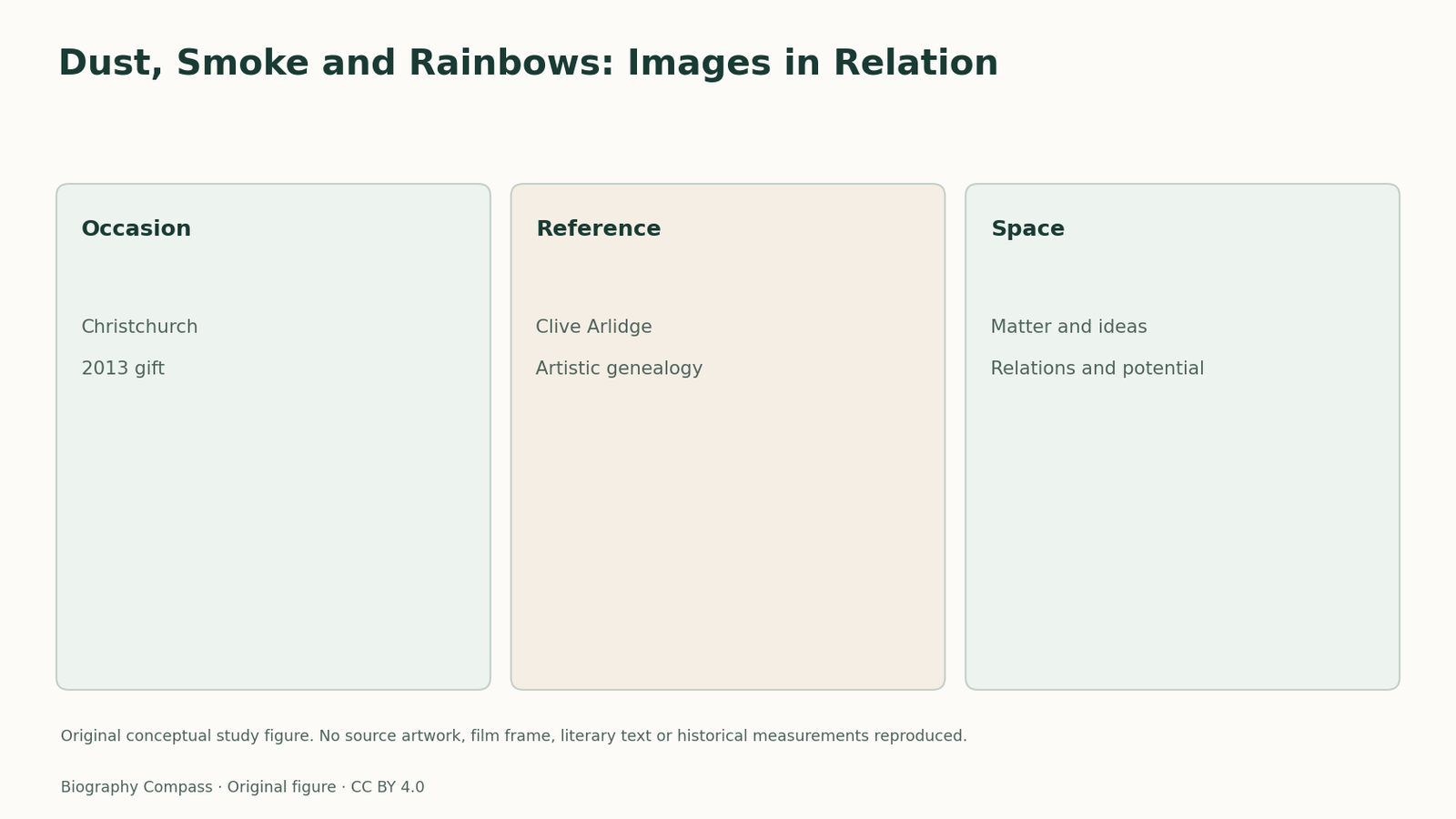
Create a diagram using only text boxes. Put the 2013 painting in the centre, with one connection to the earthquake-era gift, another to Arlidge’s earlier work and a third to the gallery’s account of cosmological potential. Label the connections occasion, artistic reference and interpretive framework. A possible answer explains that the occasion tells us why a gift was made, the reference identifies another maker’s contribution to the image’s lineage, and the framework suggests how its space may be understood. None is interchangeable with the others. Add a question asking whether a painting can respond to an event without depicting it literally. A supported response points to the gallery’s documented gift account while allowing the picture’s relationships to exceed that occasion. This exercise produces an account of several connected histories without copying a Māori motif, a carving or the painting’s arrangement. It also clarifies why a network of references may be more useful here than a timeline that assumes each element replaces the previous one. The work can hold different times in relation within a single surface.
Continue the chronology
Related history guides
Biography context
Explore New Zealand through connected lives
Connected biographies
People and related creative practices

1964–present
Shane Cotton
New Zealand painterShane Cotton developed from art-school and teaching work into a sustained painting career that moves between land, inherited images and expansive sky spaces.Read biography1943–present
Dick Frizzell
New Zealand painter, illustrator and writerDick Frizzell moved between advertising, illustration, teaching and painting, turning familiar public images into humorous and sometimes contested works.Read biographyQuick answers
Common questions
- Does the Clive Arlidge reference mean he co-painted the work?
- No. The museum identifies a reference to his earlier carving within Cotton’s 2013 painting.
Primary and institutional sources
How this history was checked
Sources include production records, institutional collections and the specifically identified passages discussed here. Interpretations and teaching models are distinguished from credits and publication facts. This article was reviewed on 8 November 2026.