
The short answer
How did the 2016 capital subscription combine differently priced share classes, and why did the investor describe an equity-method affiliate?
Original record comparison
Read price, capital and control as separate fields
Keep the entity, period, units and document scope attached to the numbers.
| Record or calculation | What it establishes | What it does not establish |
|---|---|---|
| Completion release | Quantities, prices, rounded peso total and approximately 20% after dilution. | Current value, return or the full class-rights instruments. |
| Financial note | Newly issued private-placement shares and equity-method affiliation. | A full takeover or an automatic rule for all 20% holdings. |
| Historical bank account | The 2016 signing date and distinct named offices. | A reason to collapse signing and completion into one event. |
Chronology
A timeline of the turning points
Subscription agreement
Date established by the financial note and bank’s historical account.
Completion
Investment completed and two nominees elected.
Accounting application
Financial note starts equity-method affiliation on this date.
The transaction was a subscription for new capital
BTMU’s 2016 semi-annual securities report describes a capital increase through a private placement of newly issued Security Bank shares. It dates the subscription agreement to 14 January 2016 and the acquisition to 1 April 2016. The original completion release gives the acquired share classes and their prices. Reading these records together establishes the form of the transaction before calculating its amount. New issuance is different from buying every existing shareholder’s holding, and an approximately 20% interest is different from full ownership. The investor’s own accounting description supplies a further check on the relationship.
Two classes had sharply different subscription prices
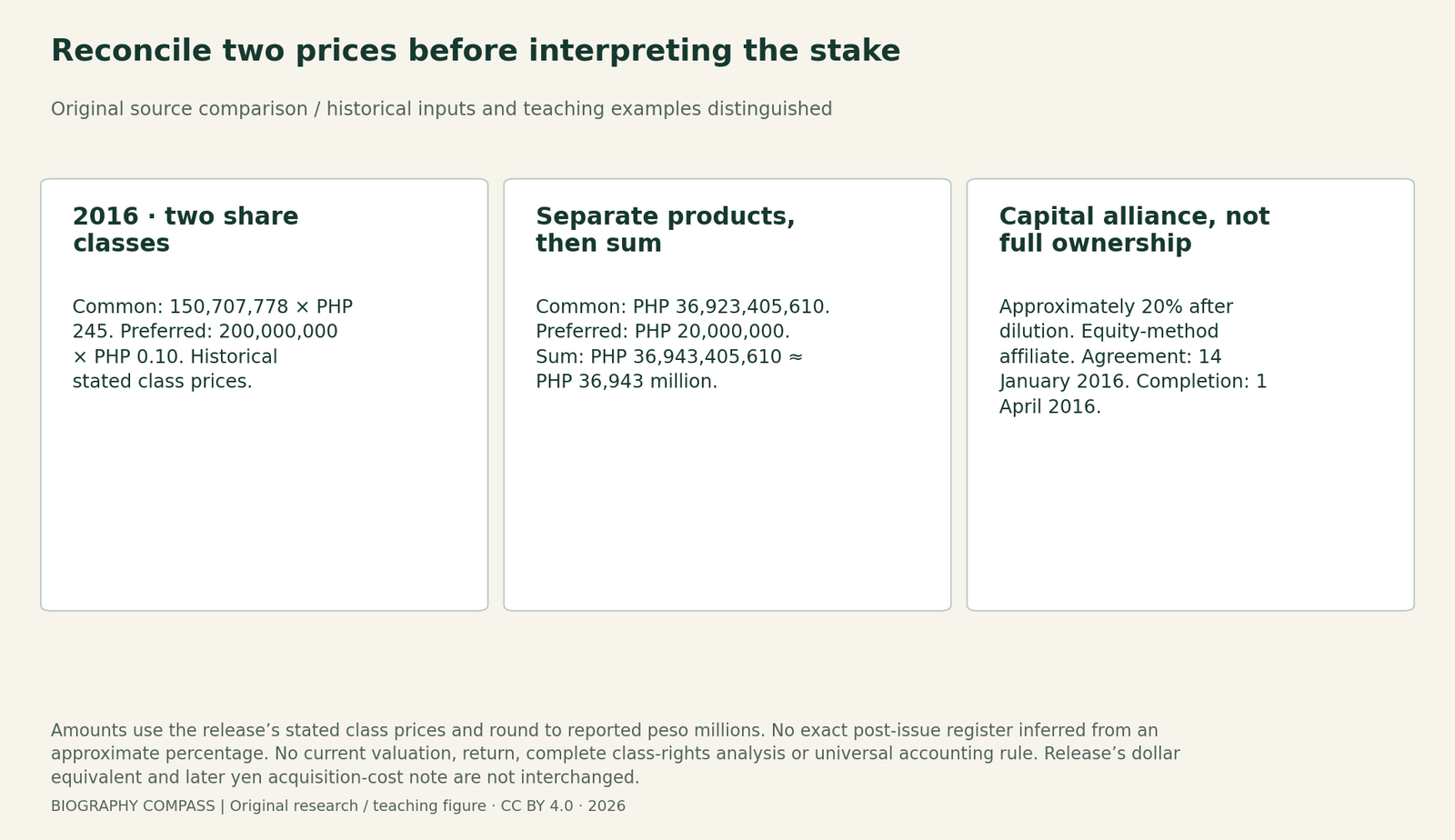
The completion release lists 150,707,778 common shares at PHP 245 each and 200,000,000 preferred shares at PHP 0.1 each. It describes the investment portion as approximately 20% after dilution in common and preferred shares with voting rights. The price is therefore a property of the named class in this transaction. One cannot add the two share quantities and price the entire sum at 245. Nor does a lower subscription price by itself establish every economic or voting term of a preferred class. The complete rights require the relevant corporate instruments.
Sources for this section: [1]
The reported peso total can be checked without guessing a return
Multiplying the stated quantities and prices gives a common-share component of PHP 36,923,405,610 and a preferred-share component of PHP 20,000,000. Their sum is PHP 36,943,405,610, or 36,943.40561 million, which rounds to the release’s PHP 36,943 million. The calculation reconciles a reported subscription table; it does not measure an investor’s later return or a founder’s personal proceeds. The release’s US-dollar equivalent also uses its own stated exchange rate. The later financial note’s yen acquisition cost includes a different reporting context and fees, and should not be substituted into this peso check.
Equity-method affiliation is the relationship actually reported
The financial note calls Security Bank an affiliate accounted for using the equity method, with 20% of voting rights after the acquisition. The completion release also records the election of two BTMU nominees to Security Bank’s board. These are concrete governance and accounting facts. They do not describe a wholly owned subsidiary or establish that every board decision was controlled by the investor. The guide uses the issuer’s actual 2016 classification. It does not offer a universal rule that any 20% holding automatically determines accounting treatment in every company or later period.
The two dates also expose a small source error
The one-page April 2016 release refers back to a January 14 announcement using the year 2015. The later 2016 financial note explicitly dates the share subscription agreement to 14 January 2016, and Security Bank’s 2021 historical account gives the same 2016 date. Its signing caption separately identifies chairman Alberto Villarosa, chairman emeritus Frederick Dy and BTMU’s Go Watanabe. The cross-check supports 2016 without silently copying the erroneous year or treating the caption’s earlier signing as completion. Completion and equity-method application remain dated 1 April 2016.
Original exercise: audit the subscription summary
An editor combines the two classes into 350,707,778 shares and multiplies all of them by PHP 245. The draft then calls the result the price of a full bank takeover. Rebuild the class-by-class calculation in pesos and millions, and reconcile it to the rounded total. Next identify the specific source phrases that correct the transaction form and control description. Finally, write one sentence distinguishing the January agreement from the April completion, and note why the 2015 year in one source should not be retained. Avoid inferring exact post-issue registers from an approximately 20% figure alone.
Worked answer: retain the classes and the reported relationship
The correct calculation is 150,707,778×245 plus 200,000,000×0.1, totalling PHP 36,943,405,610 or approximately PHP 36,943 million. The flawed method applies the common-share price to preferred shares. The financial note supplies “private placement of newly issued shares” and equity-method affiliation; the release supplies approximately 20% after dilution and two board nominees. A defensible sentence says: “The subscription agreement was dated 14 January 2016, and completion was announced on 1 April 2016.” The later financial note and the bank’s historical account resolve the release’s mistaken 2015 reference. This is a bounded reconstruction of a historical capital transaction, not advice to buy, price or classify a current security.
Continue the chronology
Related history guides
DMCI’s Order Book: What Moves the Balance?
Why can booked revenue reduce an order book while still being reported as revenue, and what can the selected quarterly tables reconcile?
Read the timelineYear ended 31 December 2024Robinsons Retail: Which Stores Are Counted?
What does a drugstore’s share of a retailer’s footprint mean when the report separately counts a large franchised network?
Read the timelineBiography context
Explore Philippines through connected lives
Connected biographies
Business careers in context
Business career documented from 1980
Frederick Dy
Banking and industrial-company directorFrederick Dy’s documented career combines industrial directorships with a long period chairing Security Bank and a later chairman-emeritus role.Read biographyQuick answers
Common questions
- Was this a purchase of the whole bank?
- No. The records describe approximately 20% after dilution and equity-method affiliation.
- Does the exercise value the bank today?
- No. It only reconstructs the classes, prices and reported amount in the 2016 historical subscription.
Primary and institutional sources
How this history was checked
Read the selected historical records within the stated scopes. The worked comparisons are original editorial calculations, not investment recommendations or independently audited impact claims. This article was reviewed on 27 October 2026.