
The short answer
How did the 1906 Chicago plant connect catalogue orders, stock and dispatch?
Read the records together
Evidence, functions and interpretation
Compare the particular records and mechanisms discussed in this study.
| Record or mechanism | What it establishes | The distinct question |
|---|---|---|
| 1905–1906 construction record | Identifies the original complex’s major functions. | It should not absorb every later addition. |
| Powerhouse description | Connects utilities with working equipment. | It supplies functions, not a newly calculated throughput. |
| Dated drawing inventory | Separates 1905,1913 and 1914 design records. | Listed drawings were identified, not all independently inspected. |
A catalogue created promises that a plant had to fulfil
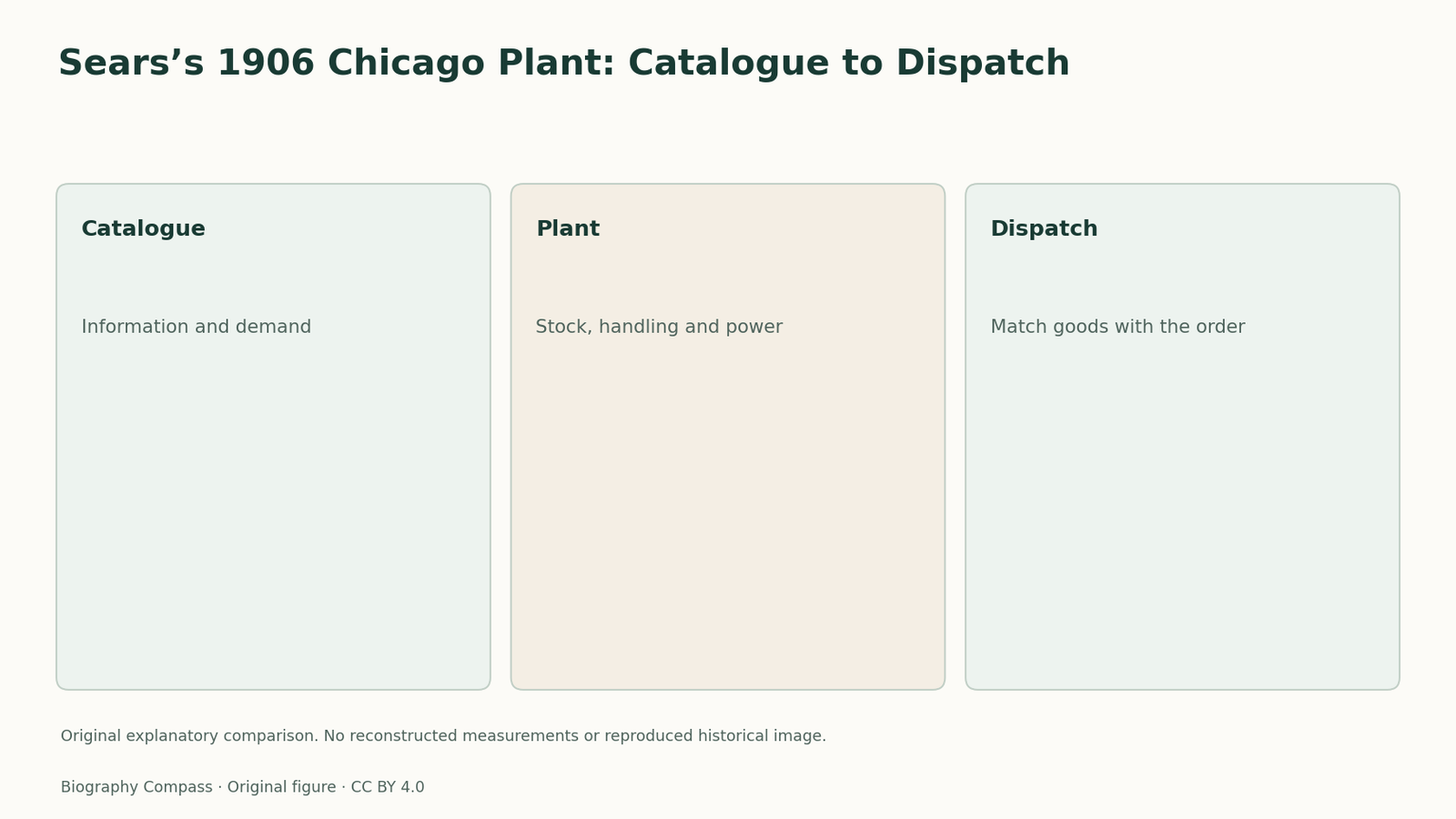
Sears’s Chicago complex was built in 1905–1906 to serve a growing mail-order business. The historical documentation identifies separate merchandise, administration, printing and power functions. Their relationship explains why the complex mattered. A catalogue could create a sale without putting the advertised object in the buyer’s hands. Fulfilment required the firm to connect an order with stock, prepare the goods and arrange dispatch. The plant gave those different activities a coordinated physical setting.
Information and goods moved in different forms
The documentation identifies both pneumatic tubes and conveyors. Those systems should not be treated as interchangeable. A tube can carry information or a small item between stations; a conveyor supports material movement through a working space. In a mail-order operation, the customer’s request and the merchandise must eventually be brought together, even if they travel through different channels inside the plant. This functional distinction explains the value of coordinated design without supplying an uninspected historical routing plan or an invented processing speed.
Sources for this section: [1]
The powerhouse supported more than lighting
The HABS description records the powerhouse’s connection with conveyors, tubes, pumps, refrigeration and lighting. Power therefore supported a set of operational services rather than only illuminating offices. The complex depended on a network of supporting functions behind the visible catalogue. This helps explain why a mail-order plant could be an industrial-scale undertaking even though its central business was retail. Buying and selling goods at distance generated a need for machinery, utilities and people able to operate a coordinated handling system.
Sources for this section: [1]
A later drawing is not automatically an opening-day plan
The same documentation lists a 1905 tube-station drawing, a 1913 empty-box conveyor arrangement and a 1914 billing and basket-return scheme. Their dates matter. They establish a sequence of documented design work, rather than proof that every listed arrangement existed in its final form when the plant opened. Buildings and handling systems could be expanded or modified. Reading the dated list prevents a later configuration from being mistaken for the original 1906 layout, while still showing the kinds of practical problems the organisation continued to address.
Sources for this section: [1]
An original order-tracing exercise
Take an invented order for two different products. Write one line for information: the requested items, quantity and address. Write another for goods: locating stock, bringing the items together and packing them. Where must the lines meet? The checked answer is before dispatch, when the package must be checked against the request and destination. Now suppose a return conveyor is added years after opening. Does its later drawing establish its presence on opening day? No. This original exercise distinguishes coordination from chronology without claiming to reproduce Sears’s complete historic operating procedure.
Continue the chronology
Related history guides
Ward’s 1872 Catalogue and the Later Postal Network
Compare Ward’s 1872 single-sheet catalogue with the later 1896 rural-delivery experiments and 1913 Parcel Post service, separating a selling method from its networks.
Read the timeline1916–1917Piggly Wiggly’s Patent: The Route to Checkout
Read Saunders’s 1916–1917 self-serving-store patent to see how shelves, a circuitous customer route and a checking station formed one retail arrangement.
Read the timelineBiography context
Explore United States through connected lives
Richard Warren Sears
Richard Warren Sears was a mail-order entrepreneur, known for building Sears’s catalogue business with Alvah Roebuck and later partners while the firm developed national fulfilment capacity.
Explore the biographiesWider contextHenry Ford
Read Henry Ford’s automobile manufacturer and founder of ford motor company career as a separate contextual comparison.
Explore the biographiesConnected biographies
People and wider context
1863–1914
Richard Warren Sears
Mail-order entrepreneurRichard Warren Sears was a mail-order entrepreneur, known for building Sears’s catalogue business with Alvah Roebuck and later partners while the firm developed national fulfilment capacity.Read biography
1863–1947
Henry Ford
Automobile manufacturer and founder of Ford Motor CompanyAn American manufacturer whose company made the Model T in enormous numbers, developed moving assembly methods and combined high wages with intrusive labor policies.Read biographyQuick answers
Common questions
- Was Sears only a watch seller?
- His initial watch business expanded into a broad catalogue enterprise serving a national market.
- Did every system listed in the plant documentation exist in 1906?
- No. The document lists drawings and changes from several dates, so later arrangements must be kept separate.
Primary and institutional sources
How this history was checked
Primary records, institutional catalogues and historical interpretation answer different questions. The comparison and worked example are original editorial analysis. This article was reviewed on 8 November 2026.
- Deborah Slaton, Jeffrey Koerber and Harry Hunderman / Wiss, Janney, Elstner Associates,1994Sears, Roebuck and Company Mail Order Plant, HABS IL-1187
- Library of CongressSears, Roebuck and Co. Goes Public
- Harvard Business School Leadership InitiativeRichard W. Sears
- Sears Archives, preserved mirrorRichard Sears: archived company biography