
The short answer
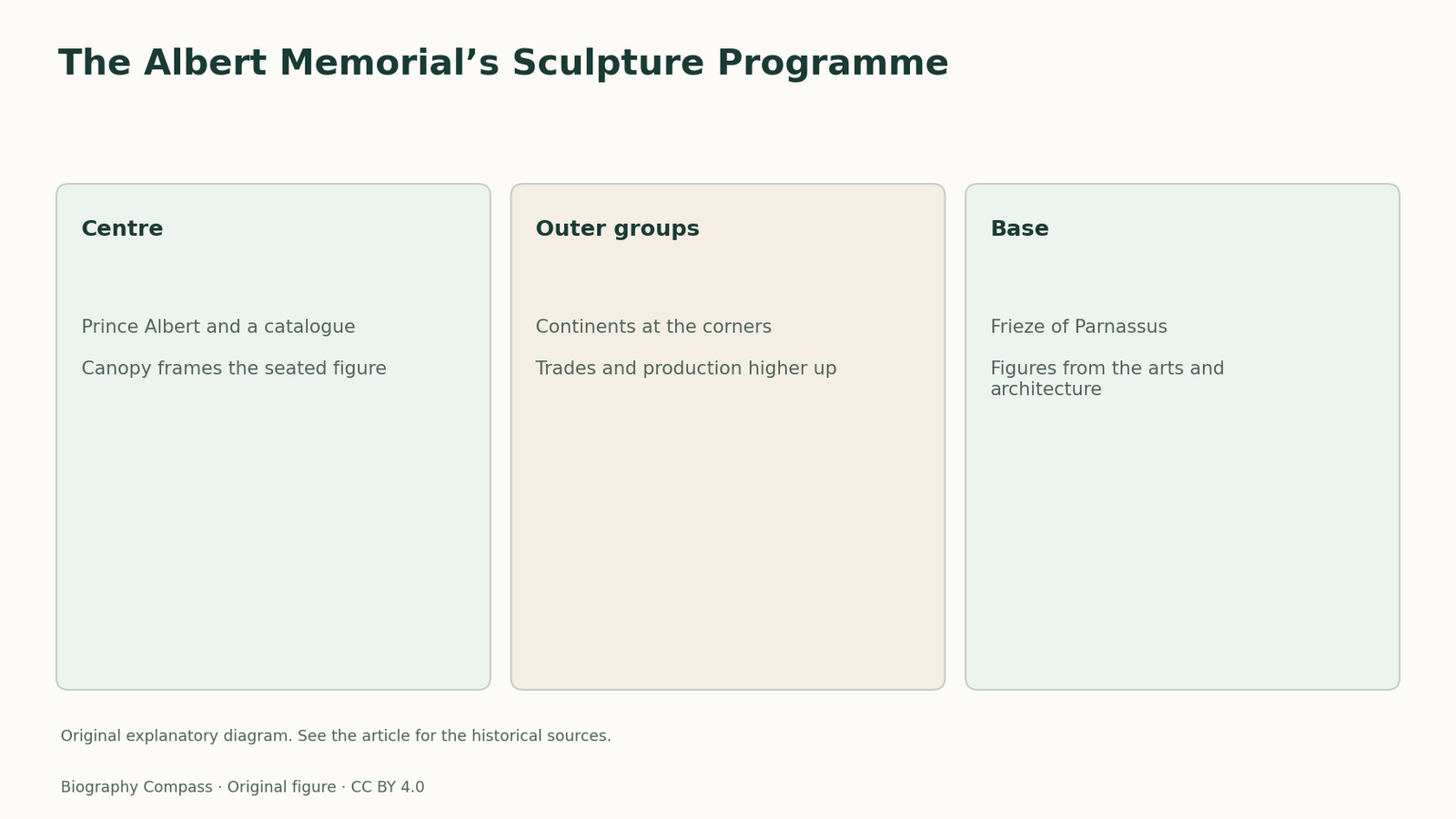
The Albert Memorial distributes figures across a base, outer groups and a tall canopy. Reading them in place shows how George Gilbert Scott’s architectural scheme gave many artists a shared structure.
Compare the evidence
Decisions and their effects
The records describe different stages of the work.
| Country | Documented decision | What it explains |
|---|---|---|
| Central figure | Albert holds the Great Exhibition catalogue | The attribute identifies a specific public association |
| Outer and upper groups | Continents and productive activities occupy different levels | Position separates the two themes |
| Parnassus frieze | Artists and architects occupy a band around the base | Close viewing reveals a different scale of detail |
A figure and an object tell the first story
The memorial commemorates Prince Albert in Kensington Gardens. Under the canopy sits Albert holding a catalogue of the Great Exhibition of 1851. The object gives the portrait a specific reference beyond recognition of the sitter: Albert is shown through his connection with the exhibition. Historic England’s listing describes the architectural frame in several materials and attributes the overall work to George Gilbert Scott with numerous contributors. Start with the figure, the object it holds and the space set apart for it, since each of these decisions directs the viewer to a different aspect of the commemoration.
The outer groups organise a broad public theme
The Royal Parks identifies groups representing Europe, Asia, Africa and America at the monument’s corners. Groups representing manufacture, commerce, agriculture and engineering stand higher. The arrangement creates a visual distinction between a Victorian representation of the world and a set of activities associated with production and exchange. Those groups express assumptions of the era that commissioned them. Their location and subjects are documented, while an interpretation of how a viewer reads the relationships between them depends on observing the composition as a whole.
The frieze works at a different distance
Around the base, the Frieze of Parnassus gathers figures from the arts and architecture into a continuous band. Its position rewards a viewer who follows the perimeter and attends to many individuals in sequence. By contrast, the upper canopy and spire establish the silhouette before the base can be examined in detail. This is a useful spatial comparison because the same memorial has to function at the scale of a park view and a close inspection. The groups, frieze and canopy offer different amounts and kinds of information at those distances.
An unveiling and a construction range answer different questions
The Royal Parks gives 1872 as the year the memorial was unveiled. Historic England dates the memorial from 1862 to 1875. One record specifies a public milestone and the other gives a range for the work as a whole. A timeline that uses both preserves the sequence without requiring every component to have been in place on the unveiling day. The broad listed date range also leaves room for the practical fact that the architect’s framework and the work of separate artists and craftsmen could reach completion on different schedules.
A method for reading collective authorship
Use three observations to describe the memorial. Name the part of the structure where the work sits, identify what it depicts and check whether the source names the person who made it. An example is the lower frieze, where the location and subject are supported by the Parks account and the broader multi-artist credit by the list entry. The distinction matters when expanding an architect’s biography into a history of the monument. Scott’s contribution is visible in the ordering of the whole while the sculpture remains the work of multiple specialists.
Biography context
Explore Kensington Gardens, London, England through connected lives
Connected biographies
People behind the work
1811–1878
George Gilbert Scott
Architect and surveyor of historic buildingsGeorge Gilbert Scott designed the Albert Memorial and major Victorian buildings while directing restoration projects at Westminster Abbey and elsewhere.Read biographyQuick answers
Common questions
- What is Albert holding?
- He holds a catalogue of the 1851 Great Exhibition, with which he was closely associated.
- Where is the Frieze of Parnassus?
- It runs around the base of the memorial, below the principal figure and canopy.
Primary and institutional sources
How this history was checked
Dates, legal milestones and historical claims are checked against the official and institutional records below. This article was reviewed on 13 November 2026.