
The short answer
How did peptide chemistry and activity tests establish a releasing hormone without making each biological assay a complete structural measurement?
Read the evidence
Different records within the same investigation
The following comparison distinguishes the specific questions answered by the inspected records.
| Record or test | What it establishes | What remains different |
|---|---|---|
| Initial sequence proposal | A candidate order supported by combined chemical evidence | Further confirmation was a separate publication |
| Biological comparison | A functional check on natural and synthetic material | Response alone does not identify sequence |
What did the first paper propose?
The 1971 porcine LH- and FSH-releasing hormone paper was explicitly the first part of a structural investigation. Matsuo, Baba, Nair, Arimura and Schally proposed a decapeptide sequence. Its logic combined observations from several analytical approaches rather than relying on a physiological response alone. The word proposed is historically useful: it identifies a candidate order for the molecule’s building blocks, supported by the evidence then assembled. It does not mean the investigators had already published every later confirmation, nor does it identify a peptide solely by the effect produced in an assay.
Sources for this section: [1]
Confirmation answered a narrower question
The second structural paper, published later in 1971, described confirmation of the proposed structure by conventional sequential analyses. Schally’s Nobel lecture explains the progression from the initial combined observations to further sequence work and comparison with synthetic material. A confirmation has value because it challenges the first inference through additional evidence. It should not be collapsed into the original proposal just because both support the same final sequence. Equally, naming the senior investigator alone obscures Matsuo and the other authors whose chemical and biological contributions appear in the original record.
Biological activity supplied a different check
A molecule can have a proposed sequence without the preparation having all the properties attributed to natural material. Schally’s lecture discusses the comparison of synthetic and natural releasing hormone. The biological response therefore served a different role from the ordering of residues: it tested whether the proposed material behaved as expected in the stated hormonal context. Chemical sequence, preparation identity and biological response belong in a chain of support, but they are not synonyms.
Sources for this section: [4]
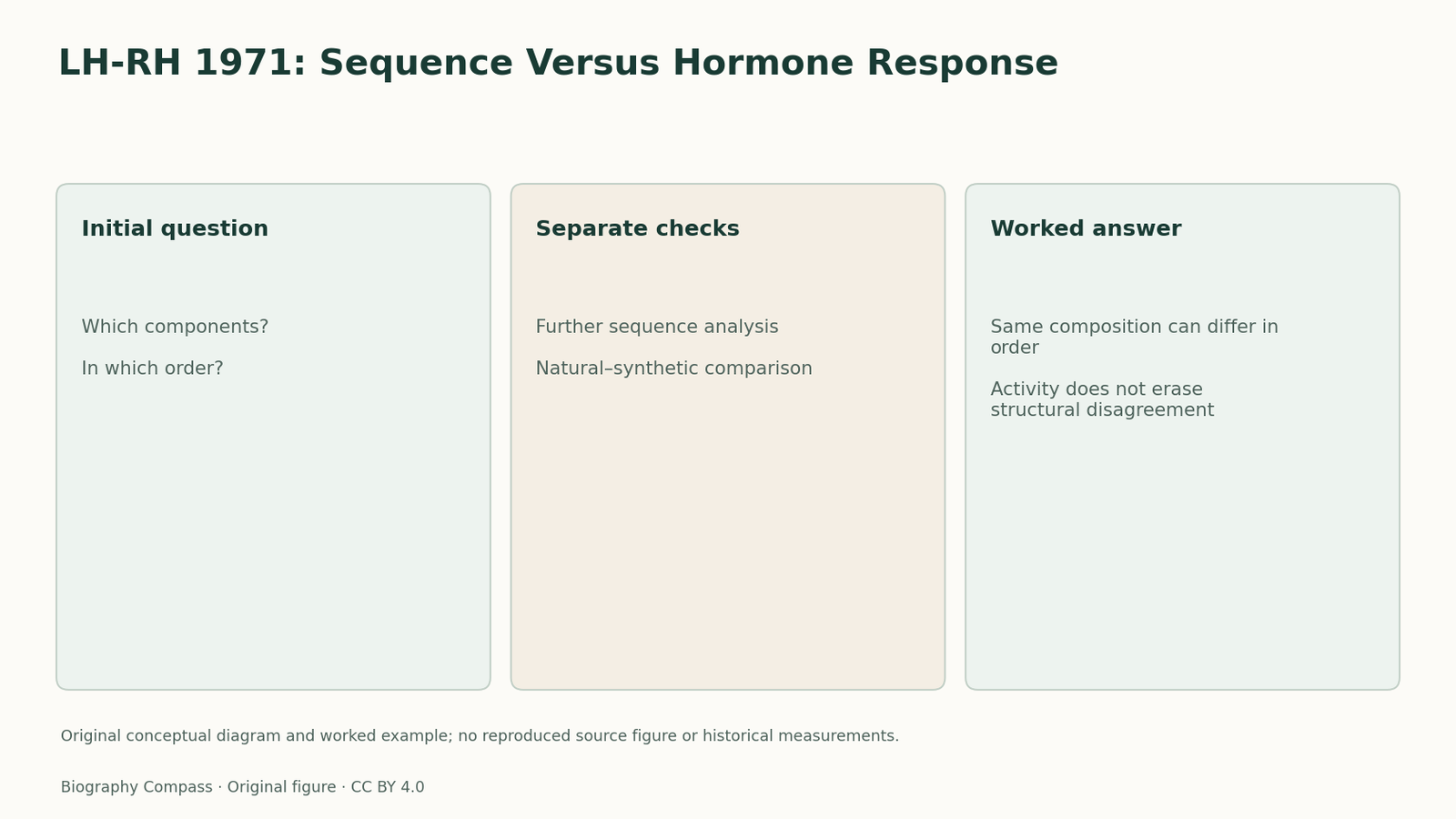
Exercise: composition does not specify order
Consider two invented short strings, ABCD and ACBD. They contain the same four symbols, so a count of components cannot distinguish them. A separate observation that B follows A distinguishes the first from the second. What additional kind of evidence has been introduced? Evidence about order, rather than composition alone. These classroom symbols are not the historical LH-RH sequence. Their purpose is to make the structural question explicit: knowing what is present and knowing how the components are arranged are different achievements that can require different observations.
A second test still has a defined scope
Now suppose both invented strings produce some response in a simplified assay, but only one agrees with the order evidence. Does the shared response make them chemically identical? No. The response is another property to compare, not permission to discard structural disagreement. This answer explains why the historical programme used multiple checks. It also limits what follows from the result: identifying a releasing hormone does not establish every downstream effect, an optimal clinical treatment or the safety of related compounds. Schally’s later investigations were new research questions. The linked biography and Guillemin topic provide context without merging their separate teams and records.
Continue the chronology
Related history guides
Biography context
Explore United States through connected lives
Connected biographies
Researchers and related approaches
1926–2024
Andrew V. Schally
Biochemist and neuroendocrinology researcherRead Andrew Schally’s life from wartime Europe to hormone research, including his team’s 1971 LH-RH sequence and his later Miami career.Read biography1921–2011
Rosalyn S. Yalow
Medical physicist and measurement researcherRosalyn S. Yalow was an American medical physicist who developed radioimmunoassay with Solomon Berson. Their work turned an unexpected observation about insulin binding into a method for measuring very small amounts of biologically important substances.Read biographyQuick answers
Common questions
- Was the initial sequence paper already the confirmation paper?
- No. The original publications label the proposed sequence and its subsequent confirmation separately.
- Does this article give instructions for making or using LH-RH?
- No. It explains the historical logic of structural and biological evidence.
Primary and institutional sources
How this history was checked
The references below distinguish the original study from later explanations. The worked exercise and comparison are newly written for this article. This article was reviewed on 8 November 2026.
- Biochemical and Biophysical Research Communications, 1971Structure of the porcine LH- and FSH-releasing hormone. I. The proposed amino acid sequence
- Biochemical and Biophysical Research Communications, 1971Structure of the porcine LH- and FSH-releasing hormone. II. Confirmation of the proposed structure by conventional sequential analyses
- University of Miami, 2024Miller School Remembers Nobel Laureate Dr. Andrew Schally
- Nobel Prize OutreachAndrew V. Schally — Nobel lecture
- Nobel Prize OutreachAndrew V. Schally — Facts
- Nobel Prize OutreachAndrew V. Schally — Biographical