
The short answer
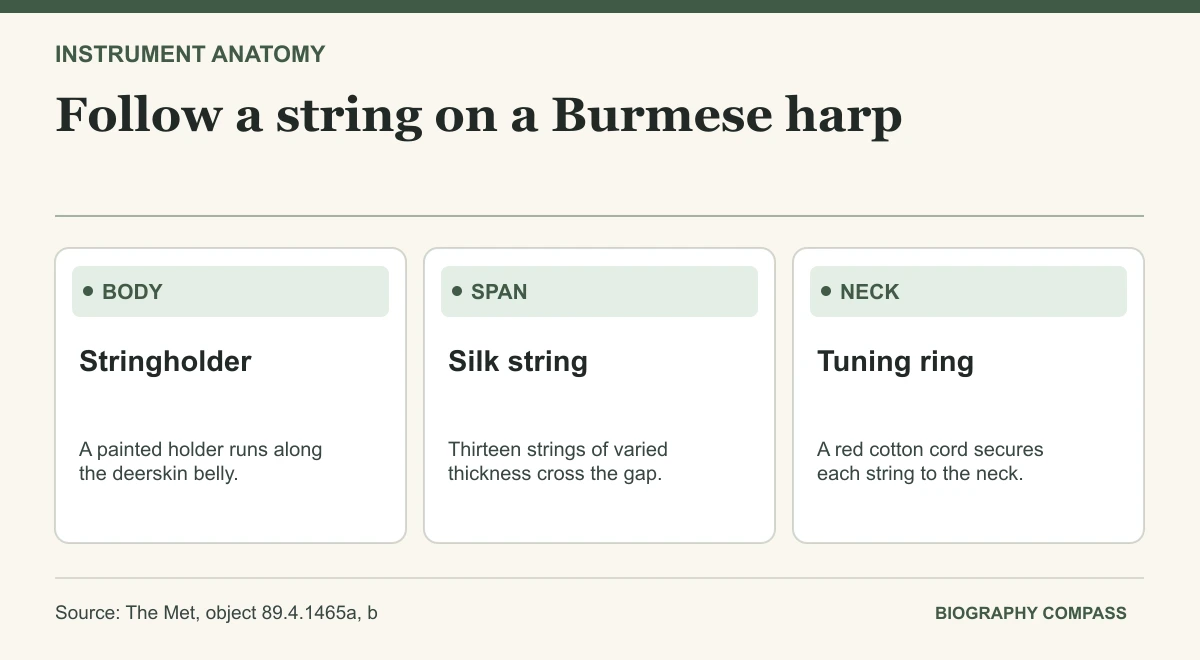
Follow one string on a Burmese arched harp from the skin-covered body up to the curved neck. Its two ends reveal how the instrument is put together. Two nineteenth-century examples in the Metropolitan Museum of Art let us compare what musicians held with what a catalogue can tell us today.
Compare the records
Read the two accession records together
The instruments share a collection credit, but their dimensions and documentation differ.
| Detail | 89.4.1465a, b | 89.4.271 |
|---|---|---|
| Height | 89.7 cm | 68.5 cm |
| Dating | Nineteenth century | Nineteenth century |
| Geography | The catalogue tentatively suggests Mandalay. | The catalogue gives Myanmar without a city. |
Chronology
A timeline of the turning points
The instruments were made
Both catalogues date their harps to the century rather than naming an exact year.
A collection date
Both entries carry the Crosby Brown Collection credit and the year 1889.
Two objects remain identifiable
Separate accession numbers let readers compare the instruments and their descriptions.
From the belly to the neck
The Met records thirteen silk strings of different thicknesses on the larger example. At the lower end, each meets a holder extending along the deerskin face of the body. At the upper end, a red cotton cord secures it around the curved neck and serves as a tuning ring. Once the eye has followed that route, the decorative tassels become easier to distinguish from the strings a player plucks.
Stories on the sides, songs in performance
Along the sides of the same harp, gold figures against a dark background depict scenes from the Ramayana. The decoration makes the instrument an object for looking as well as listening. Harps of this kind accompany songs. A catalogue photograph lets a reader examine the surfaces closely, while the recording linked by the museum offers a separate opportunity to hear the sound of a saung in an ensemble.
Why keep the second accession number?
The shorter harp shares the century and collection credit of the larger one. Its catalogue entry gives Myanmar as its place of origin. The larger harp’s record puts a question mark after Mandalay, a small but consequential indication of uncertainty. Using the numbers to identify the two objects keeps the tentative location and the detailed account of thirteen strings attached to the particular instrument for which they were recorded.
Continue the chronology
Related history guides
Yangon’s National Museum: From Jubilee Hall to Pyay Road
Set the instrument alongside Yangon’s museum displays on performing arts.
Read the timeline2017Khaen Music of Laos: The Instrument and How It Is Taught
Compare plucked strings in Myanmar with a reed instrument from Laos.
Read the timelineConnected biographies
People connected to this history
Quick answers
Common questions
- What is a saung gauk?
- It is a Burmese arched harp used, among other settings, to accompany singing.
- Does 1889 date the making of the two Met harps?
- The museum dates both to the nineteenth century. The year 1889 appears in their collection credit.
Primary and institutional sources
How this history was checked
Dates, legal milestones and historical claims are checked against the official and institutional records below. This article was reviewed on 19 November 2026.