
The short answer
A component fraction describes a share of a total. It does not supply that total, and the equilibrium model used to obtain the fractions has conditions of its own.
Selected record and original reasoning
Ratios, fractions and amounts
Keep the stated conditions attached to each calculation.
| Check | Observation or input | What follows |
|---|---|---|
| Successive ratios | B/F=10; C/B=0.001 | Multiply to obtain C/F. |
| Fractions | 100: 1000: 1, normalised by 1101 | No absolute total is supplied by these shares. |
| Absolute amount | Multiply every fraction by T | Doubling T doubles each amount in this fixture. |
Chronology
A timeline of the turning points
Original record
Equilibrium-table paper.
Career context
Tokyo chemistry doctorate.
Scientific opportunity
Saruhashi Prize began.
Read the selected approximation
The paper treats activity coefficients as approximately unity for an extremely dilute fresh-water model. Its two dissociation relations connect H₂CO₃, HCO₃⁻ and CO₃²⁻; its H₂CO₃ convention includes dissolved free CO₂.
This is the specific approximation used below. It is not a general assertion that all natural waters behave ideally or that the same constants can be carried over to sea water.
Sources for this section: [1]
Original ratio chain
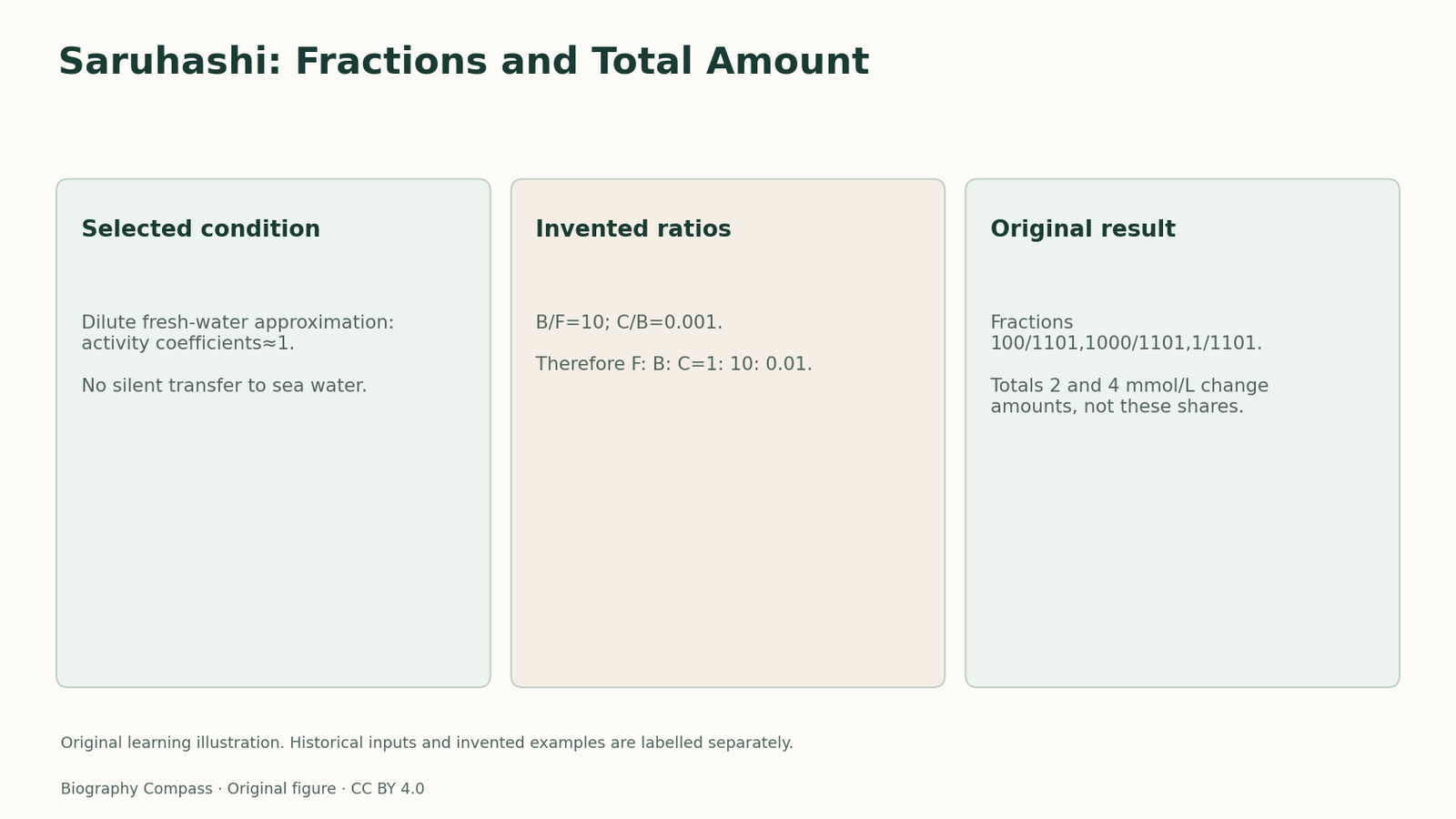
Let F denote the paper’s combined H₂CO₃ group, B bicarbonate and C carbonate. H is hydrogen-ion concentration; K₁ and K₂ are dissociation constants. In the invented ideal dilute model, use consistent concentration units and stipulate positive H with ratios K₁/H=10 and K₂/H=0.001. The relations give B/F=10 and C/B=0.001. Find F: B: C and fractions that sum to 1.
Supply total concentration T=2 mmol/L and calculate each concentration. Repeat for T=4 mmol/L while retaining the stipulated ratios. No actual pH, temperature or sampled water is reconstructed; the ratios and totals are original numerical inputs.
Sources for this section: [1]
Reference answer: the ratios form a chain
Taking F=1 gives B=10 and C=0.01, so F: B: C=1: 10: 0.01. The sum is 11.01. The fractions are 100/1101,1000/1101 and 1/1101, approximately 0.0908265,0.9082652 and 0.0009083. They are nonnegative and sum exactly to 1.
At T=2 mmol/L, the concentrations are 200/1101,2000/1101 and 2/1101 mmol/L, approximately 0.18165,1.81653 and 0.0018165. At T=4 they double. The fractions do not change because the two ratios were held fixed.
A common error is to use C/F=0.001. The supplied second ratio is C/B, so C/F=(C/B)(B/F)=0.01. Another is to present the fractions as absolute concentrations without supplying a total. These are different errors: one misreads a ratio, the other omits a scale.
Sources for this section: [1]
Return to the purpose of the tables
The historical tables were intended to reduce repeated calculations from total amount, pH and temperature, with separate treatment of electrolytes in sea water.
The original fixture makes one part of that logic visible. It does not reproduce the tables, provide a contemporary seawater model or infer how an actual ocean has changed. The constants and the total must each be appropriate to the question being asked.
Sources for this section: [1]
Continue the chronology
Related history guides
Biography context
Explore Japan through connected lives
Connected biographies
The research career behind the record
Quick answers
Common questions
- Do the two ratios alone specify an absolute concentration?
- No. Multiplying all three amounts by the same positive factor preserves both ratios.
- Is the fixture a present-day seawater calculation?
- No. It is an explicitly ideal dilute model with stipulated ratios and totals.
Primary and institutional sources
How this history was checked
Selected records and their reading limits are identified below. The numerical fixtures and reference answers are original. This article was reviewed on 31 October 2026.
- K. Saruhashi, Papers in Meteorology and Geophysics 6,38–55(1955)On the Equilibrium Concentration Ratio of Carbonic Acid Substances Dissolved in Natural Water
- Mário Gonçalves, European Association of Geochemistry, 25 November 2022Lives of the Great Geochemists: Katsuko Saruhashi
- TIME, 22 March 20185 Things You Might Not Have Known About Pioneering Geochemist Katsuko Saruhashi