
The short answer
What do the production record and critical accounts establish about Salome’s competing narratives and its director-writer collaboration?
Compare the records
Different records answer different questions
The distinctions below follow the identified sources.
| Record | What it establishes | Limit of the conclusion |
|---|---|---|
| Production credits | Identify direction, screenplay and performers. | Do not allocate every narrative decision to a single person. |
| Torre’s critical essay | Offers a dated interpretation of subjectivity and guilt. | A critical judgement is not proof about a real assault case. |
| GMA career account | Recognises the Guillen–Lee collaboration and directing award. | A retrospective summary does not supply a complete scene sequence. |
The production record identifies a collaboration
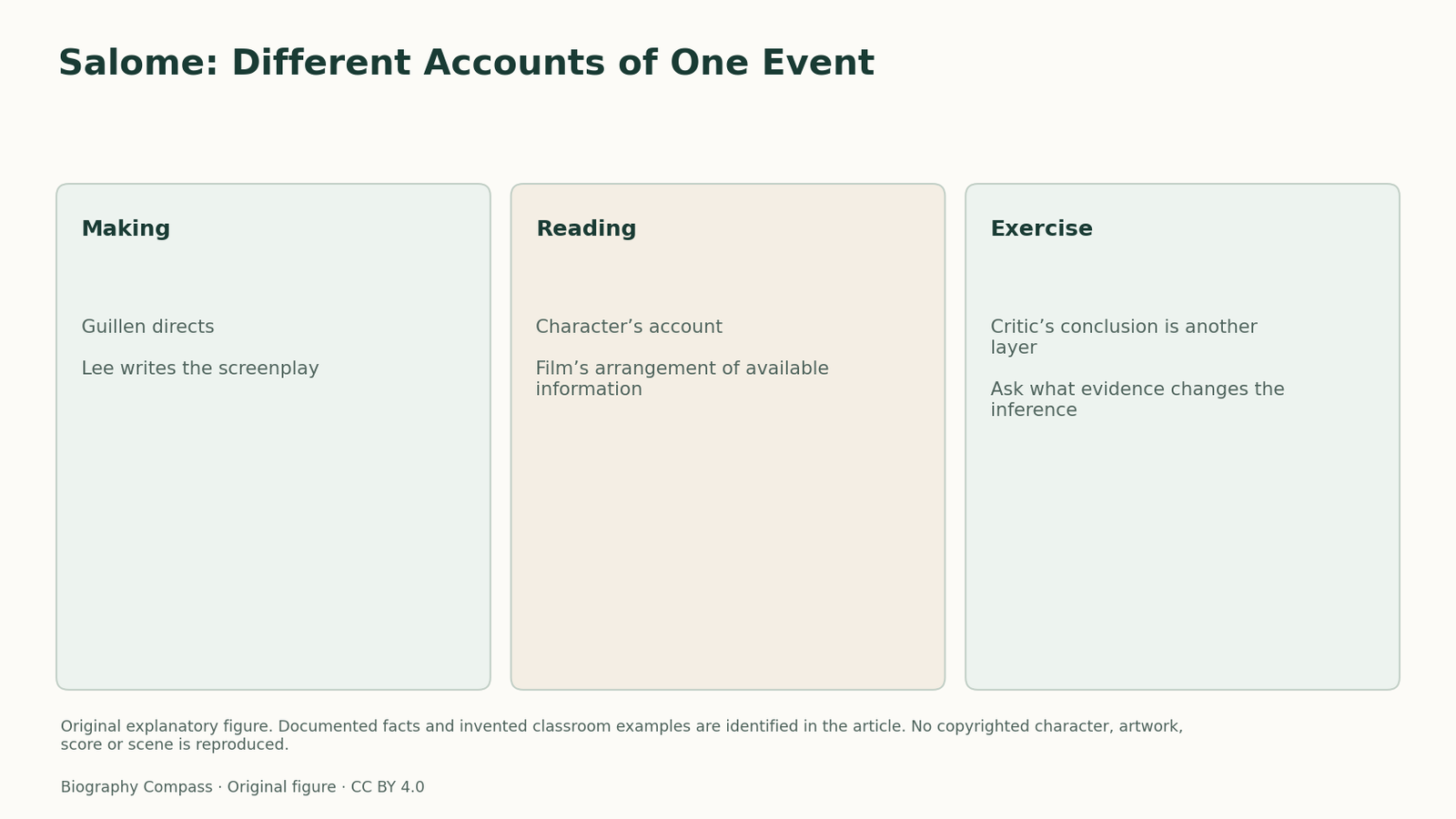
Salome is a 1981 film directed by Laurice Guillen, with a screenplay credited to Ricky Lee, also listed as Ricardo Lee. Gina Alajar plays Salome and Johnny Delgado plays Macario. These credits establish recognised responsibilities and characters before an interpretation of the story begins. They do not tell us that every idea in a finished scene originated with one participant. GMA’s later career account explicitly identifies a collaboration between Guillen and Lee, while the directing award it mentions recognises a particular role rather than cancelling the contribution of the screenplay or performance.
A critical reading needs its author and date
In his CCP encyclopedia essay, Nestor U. Torre approaches Salome through an alleged rape, a killing and the relation between guilt and a character’s subjective experience. He connects that reading with the camera’s access to an interior world where perceptions and fantasies are difficult to separate. This is evidence of one critic’s interpretation. It should not be restated as a universal proposition that an allegation of sexual violence is inherently doubtful, nor converted into a factual judgement about real complainants. A fiction’s construction of uncertainty and a commentator’s language about that construction are distinct objects of analysis.
Sources for this section: [3]
Separate a character’s account from the film’s arrangement
When a film presents competing accounts, the relevant question is not simply which speaker sounds convincing. A viewer also encounters an arrangement made through writing, direction, performance and editing. An account may acquire authority because it appears first, because an image accompanies it, or because another character reacts to it. These are original analytical questions prompted by Torre’s discussion, not a newly verified sequence of Salome’s shots. The cited material permits study of subjective narration and credited collaboration; we have not newly viewed a complete print, timed the versions or claimed to settle every ambiguity in its ending.
Three-level reading exercise and answer
Create a chart with three headings: what a character reports, what the film makes available, and what the critic concludes. For an invented example, imagine that a character remembers a closed door while a later account describes the door as open. Explain what additional evidence would be needed before calling either account a deliberate lie. A defensible answer recognises alternatives such as limited viewpoint, changed circumstances, selective memory or an explicitly contradictory construction. It also distinguishes a critic’s moral conclusion from a fact directly shown. The example is not a reconstructed Salome scene. Its value is a disciplined way to discuss this film’s documented interest in subjectivity without importing a prejudged answer or erasing the team that shaped the narrative.
Continue the chronology
Related history guides
Biography context
Explore Philippines through connected lives
Connected biographies
People and practices to explore
b. 1947
Laurice Guillen
Actor and film directorLaurice Guillen developed a career across acting, film direction and filmmaking institutions, with Salome establishing an important collaboration with screenwriter Ricky Lee.Read biography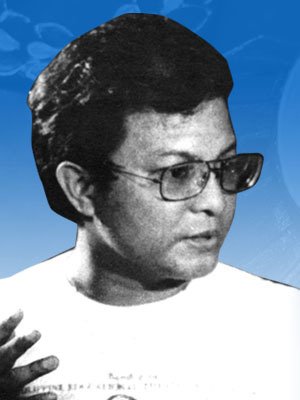
1939—1991
Lino Brocka
Film director, writer and cultural activistA director who used melodrama, realism and political urgency to place marginalised lives at the centre of Philippine cinema.Read biography1938–1996
Ishmael Bernal
Film, television and stage director, screenwriter and mentorIshmael Bernal worked across popular genres and formally adventurous films, collaborating with writers and performers while treating the city, belief and intimate relationships as complex social worlds.Read biographyQuick answers
Common questions
- Does the guide decide which Salome account is the truth?
- No. It compares a production-credit record and a dated critical interpretation, offering a method for discussing subjective narration without pretending to have newly resolved the complete film.
Primary and institutional sources
How this history was checked
Written catalogues, production records and interviews are distinguished from our own learning exercise. No complete film viewing, song listening or full-novel reading is claimed where only the identified written material was inspected. This article was reviewed on 7 November 2026.
- IMDbLaurice Guillen biography
- Festival des Cinémas d’Asie de VesoulLaurice Guillen:2015 International Jury
- Nestor U. Torre / CCP Encyclopedia, National Library of the Philippines scanClassics of the Filipino Film
- GMA Network, Aaron Brennt EusebioLaurice Guillen receives Aliw lifetime recognition
- IMDbSalome full production credits