
The short answer
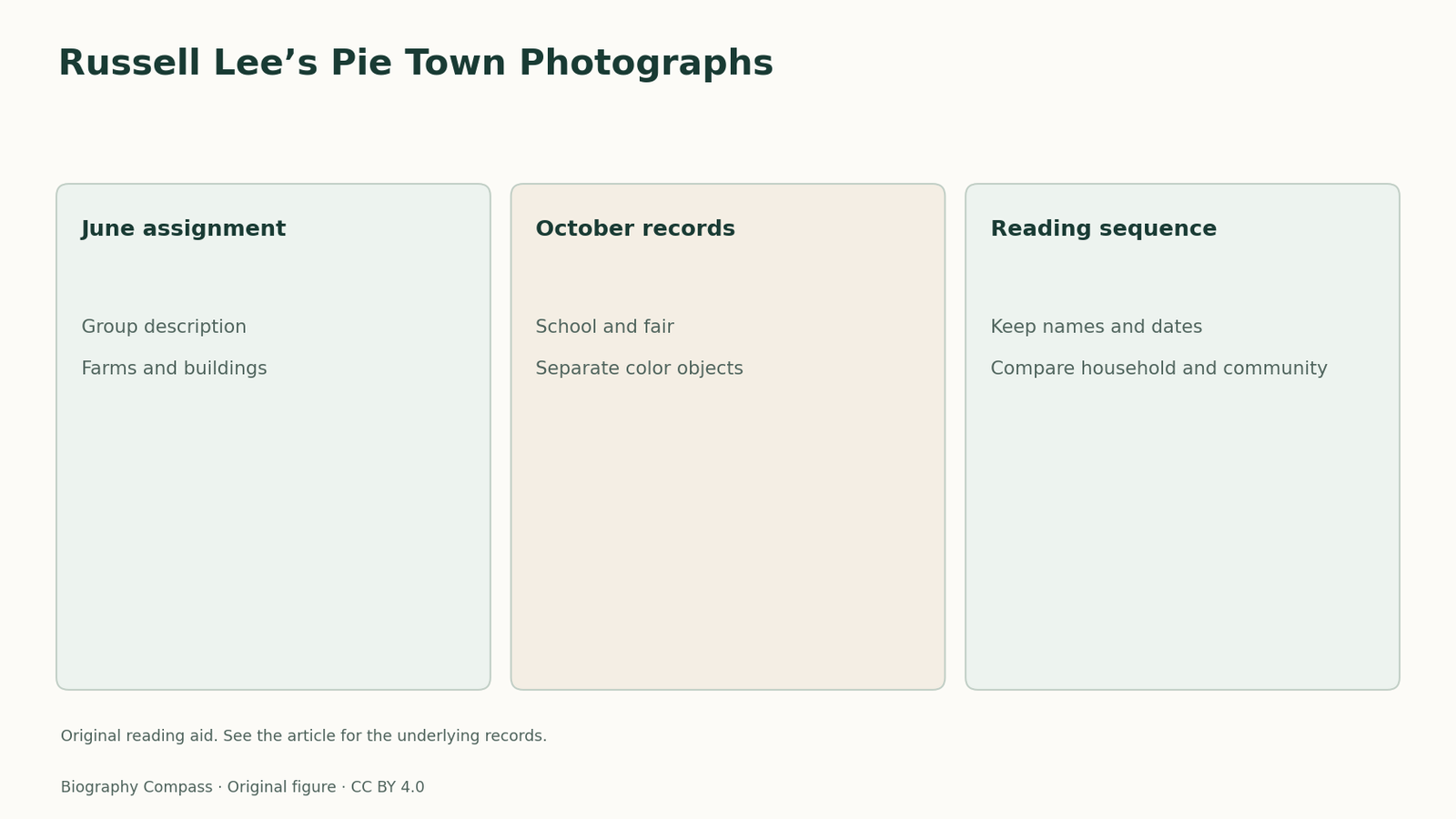
Photographs of the school, fair and named residents make it possible to read Pie Town as a sequence of places and activities rather than a single emblem of the Depression.
Compare the evidence
Compare three scales of description
Each record adds a different part of the community.
| Record or element | Record | Contribution |
|---|---|---|
| June group record | Farm operations, objects and buildings | Assignment scope |
| School photograph | Use of the Farm Bureau building | Shared facility |
| Fair or named household | A specific occasion or people | Activity and individual identification |
Begin with the group record
The Library of Congress catalogues a group of Russell Lee’s Pie Town photographs under June 1940. Its description names farm operations, buildings and things homesteaders made. The grouped description is a starting point for research because it explains the reach of the assignment. It cannot supply the individual identity, date or medium of every related photograph. A second search through item records finds color material made in October. Keeping the month with each record prevents an attractive group of examples from turning into a fictional account of one afternoon. It also preserves the different ways Lee documented the same community over time.
The Farm Bureau building has two roles
An October record describes the Pie Town school as operating in a building constructed through cooperative effort. The catalog’s wording gives two kinds of information about the same structure: its connection to the Farm Bureau and its use as a school. Looking for the institutional name as well as the activity in the caption helps a reader connect photographs that would otherwise seem unrelated. The scan linked to another school photograph offers a separate object for comparison. A descriptive claim about the way a classroom was arranged should be attached to the photograph that actually shows it.
People and occasions in the color records
The color exhibition identifies Faro and Doris Caudill in a portrait from Pie Town. The Library’s fair record identifies a homesteader and his children eating together. Those entries make it possible to compare a named household with a public occasion without assuming the people in one appear in the other. Ask what kind of information is available from each photograph. A portrait can name people in a particular place, while the fair photograph can make an activity at a gathering visible. The caption is useful to the comparison because it gives names or relationships a viewer may have no way to infer visually.
Build a small series with explicit dates
Select a group record, one school photograph and one record of the fair. Put the catalog date and identifier on each line. Add a sentence explaining how the photograph changes the scale of the account, for instance from a household to a shared building. The result can show several dimensions of a community without asking any one picture to stand for all its residents. It also gives a reader a way to check whether a later exhibition has reordered or narrowed the photographs. In the color exhibition, the named Caudill record can serve as a check against a caption that identifies only a homesteader. The series is therefore both a subject and a method for looking at how documentary evidence is organized.
Continue the chronology
Related history guides
Wolcott’s Juke Joint Photograph and Caption
Compare Marion Post Wolcott’s November 1939 Clarksdale photographs and learn how caption cards, negative identifiers and later records distinguish them.
Read the timeline1936–1939John Vachon and the FSA Picture File
Follow John Vachon’s move from federal picture filing to the Omaha assignment and see how a book selected five images from a larger body of work.
Read the timelineBiography context
Explore United States through connected lives
Connected biographies
Photographers and related work
1903–1986
Russell Lee
Documentary photographer and educatorRussell Lee used sustained assignments to record how people worked, made homes and gathered in communities across the United States.Read biography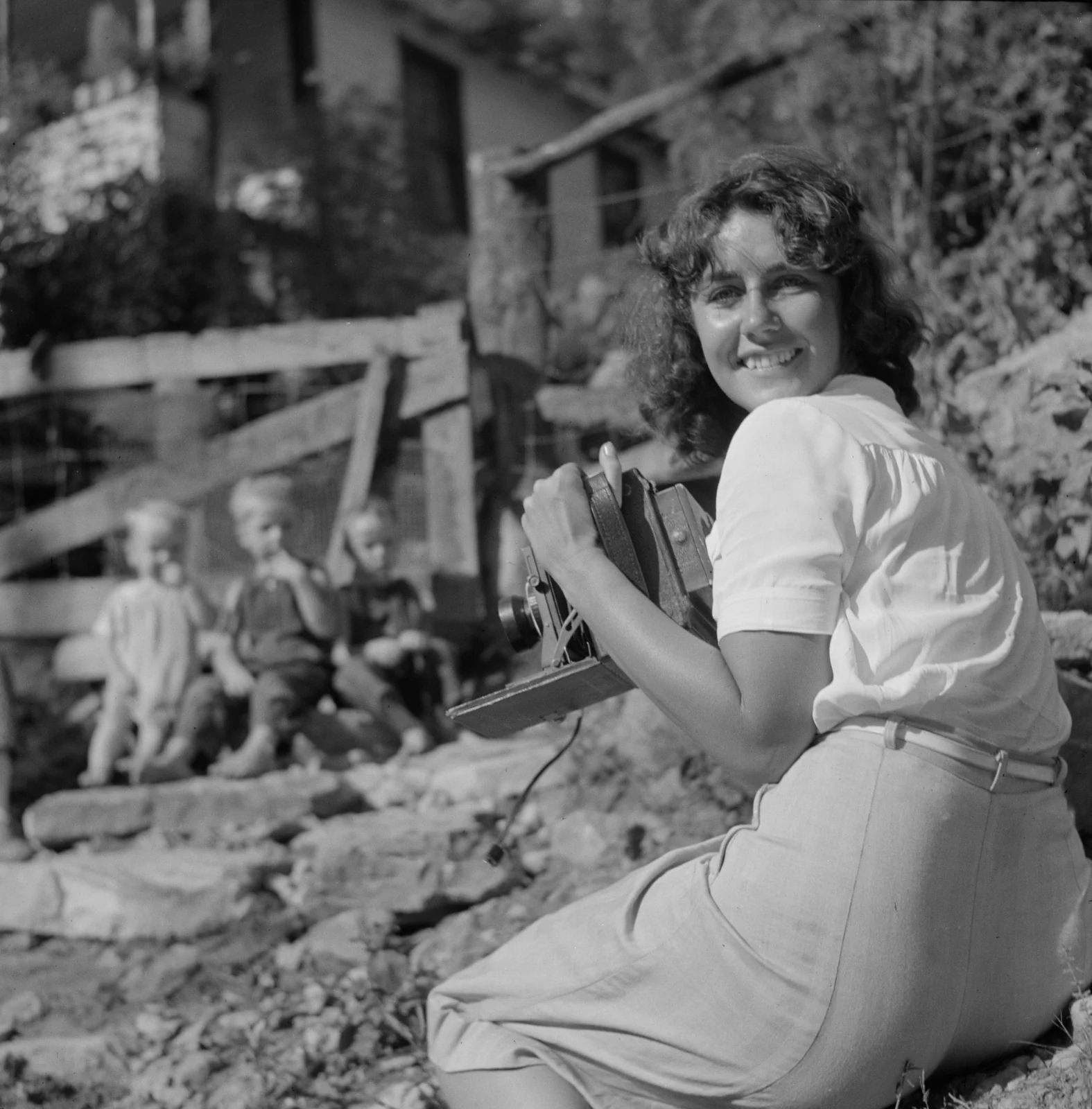
1910–1990
Marion Post Wolcott
Documentary photographerMarion Post Wolcott photographed for the Farm Security Administration, creating an extensive record of everyday life across several American regions.Read biography1903–1975
Walker Evans
Photographer, editor and teacherA photographer and editor who found lasting visual complexity in ordinary places, objects and public encounters.Read biographyQuick answers
Common questions
- When were the Pie Town photographs made?
- The records discussed include June and October 1940.
- What did the Farm Bureau building house?
- A Library of Congress caption describes it as the building used for the school.
Primary and institutional sources
How this history was checked
Dates, legal milestones and historical claims are checked against the official and institutional records below. This article was reviewed on 13 November 2026.
- Briscoe Center for American HistoryRussell Lee Biography
- Harry Ransom CenterRussell Lee finding aid
- Harry Ransom CenterGo Out and Look
- Library of CongressPie Town, June 1940 group record
- University of Texas at AustinPhotography & Media Area history
- Library of CongressBound for Glory exhibition items
- Library of CongressPie Town school and Farm Bureau building
- Library of CongressPie Town school, slide 1a34104
- Library of CongressFaro and Doris Caudill
- Library of CongressHomesteader and children at the Pie Town fair