
The short answer
How did a cell-free filtrate experiment distinguish a transmissible tumour-inducing agent from transplanted tumour cells?
Read the evidence
Different records within the same investigation
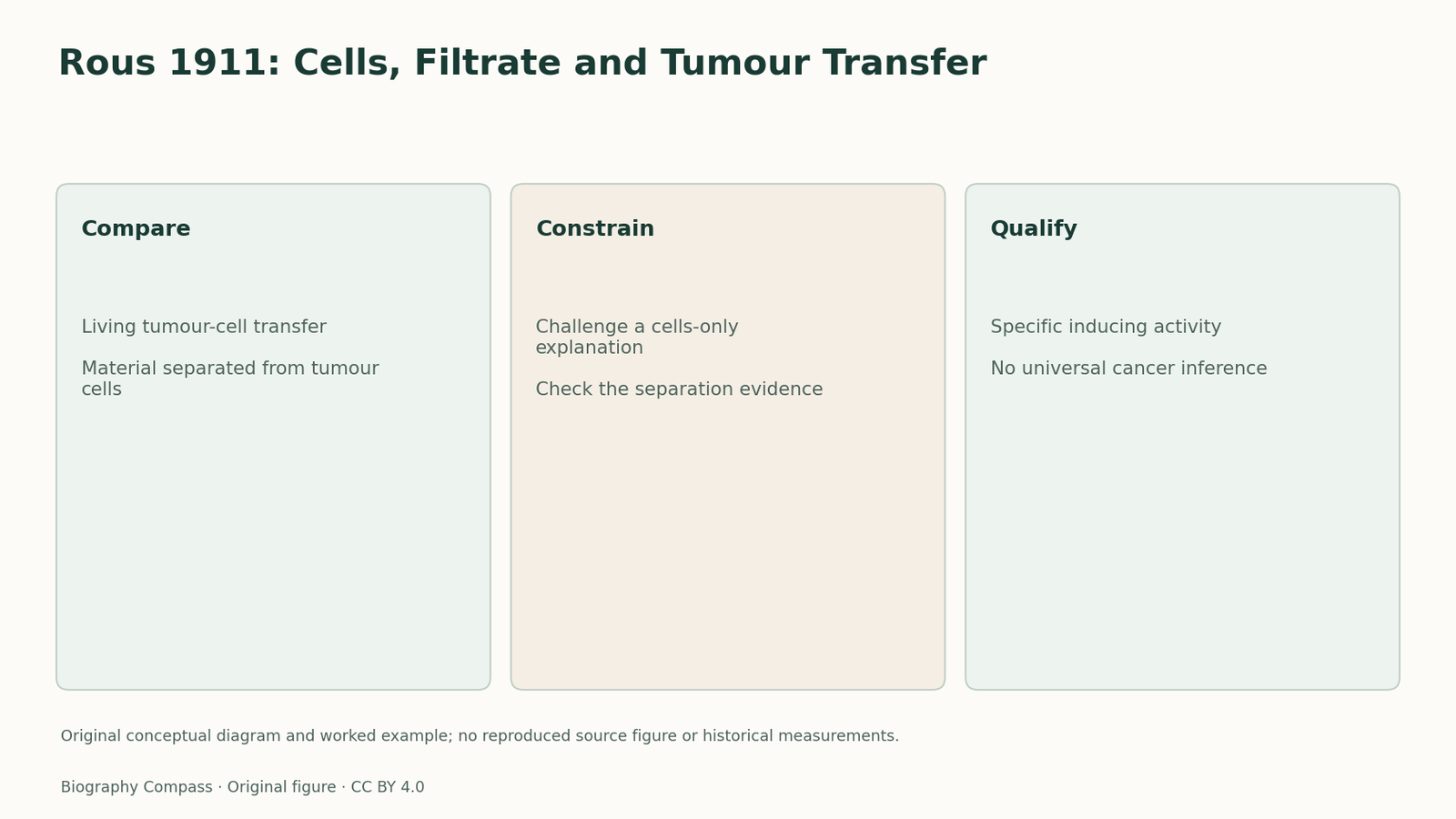
The following comparison distinguishes the specific questions answered by the inspected records.
| Record or test | What it establishes | What remains different |
|---|---|---|
| Cell transplantation | Transfers living tumour cells. | Does not require a distinct inducing agent. |
| Cell-free inducing activity | Challenges a cells-only transfer explanation. | Depends on evidence that cells were removed. |
| Molecular mechanism | Explains how the agent changes cellular behaviour. | Requires evidence beyond the separation result. |
The question distinguished a cause from the tumour itself
Rous’s 1911 paper addressed a chicken sarcoma transmissible by an agent separable from the tumour cells. That wording identifies the central comparison. Transplanting living tumour cells can continue an existing growth in a recipient; demonstrating activity in material separated from those cells supports another explanation. The important inference was therefore not simply that a tumour appeared after material was transferred. It concerned what the active transferred material could be and which competing account the preparation was designed to address.
Sources for this section: [1]
Cell-free evidence challenged a transplantation-only explanation
The original report and Rockefeller’s institutional history describe activity after separation intended to remove tumour cells. If living tumour cells alone explained the result, material genuinely free of those cells should not reproduce the same effect through cell transplantation. The evidence therefore supported an inducing agent distinct from the transferred neoplastic cells. The interpretation depends on the validity of that separation, not on the phrase cell-free acting as an unexamined guarantee. This guide explains that causal distinction without reproducing an infectious-material preparation or animal-testing procedure.
The result was specific rather than a universal cancer theory
An agent capable of inducing a particular tumour does not show that every tumour is infectious or has the same cause. Rous’s later biography describes difficulty extending similar findings to other systems and a shift to other research questions. The historical paper also did not establish the later molecular mechanism of viral effects on cellular genes. Those are stronger and different claims. A useful account can recognise a major causal result while refusing to convert the investigated chicken system into a blanket explanation of human cancer.
Later recognition should preserve the earlier experimental scope
The Nobel record recognises Rous for tumour-inducing viruses. The institutional history links that recognition to the cell-free transmission milestone, while his biography makes clear the long interval and broader career between the early experiments and the award. Neither a later prize nor modern terminology should erase the original question. The paper demonstrated a separable inducing activity within its system. Chemical identity, viral structure, host specificity and molecular transformation remained questions for further research rather than details already measured by the first separation comparison.
An original causal comparison and answer
Imagine a fictional growth transferred in two kinds of material: A contains living abnormal cells, while B has been independently shown not to contain them but still produces a related growth. Which explanation is challenged by B? The claim that transferred living abnormal cells are the sole route to the outcome. These invented labels contain no procedure and are not Rous’s experimental data. The observation would support a separable activity, but it would not by itself identify its molecular composition or show that all growths share that cause. A careful answer also asks whether the cell-removal evidence is sound and whether relevant comparison materials were tested. The exercise distinguishes eliminating one causal alternative from completing every part of a mechanistic explanation.
Continue the chronology
Related history guides
Biography context
Explore United States through connected lives
Connected biographies
Researchers and related approaches
1879–1970
Francis Peyton Rous
Pathologist and tumour-virus researcherPeyton Rous investigated transmissible chicken tumours, distinguishing an agent separable from tumour cells from the transfer of the cells themselves.Read biography1912–1991
Salvador Luria
Microbiologist and scientific institution builderSalvador Luria studied bacterial viruses, helped establish microbial genetics and later combined research leadership at MIT with public political engagement.Read biographyQuick answers
Common questions
- Does one tumour-inducing agent explain all cancers?
- No. The experimental system and scope must remain explicit.
- Does cell-free activity identify a complete molecular mechanism?
- No. It addresses a causal distinction before the full mechanism is known.
Primary and institutional sources
How this history was checked
The references below distinguish the original study from later explanations. The worked exercise and comparison are newly written for this article. This article was reviewed on 8 November 2026.
- Peyton Rous, Journal of Experimental Medicine, 1911A Sarcoma of the Fowl Transmissible by an Agent Separable from the Tumor Cells
- The Rockefeller University Hospital CentennialCancer research: Peyton Rous and transmissible tumours
- Nobel Prize OutreachFrancis Peyton Rous — Facts
- Nobel Prize OutreachFrancis Peyton Rous — Biographical