
The short answer
What changed when a company that already launched satellites became publicly traded? Compare a mission record, a corporate filing and an exchange notice before deciding which event a date actually names.
Original source comparison
Which record answers which question?
Keep the event, reporting boundary and unit attached to each observation.
| Country | What the record supports | What remains separate |
|---|---|---|
| Mission record | An achieved orbital flight on a specified date. | A complete profitability or reliability assessment. |
| March 2018 announcement | A plan for the next commercial flight. | Proof that it flew on the announcement date. |
| Nasdaq notice | A securities name and symbol transition. | An engineering certification or return forecast. |
| Transaction proceeds | Corporate gross financing, including PIPE. | Personal pay, profit, or an additional PIPE amount to double-count. |
Chronology
A timeline of the turning points
Still Testing
Electron reaches orbit from Māhia.
Commercial-flight preparation
A release describes plans for the next flight.
Domestication and exchange notice
Corporate and securities preparations are recorded.
Merger and market transition
The combination closes and RKLB becomes the stock symbol.
Start with the question a source was created to answer
Rocket Lab’s history contains engineering events and corporate events that can look deceptively similar in a short timeline. The Still Testing mission record identifies an orbital flight in January 2018. The August 2021 merger announcement concerns financing and public trading. Nasdaq’s operational notice explains changes to securities names and symbols. Each is a primary record, but their purposes differ. A source can be authoritative for its own event without establishing everything about the company. Begin by writing a question beside each record: did a vehicle reach orbit, did a transaction close, or did a security become tradable under a new symbol?
An orbital mission preceded the stock-market milestone
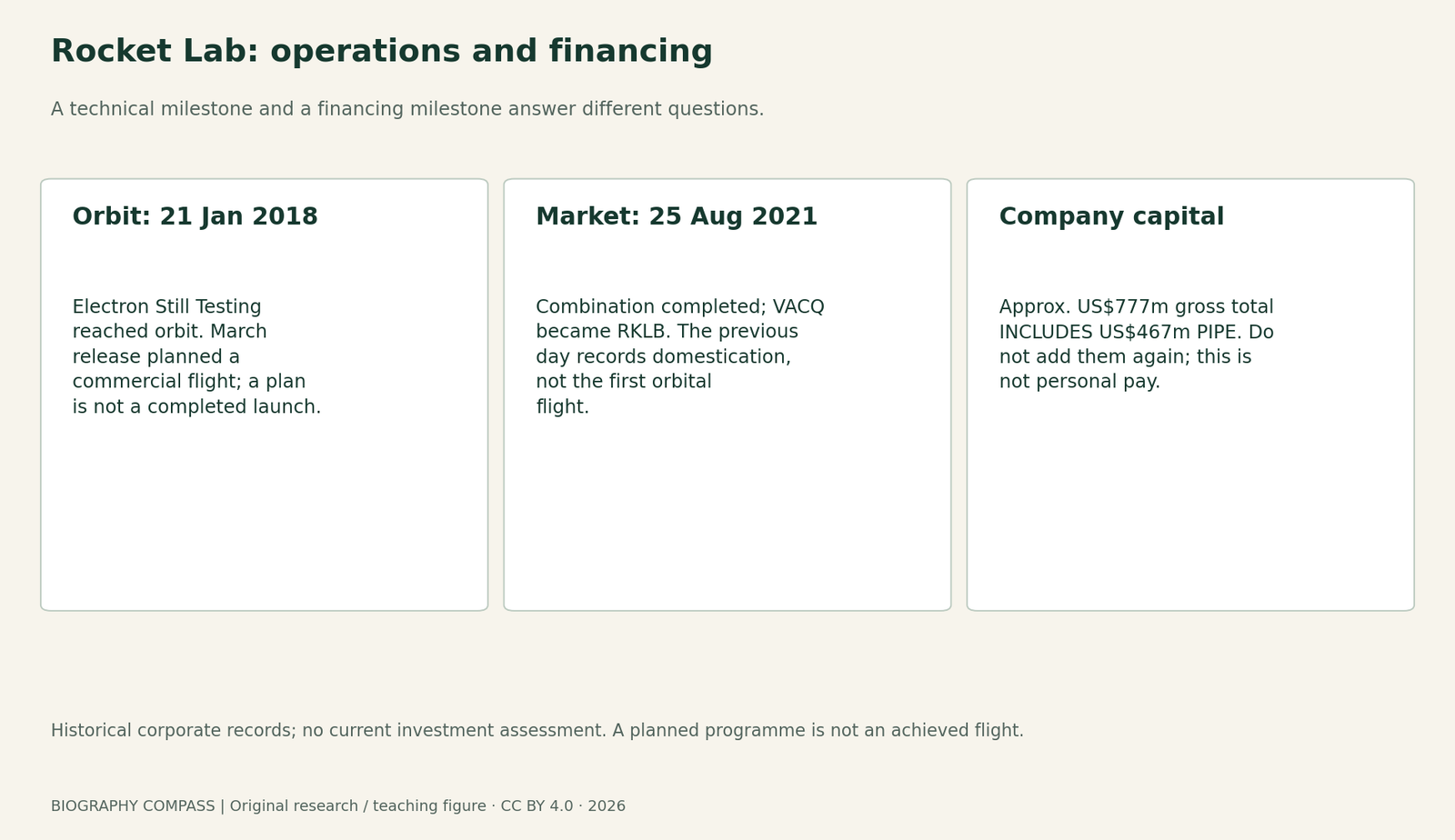
Still Testing launched from Launch Complex 1 on the Māhia Peninsula on 21 January 2018. Rocket Lab identifies it as Electron’s first orbital launch and names payloads for Planet and Spire. The mission record therefore establishes a technical milestone years before RKLB appeared on Nasdaq. It does not establish that the flight alone made the business profitable. Nor does carrying customer satellites make the mission’s official test designation meaningless. A test can carry useful payloads while supplying engineering evidence. Keep that description intact instead of forcing the flight into a choice between an experiment and a commercial relationship.
Sources for this section: [1]
Read a preparation announcement in its original tense
In March 2018, Rocket Lab announced that its next flight would be its first fully commercial mission, under the name It’s Business Time. The release discussed a growing manifest, production plans and the private launch site. These statements record what the company was preparing to do at that point. They should not be silently rewritten as a completed March launch. The useful comparison is between a dated achieved orbital mission and a subsequent statement of plans for commercial operations. It helps explain why preparation, flight completion and a continuing service need separate entries in a researcher’s notes.
Sources for this section: [2]
A business combination has a legal sequence
The 2021 Form 8-K explains that Vector Acquisition Corporation first domesticated from the Cayman Islands into Delaware on 24 August. On 25 August, the parties completed the merger sequence set out in their agreement. The filing describes how shares, warrants and units were treated. These are changes in corporate and security arrangements, rather than a description of a launch. Peter Beck signed the filing as president, chief executive and chairman. Reading the sequence also prevents a common shortcut: the public-market transaction did not found the operating venture from scratch or move Electron’s first orbital achievement into 2021.
Sources for this section: [3]
The exchange notice makes the security changes concrete
Nasdaq’s 24 August alert specifies the marketplace-effective date of 25 August 2021. Vector’s common-stock symbol VACQ became RKLB, and its warrant symbol VACQW became RKLBW; the units were suspended from trading. Common stock and a warrant are separately identified securities, even though both relate to the same company. The alert’s job was to make an exchange transition operationally clear. It was not an assessment of rocket reliability, a forecast of investment returns or a certificate that future development programmes would succeed. A reliable historical account can use the notice without asking it to answer those other questions.
Sources for this section: [5]
Corporate financing is a resource, not an achieved flight
The company’s completion announcement reports approximately US$777 million in gross proceeds from the trust account and concurrent private investment. The filing separately specifies US$467 million from the PIPE, a private investment in public equity. Do not add the latter amount to the total again. The company discussed funding space systems, acquisitions and development of Neutron. Those are intended uses of corporate capital. Gross proceeds precede transaction expenses and are not automatically money spent on one programme. Neither amount measures Beck’s personal fortune, company profit or the number of satellites successfully delivered to orbit.
Exercise: rebuild a misleading museum label
A fictional label reads: “Rocket Lab began in August 2021, immediately launched its first orbital rocket and paid its founder US$1.244 billion after raising US$777 million plus US$467 million.” Rewrite it as three dated sentences using the mission record, exchange alert and filing. Then draw two columns headed Operations and Corporate finance. Place the January 2018 flight, March 2018 commercial-flight plan, August 2021 symbol change and financing in the appropriate column. Add a third annotation for claims requiring later evidence, such as a programme’s first flight, sustained profitability or the final allocation of transaction proceeds.
Reference answer: use separate milestones in one connected history
A corrected label places Electron’s first orbital mission on 21 January 2018 and the public-market combination and RKLB transition on 25 August 2021. It records approximately US$777 million of gross company financing, including the PIPE; US$467 million is not an additional pot to add again. Nothing in those records establishes a personal payment of that total to Beck. The March announcement belongs under preparation for commercial operations. The resulting history connects technological capability with finance while preserving the difference between them. This exercise explains a historical transaction; an assessment of securities today would require a different and current evidential task.
Continue the chronology
Related history guides
Connected biographies
People and institutions
1976/77–
Peter Beck
Rocket Lab founder and aerospace entrepreneurPeter Beck built a career in precision engineering before founding Rocket Lab in 2006. The company’s progression from experimental rockets to orbital launches and public markets linked engineering development with manufacturing, launch infrastructure and finance.Read biographyQuick answers
Common questions
- Was 2021 Rocket Lab’s first orbital launch?
- No. The mission record places Electron’s first orbital launch on 21 January 2018.
- Can the US$467 million PIPE be added to the announced US$777 million total?
- No. The announced total already combines the trust-account and PIPE financing.
Primary and institutional sources
How this history was checked
Read the dated primary records beside the original comparisons and exercises. Company plans and accounting measures retain their stated scope. This article was reviewed on 27 October 2026.
- Rocket LabStill Testing mission record, 21 January 2018
- Rocket LabIt’s Business Time at Rocket Lab, 13 March 2018
- Rocket Lab / US Securities and Exchange CommissionForm 8-K: domestication, merger and PIPE, filed 30 August 2021, printed pages 1–2
- Rocket LabMerger completion with Vector Acquisition, 25 August 2021
- Nasdaq TraderCorporate Actions Alert 2021-176, 24 August 2021