
The short answer
A speaker can claim to represent a community, promise an action and shift responsibility in the same sentence. Identify each move separately before evaluating the support offered.
Original record and worked example
Several moves can coexist
This table analyses only the fictional wording.
| Statement | Claimed position or action | Unanswered question |
|---|---|---|
| A | Parent/member; responsibility sent elsewhere | What did the installation or inspection actually involve? |
| B | A publication commitment | Was the promise completed, and what does the record show? |
Chronology
A timeline of the turning points
Published study
Qualitative RF-discourse analysis.
Original exercise
Two fictional statements, not interview quotations.
What the researchers actually analysed
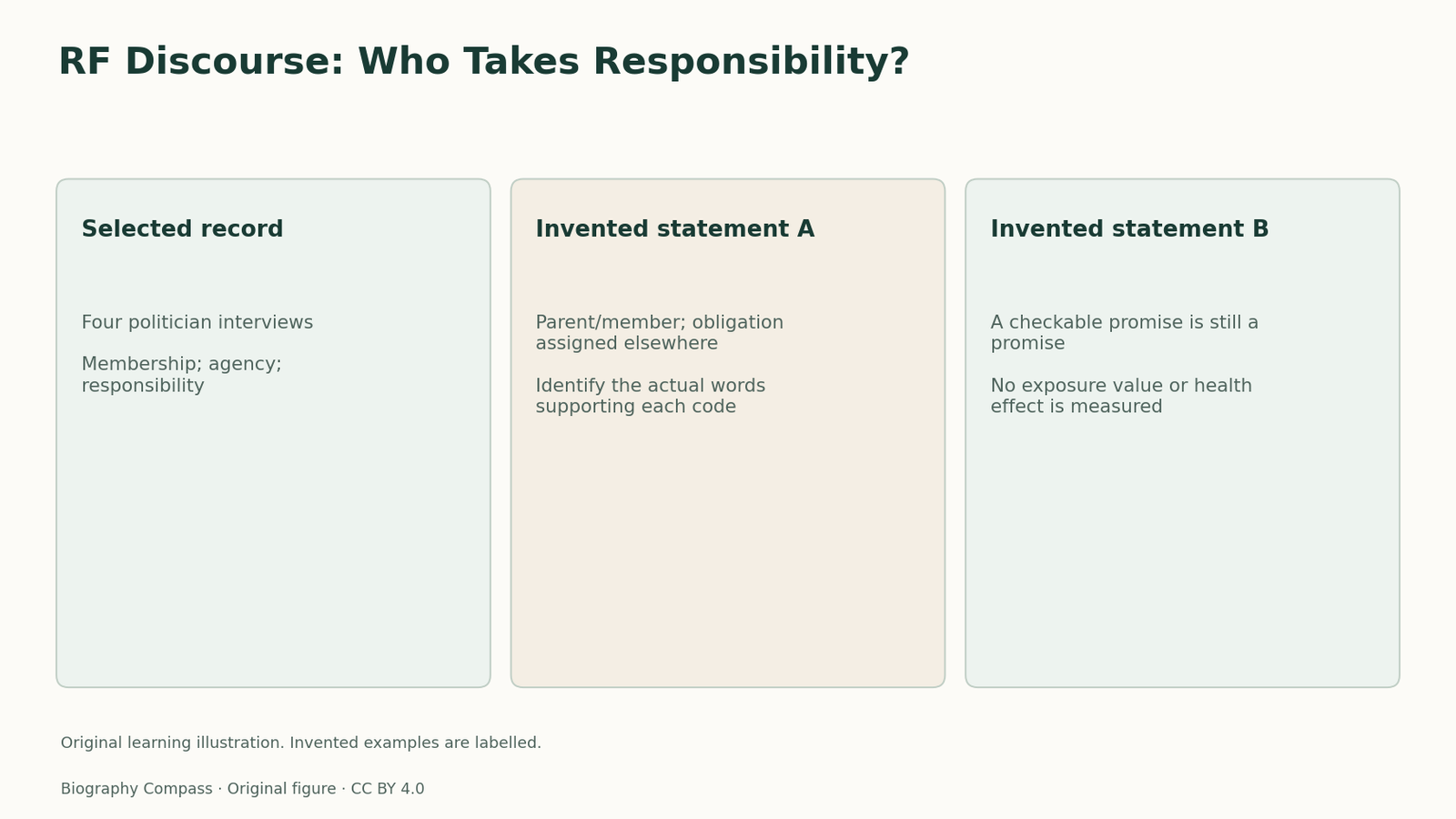
Fernandez and colleagues analysed four semi-structured politician interviews using membership, agency and responsibility as coding categories. They examined legitimisation and blame avoidance.
The record asks how speakers construct trust. It does not turn a claim of concern, expertise or official authority into an exposure measurement. A careful reading can recognise a communication strategy without deciding whether every factual assertion in the statement is true.
Sources for this section: [1]
An invented pair of statements
Statement A: As a parent in this neighbourhood, I understand your concern. The previous council allowed the installation, so the operator must solve it. Statement B: I will publish the inspection record on Friday and identify the office responsible for responding. These are fictional statements, not quotations from the interviews.
Mark three things: which affiliation is invoked; which actor is assigned an action; and which actor accepts or transfers an obligation. Allow more than one code. Also identify a factual question that the words alone cannot answer.
Sources for this section: [1]
Reference reading
A invokes parental and neighbourhood membership. It assigns responsibility to the previous council and an obligation to the operator, while giving the speaker no explicit task. This is a defensible reading of responsibility transfer; it is not proof of dishonest intent.
B commits the speaker to publishing a record and naming an accountable office. That is a more inspectable promise, but it is still a promise. The statement does not show that publication happened, that the record is adequate or what an inspection measured.
Neither statement supplies an exposure value or a health-effect study. A coding answer should cite the actual words that support its interpretation and permit a reasoned alternative where the wording is ambiguous.
Sources for this section: [1]
Keep the research question bounded
The exercise applies a small coding distinction to invented language. It is not a population survey, a ranking of political parties or a test of whether a particular installation is safe. The original study’s interview design and its authors’ interpretations should remain visible when its findings are discussed.
A useful extension is to rewrite A so the speaker accepts a specific, checkable task without pretending that the task itself settles the scientific dispute. For example: I will request the dated inspection record and publish the responsible agency’s reply.
Sources for this section: [1]
Continue the chronology
Related history guides
Biography context
Explore Malaysia through connected lives
Connected biographies
A career behind the record
Quick answers
Common questions
- Does coding a statement prove its scientific claim?
- No. Coding identifies how responsibility and credibility are presented; the claim still needs its own evidence.
- Is there only one possible code per sentence?
- No. The fixture deliberately allows affiliation, action and responsibility to overlap.
Primary and institutional sources
How this history was checked
Selected original records support the historical discussion. Worked examples are original and explicitly bounded; they are not reconstructed experiments. This article was reviewed on 31 October 2026.