
The short answer
How do the documented history and surviving records of Rayuan Pulau Kelapa distinguish its composer, song and later public uses?
Compare the records
Different records answer different questions
The distinctions below follow the identified sources.
| Record | What it establishes | Limit of the conclusion |
|---|---|---|
| Ministry composer biography | Identifies Marzuki, the 1944 work and a later TVRI use. | Different later uses are not new composition dates. |
| Broadcasting scholarship | Places the song in a wartime radio setting. | A historical account is not an exhaustive transmission log. |
| Smithsonian 2016 programme | Names the work, composer and closing ensembles. | A programme is not an audio record or a complete arrangement score. |
The composition belongs to a particular career
The Ministry of Culture’s biography identifies Rayuan Pulau Kelapa with Ismail Marzuki and dates the song to 1944. Its account connects his musical life with radio, arrangement and the relation between romantic feeling and national attachment. That is evidence for a work and its composer, not proof that every later recording preserves an identical instrumentation or emotional effect. The distinction is especially useful for songs that become widely familiar: a listener may recognise a title or public use while knowing little about the person who first made the composition.
Sources for this section: [1]
Broadcast use adds another historical setting
The same biography records the song’s later use as a closing piece on TVRI during the New Order period. A scholarly history of wartime broadcasting places it in an earlier radio-orchestra context under Japanese occupation. These settings should not be collapsed into the song’s original composition date. A work can be selected by different institutions over time, acquiring new associations without being newly composed at each use. The records examined here identify institutional settings, not a complete sequence of every broadcast. We have not listened to an archival radio programme or checked an exhaustive log of television transmissions.
A 2016 programme documents another act of interpretation
The Smithsonian’s Performing Indonesia programme lists Rayuan Pulau Kelapa in its closing section, following a piece by Liberty Manik. It credits Marzuki and names Harmony, House of Angklung, IMAAM Children’s Choir and Saroha for the closing group. Its short description connects the song with affection for the country’s landscape. The programme establishes planned repertoire and participating groups, not an audible record of precisely how the performance sounded. It therefore supports a comparison between composition credit and later presentation while leaving tempo, arrangement details and actual execution to evidence that would document those features directly.
Sources for this section: [3]
Composer-and-performance exercise and answer
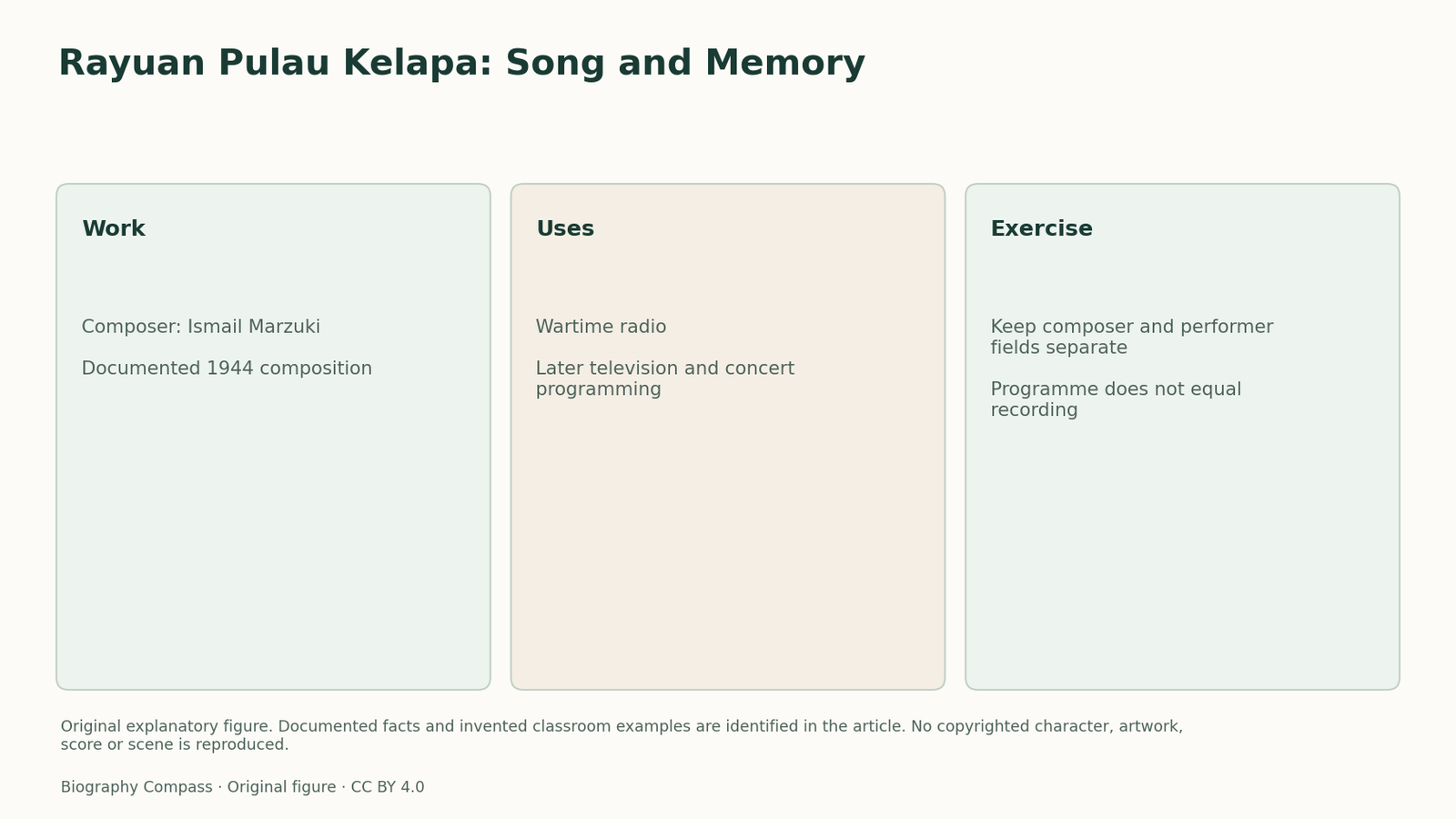
Make four separate fields labelled composition, institution, performers and evidence type. Enter Marzuki under composition; the wartime radio, later television and 2016 concert settings in separate rows under institution; and the documented 2016 groups only in that row. Then ask whether the date of a programme can establish the date a song was written, or whether naming a performer makes that performer its composer. A supported answer rejects both inferences. The same work can move through several arrangements and public uses while retaining its original credit, and a programme records an intended event rather than providing a recording. This exercise uses no lyric quotation or transcribed melody. It follows the song’s documented movement between contexts without inventing a particular arrangement.
Continue the chronology
Related history guides
Biography context
Explore Indonesia through connected lives
Connected biographies
People and practices to explore
1914–1958
Ismail Marzuki
Composer and songwriterIsmail Marzuki composed songs that joined romance and national feeling, leaving works that continued to circulate through broadcasting, public remembrance and later ensemble performance.Read biography1961—
Iwan Fals
Singer, songwriter and guitaristIwan Fals is an Indonesian singer and songwriter whose career grew from street performance into widely heard songs about work, inequality, affection and public life. His recordings include Sarjana Muda and the later collaborative album Pun Aku.Read biographyb. 1952
Ramli Sarip
Singer, songwriter and producerRamli Sarip helped establish Sweet Charity’s regional rock audience before developing a solo career across singing, songwriting and production, while continuing to revisit band collaboration.Read biographyQuick answers
Common questions
- Did the 2016 concert programme make its ensembles the song’s composers?
- No. The programme retains Ismail Marzuki’s composition credit. The named ensembles identify a later presentation of the work.
Primary and institutional sources
How this history was checked
Written catalogues, production records and interviews are distinguished from our own learning exercise. No complete film viewing, song listening or full-novel reading is claimed where only the identified written material was inspected. This article was reviewed on 7 November 2026.
- Indonesian Ministry of Culture, Ensiklopedia Sejarah IndonesiaIsmail Marzuki
- Indonesian education/culture ministry repositoryCultural honours directory, Ismail Marzuki
- Smithsonian Freer/Sackler Galleries and Embassy of IndonesiaPerforming Indonesia 2016, part I
- Humaniora, journal article in Indonesian scholarly repositoryThe Forgotten Medium: Hoso Kanri Kyoku