
The short answer
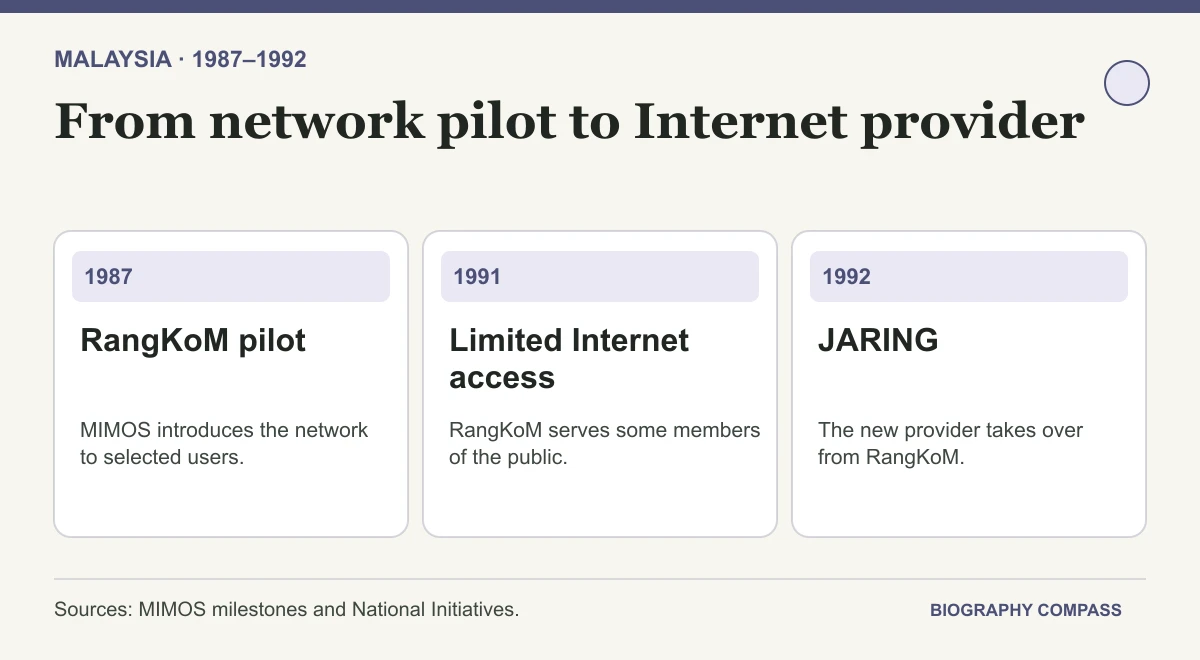
MIMOS introduced RangKoM to selected computer users in 1987. Its institutional chronology dates limited Internet service through RangKoM to 1991 and the launch of JARING to 1992. Long before access reached a mass audience, these stages took networking from a research project to a service that others could use.
Compare the records
What changed at each stage
Connect the dates with the different groups the network could serve.
| Stage | Who could use it | What the record establishes |
|---|---|---|
| RangKoM introduction | Selected user groups | MIMOS puts the network project in use |
| RangKoM as service | Limited members of the public | A wider group can access Internet services |
| JARING launch | Users of the new provider | MIMOS moves the service to a successor under a new name |
Chronology
A timeline of the turning points
MIMOS starts operations
The government sets up a research unit in the Prime Minister’s Department.
RangKoM introduced
MIMOS links selected user groups through the computer network.
Limited Internet service
RangKoM offers service to a limited group outside the pilot.
JARING replaces RangKoM
MIMOS launches an Internet service provider under the new name.
Why a connected research group mattered
The name RangKoM comes from Rangkaian Komputer Malaysia, or Malaysia Computer Network. MIMOS initially introduced it to selected groups. A limited set of users gave the project an identifiable community to serve while the institution put networking into practice. The founding of MIMOS in 1985 anchors this work in a public research programme. Its own history records university researchers among the people who took part in early discussions about building technical capacity.
What access meant in 1991
MIMOS dates an Internet service for limited members of the public to RangKoM in 1991. That description indicates that the circle of users had widened. It does not quantify the number of connections, their cost or where they were available. Early service and widespread adoption are separate milestones, and the provider’s own chronology establishes the first of those here.
Why more than one launch year appears
MIMOS places RangKoM’s formation in 1986 on its National Initiatives page and its introduction to selected groups in 1987 in the milestone chronology. These accounts then converge on 1992 for JARING’s launch as RangKoM’s successor. The distinction lets a student label a timeline precisely: a project can be formed, put into use, expanded into a service and then replaced under a new name.
Continue the chronology
Related history guides
How ThaiSarn Brought the Internet to Thailand
Compare the roles of early email, leased access and providers in Thailand.
Read the timeline1997–2003How Vietnam Joined the Internet and Built VNIX
Compare the timeline of Vietnam’s global connection, resource registry and domestic exchange.
Read the timeline1966–1996How Malaysia Built SIRIM from Two Industrial Institutions
Compare the earlier public-sector institutions that built Malaysia’s capability in industrial research and testing.
Read the timeline1956–1967How the RIDA Training Centre Became Institut Teknologi MARA
Follow a different national institution created to build technical skills.
Read the timelineConnected biographies
People connected to this history
Quick answers
Common questions
- Did RangKoM and JARING start in the same year?
- MIMOS dates RangKoM’s introduction to selected users to 1987 and JARING’s launch as its successor to 1992.
- What happened in 1991?
- MIMOS records that RangKoM offered Internet service to limited members of the public.
Primary and institutional sources
How this history was checked
Dates, legal milestones and historical claims are checked against the official and institutional records below. This article was reviewed on 19 November 2026.