
The short answer
What did the 2000 atomic structure describe, and what additional questions required the complete ribosome and observations of different states?
Source comparison
Observation, inference and limit
Identify the object and the evidence needed for each claim.
| Record or example | What is established | Limit |
|---|---|---|
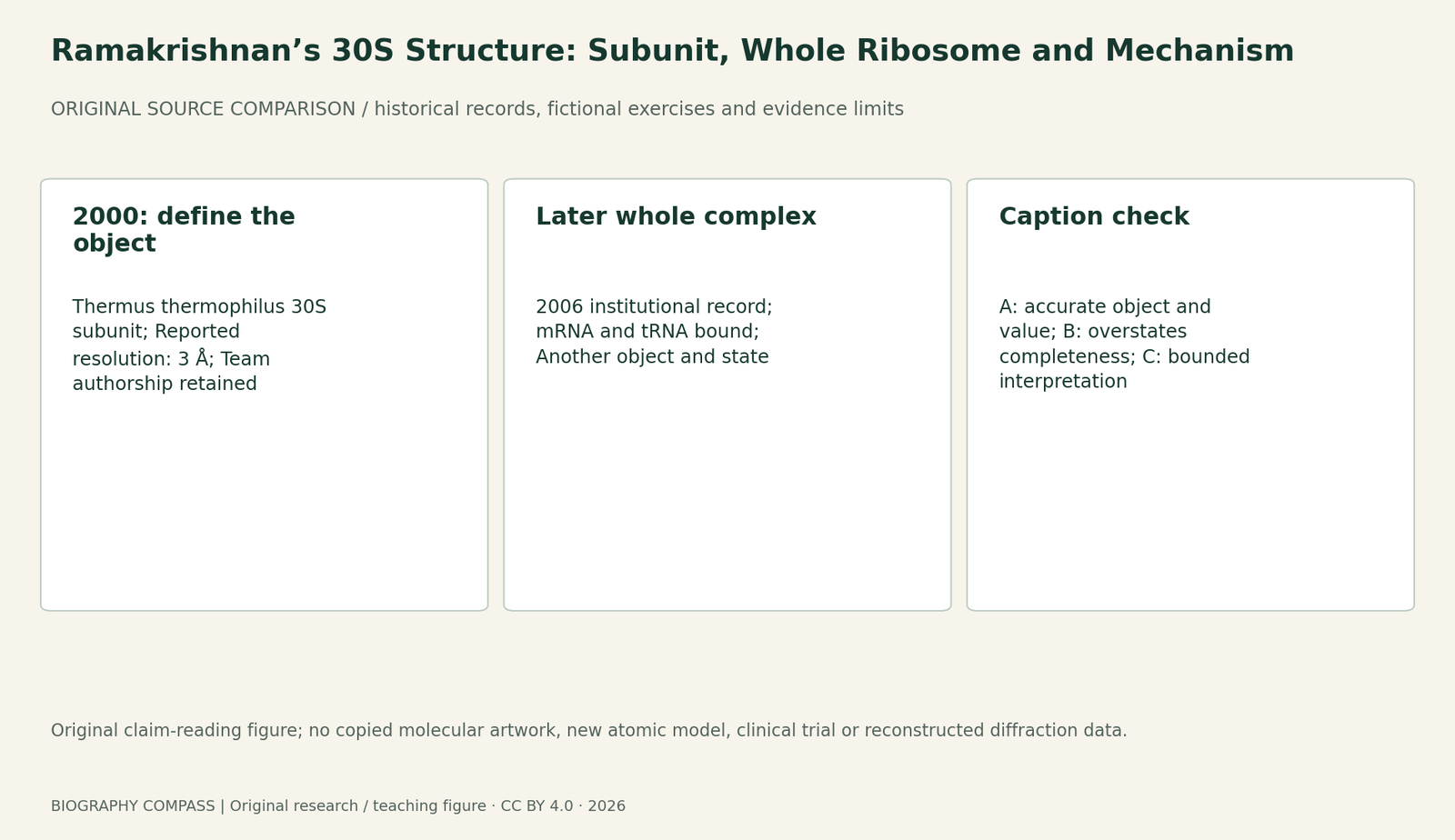
| 2000 paper | 30S subunit; 3 Å reported resolution | Not the entire 70S complex or a complete mechanistic film. |
| 2006 institutional record | Whole ribosome with messenger and transfer RNA | A later complex record, not a rewritten date for the 2000 paper. |
| Caption exercise | A accurate; B overstated; C bounded | No new molecular reconstruction or clinical efficacy result. |
Chronology
A timeline of the turning points
Records in context
Original claim-reading figure; no copied molecular artwork, new atomic model, clinical trial or reconstructed diffraction data.
Name the object in the original paper
Wimberly and colleagues’ 2000 Nature abstract reports a 3 Å structure of the 30S subunit from Thermus thermophilus. Bacterial ribosomes contain 30S and 50S subunits; 30S is therefore not a synonym for the complete 70S complex. The author and equal-contribution notes identify the team behind the model.
Ramakrishnan’s lecture assigns different roles to the two subunits: the small subunit binds the message and anticodon portions of transfer RNA; the large subunit contains the centre associated with peptide-bond formation. A caption that turns a small-subunit structure into every function of the entire ribosome changes the object being described.
Publication dates and structural states are different
The MRC account distinguishes the 2000 small-subunit structure from the 2006 entire ribosome bound to messenger and transfer RNA. These are different records. An earlier component structure and a later assembled-complex structure can both be important without claiming they are the same accomplishment.
The same account describes complexes with antibiotics. Such structures can inform a proposed mechanism of binding or inhibition, but an atomic model is not a clinical trial. Nor is one structural state a time-resolved film of the complete translation cycle.
Original caption test with worked answers
Three invented labels accompany a reproduction-free teaching diagram. A says: “The 2000 paper reported a 3 Å 30S subunit structure.” B says: “The 2000 paper solved every step of protein synthesis in the entire 70S ribosome.” C says: “Later complex structures helped address interactions not shown by one isolated subunit.” Which fit the inspected records?
Answer: A names the original object and reported resolution accurately. B overstates both the object and mechanistic completeness. C matches the need to compare additional complexes, without claiming that every mechanism was settled. The exercise tests wording; we have not reprocessed crystallographic data or reconstructed a molecular model.
What the resolution number does not say
The 3 Å value is a reported structural resolution, not the size of the organism or a statement that every atomic coordinate has exactly 3 Å uncertainty. The guide uses the paper’s value without inventing a percentage of certainty or a linear scale of biological understanding.
For further evaluation, a reader would examine the full methods, validation and related structural studies. Here the inspected scope is the original abstract, authorship and metadata, selected opening lecture pages and the institutional chronology. That supports a bounded comparison of objects and claims, not independent validation of the complete structure.
Continue the chronology
Related history guides
Khorana’s Repeating RNA: Why Was Each Codon Still Ambiguous?
Use Khorana’s 1968 lecture to distinguish an alternating protein pattern from a unique codon assignment, then solve a clearly labelled mapping exercise.
Read the timeline2000–2004Swaminathan’s Evergreen Revolution: Yield Is Not the Whole Test
Read Swaminathan’s 2000 and 2004 arguments, distinguish yield from production and sustainability, and solve a fictional harvest comparison with answers.
Read the timeline1963Sudarshan’s 1963 Optical Equivalence: When Are Weights Probabilities?
Read Sudarshan’s original 1963 optical-equivalence paper, identify its positivity limit and test fictional weights without claiming a new quantum state.
Read the timelineBiography context
Explore United Kingdom through connected lives
Connected biographies
Researchers and context

1952–
Venkatraman Ramakrishnan
Structural biologistVenkatraman Ramakrishnan moved from physics to molecular biology and helped determine ribosomal structures, sharing the 2009 Nobel Prize in Chemistry.Read biographyQuick answers
Common questions
- Does 30S mean the entire bacterial ribosome?
- No. It identifies the small subunit; the full bacterial complex is designated 70S.
- Does an antibiotic-bound structure prove a drug works in patients?
- No. Structural binding evidence and clinical efficacy answer different questions.
Primary and institutional sources
How this history was checked
Original records, later institutional accounts and our own teaching examples are distinguished. This article was reviewed on 28 October 2026.