
The short answer
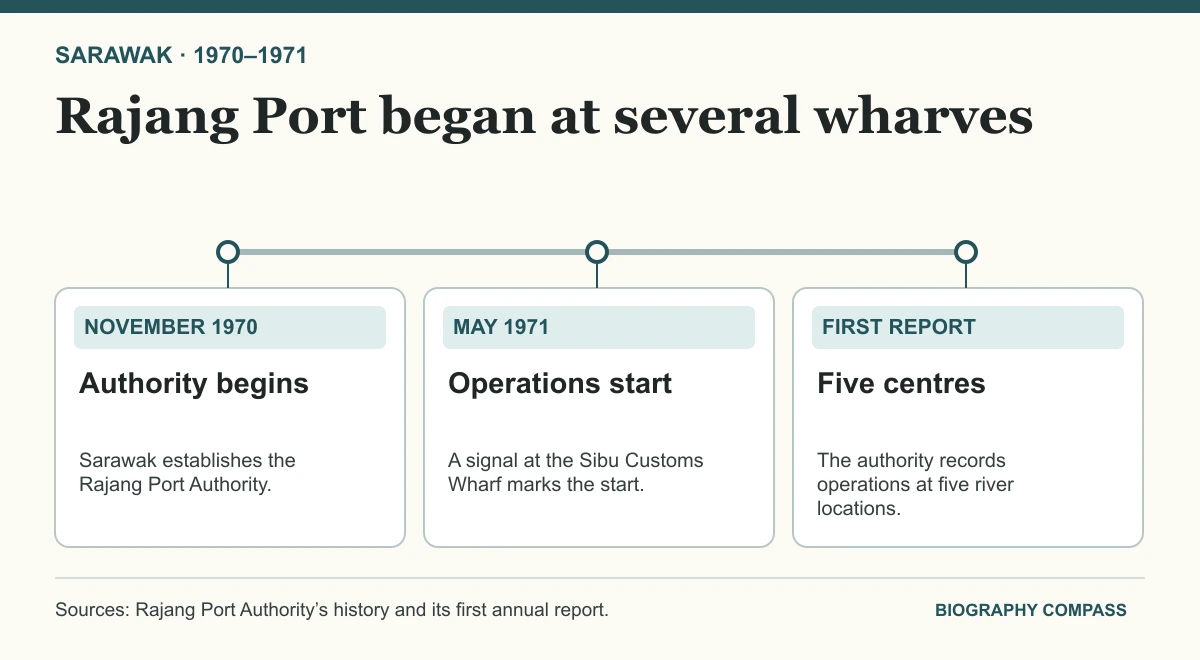
The Rajang Port Authority was established on 1 November 1970 and began operating on 17 May 1971. Its first report describes a start at the Customs Wharf in Sibu and the operation of five centres. This was a river port spread across several sites, with the authority headquartered at Sibu.
Compare the records
Reading a river port as a network
A port authority can cover a large jurisdiction while providing services at particular wharves.
| Place or group | Role in early operations | Evidence |
|---|---|---|
| Sibu | Customs Wharf and transit storage | The report records the opening signal and congestion in transit sheds |
| Sarikei | Operating centre with transit sheds | The authority reports storage pressure here as well |
| Binatang, Tanjong Mani and Sungei Merah | Other operating centres | The first report includes them in the five-centre network |
Chronology
A timeline of the turning points
Sarawak legislates for port authorities
The Port Authorities Ordinance provides the legal basis for creating the body.
Rajang Port Authority established
The authority traces its foundation to an order under the ordinance.
Operating start
A signal at the Customs Wharf in Sibu marks the beginning of the authority’s operations.
Five operating centres
The first report identifies the facilities in use along the river.
A start recorded at a specific wharf
The authority dates its establishment to November 1970 under Sarawak’s Port Authorities Ordinance. Its report for 1971, reproduced in the journal of the International Association of Ports and Harbors, describes a siren at the Customs Wharf at eight in the morning on 17 May 1971. The precise time and place identify when the authority began running services at an existing wharf.
Why the network extended beyond Sibu
The first report counts five operating centres: Sibu, Sarikei, Binatang, Tanjong Mani and the Sungei Merah oil wharf. It says the area under the authority was wider still. This matters when interpreting figures for “the port.” A shipment recorded within the authority’s network might have used one of several wharves, while a figure for Sibu alone describes a part of that system. The older spellings here follow the report so they can be matched with its tables.
What happened after a vessel unloaded
The report notes congestion in transit sheds at Sibu and Sarikei. These sheds held goods between unloading and collection or onward movement. That detail shows a constraint a count of ships cannot reflect. Efficient transfer depended on space ashore as well as vessel access. Later Sarawak infrastructure records place the authority within a broader port network, while the original report documents how its first facilities actually functioned.
Continue the chronology
Related history guides
Why North Borneo’s Railway Linked Beaufort to Two Ports
Compare the collection of inland products at rail junctions and coastal outlets in North Borneo.
Read the timeline1974–1984How Kuantan Port Opened in Stages from 1974 to 1984
Contrast the phased construction and general cargo opening of Kuantan Port.
Read the timeline1978–1983How Bintulu’s First LNG Cargo Reached Japan
Read how a purpose-built export terminal in Bintulu served an LNG supply chain.
Read the timelineConnected biographies
People connected to this history
Quick answers
Common questions
- When did Rajang Port Authority begin operations?
- It began operations on 17 May 1971, following its statutory establishment on 1 November 1970.
- Was Rajang Port just one wharf at Sibu?
- The first report lists five operating centres, although the opening signal sounded at the Customs Wharf in Sibu.
Primary and institutional sources
How this history was checked
Dates, legal milestones and historical claims are checked against the official and institutional records below. This article was reviewed on 19 November 2026.