
The short answer
What did Azlan Shah distinguish between a court’s legal task and Parliament’s power to reform secrecy law?
Evidence comparison
Read the records together
The records were created for different purposes and support different kinds of claims.
| Record | What it establishes | Question to keep open |
|---|---|---|
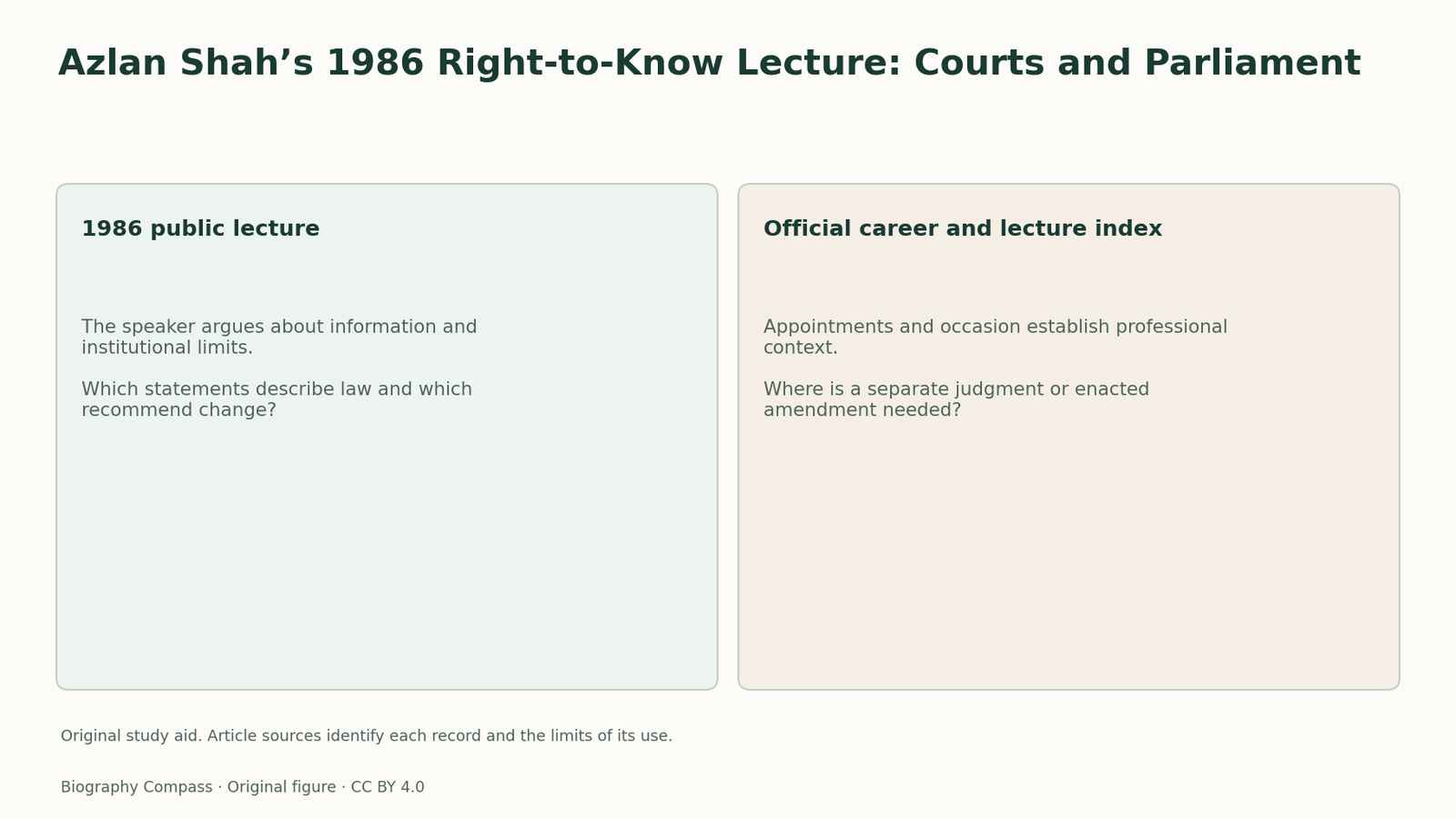
| 1986 public lecture | The speaker argues about information and institutional limits. | Which statements describe law and which recommend change? |
| Official career and lecture index | Appointments and occasion establish professional context. | Where is a separate judgment or enacted amendment needed? |
Chronology
A timeline of the turning points
Federal Court
Azlan Shah joins the Federal Court.
Lord President
He assumes judicial leadership.
Public lecture
He examines information, secrecy and institutional responsibility.
Date the argument before using it
Azlan Shah delivered this public lecture in Penang in December 1986. His discussion of British and Malaysian official secrecy legislation belongs to that historical setting. A reader should not treat his descriptions of then-existing provisions as an updated guide to present law. The collection’s index and the lecture itself establish the occasion; the argument then explains why access to public information mattered to accountability while some non-disclosure could still be justified.
Distinguish criticism from judicial authority
The lecture discusses the wide discretion associated with secrecy legislation and considers the position of courts required to apply enacted law. In referring to his earlier judicial experience, Azlan Shah does not suggest that a judge may simply replace legislation with a preferred policy. His criticism of breadth and his account of legal limits operate together. The lecture can favour reform while still recognising that courts and legislators possess different responsibilities.
Sources for this section: [3]
Trace the proposed route of change
Parliament appears in the argument as the institution able to change statutory rules, while prosecutorial restraint and careful adjudication address different parts of the existing system. These routes should not be collapsed into a general claim that an influential speech changed the law. The career chronology helps explain the speaker’s professional perspective, but authority within a biography does not transform every public recommendation into a binding legal decision.
Classify four statements
Give readers four labels: historical description, judicial interpretation, policy criticism and proposal for legislation. Ask them to place an example from the lecture under each appropriate label and identify the evidence needed to show a later change. A good response preserves the distinction between the 1986 lecture and the earlier case it discusses. This makes the text useful for studying constitutional reasoning without presenting an excerpted historical argument as contemporary legal advice.
Continue the chronology
Related history guides
Biography context
Explore Malaysia through connected lives
Connected biographies
People behind the records
1928–2014
Raja Azlan Shah
Jurist, Sultan and constitutional lecturerAzlan Shah progressed from legal service to leadership of Malaysia’s judiciary and later explained constitutional government through public lectures.Read biographyQuick answers
Common questions
- Was the right-to-know lecture itself a court judgment?
- No. It was a public lecture that discussed legal experience and policy; a judgment or legislative amendment requires a separate record.
Primary and institutional sources
How this history was checked
Sources support the chronology and the record comparison. The reading exercise is original. This article was reviewed on 7 November 2026.
- Sultan Azlan Shah Foundation, 2014 collectionSultan Azlan Shah: Perspectives
- Sultan Azlan Shah Foundation, RNS Publications, 2014His Royal Highness Sultan Azlan Shah: A Tribute
- Raja Azlan Shah, collected lecturesThe Right to Know, 19 December 1986
- Sultan Azlan Shah FoundationLectures and speeches by HRH Sultan Azlan Shah