
The short answer
A measurement can retain some details and lose others. An ideal strip scan keeps a total along each line while leaving the distribution within the line unresolved.
Reading the evidence
What the example keeps and loses
List the totals before trying to infer cell positions.
| Stage | Recorded value | Information still missing |
|---|---|---|
| Row totals | One bright cell in each row. | Which column each cell occupies. |
| Column totals | One bright cell in each column. | Which pairing with rows is correct. |
| Diagonal | Distinguishes the two proposed grids. | Whether other possibilities were excluded by the model. |
Read what a strip adds
The abstract of Bracewell’s paper describes a beam long compared with a source in one direction and narrow in the other. A scan of the beam records a combined response from different positions. To understand what has been measured, first identify the long direction. Two bright patches along the same strip can contribute to the same reading.
The archive connects the calculation with solar observations obtained at several beam angles. The beam’s narrow dimension and the directions sampled influence the details that can be recovered.
Construct an ambiguous scan
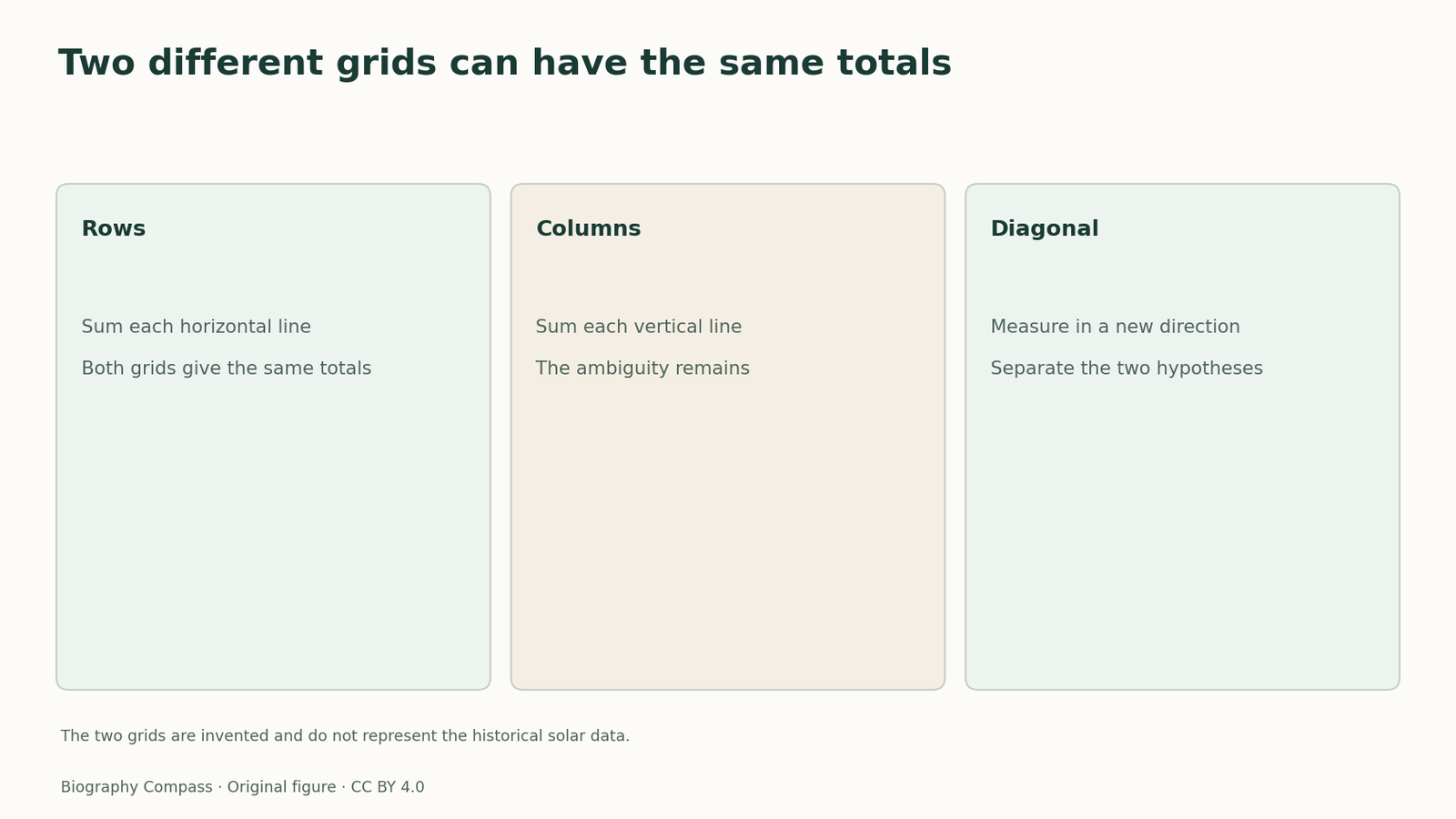
Draw two small grids, each two rows high and two columns wide. In the first grid put one bright cell at upper left and one at lower right. In the second put them at upper right and lower left. Each row sum is one in both grids, and each column sum is one. Two directions therefore still leave this particular ambiguity.
A diagonal sum separates them. One grid has both bright cells on the same downward diagonal, the other has neither there. This idealised exercise shows how a measurement chosen in a new direction can answer a question left open by the earlier ones.
Keep the mathematical ideal separate
In the ideal limit discussed in the paper, scans in all directions can reconstruct the distribution. Actual scans have a finite beam width and limited directions. Do not claim that any third observation guarantees a full map because one diagonal settled the toy case. Write down what the observations constrain and what the reconstruction has to assume.
Sources for this section: [2]
Continue the chronology
Related history guides
Biography context
Explore Australia through connected lives
Connected biographies
People in the records
1921–2007
Ronald Bracewell
Radio astronomer and electrical engineerBracewell studied how a radio telescope changes the brightness distribution it measures.Read biographyQuick answers
Common questions
- Why can two different images give the same scan?
- Adding brightness along a strip loses the location of the brightness within that strip. Other directions can constrain the missing information.
Primary and institutional sources
How this history was checked
Dates, legal milestones and historical claims are checked against the official and institutional records below. This article was reviewed on 5 November 2026.