
The short answer
A visible track can constrain an event that includes something invisible. The useful question is how much of the interpretation follows from the visible measurement and what additional assumptions are still required.
Original record and worked interpretation
An intersection test, not an identity test
Hard errors of ±2 are invented for every observation.
| Invented set | Largest lower endpoint | Smallest upper endpoint |
|---|---|---|
| A | 100 | 100 |
| B | 108 | 92 |
| Decision | A compatible at 100 | B has no common value |
Chronology
A timeline of the turning points
Collaborative paper
The acquired title record identifies four authors.
Lecture
Decay interpretation includes a tentative identification.
Read the inference and its qualification
Powell describes positive π-particles stopped in emulsion and daughter µ-tracks with nearly constant range, allowing for straggling. He connects this with a single neutral partner and tentatively identifies that partner as a neutrino.
The earlier charged-meson paper names Lattes, Muirhead, Occhialini and Powell.
The observation and the proposed identity are distinct statements. A later familiar name should not remove the original qualification.
An original compatibility test
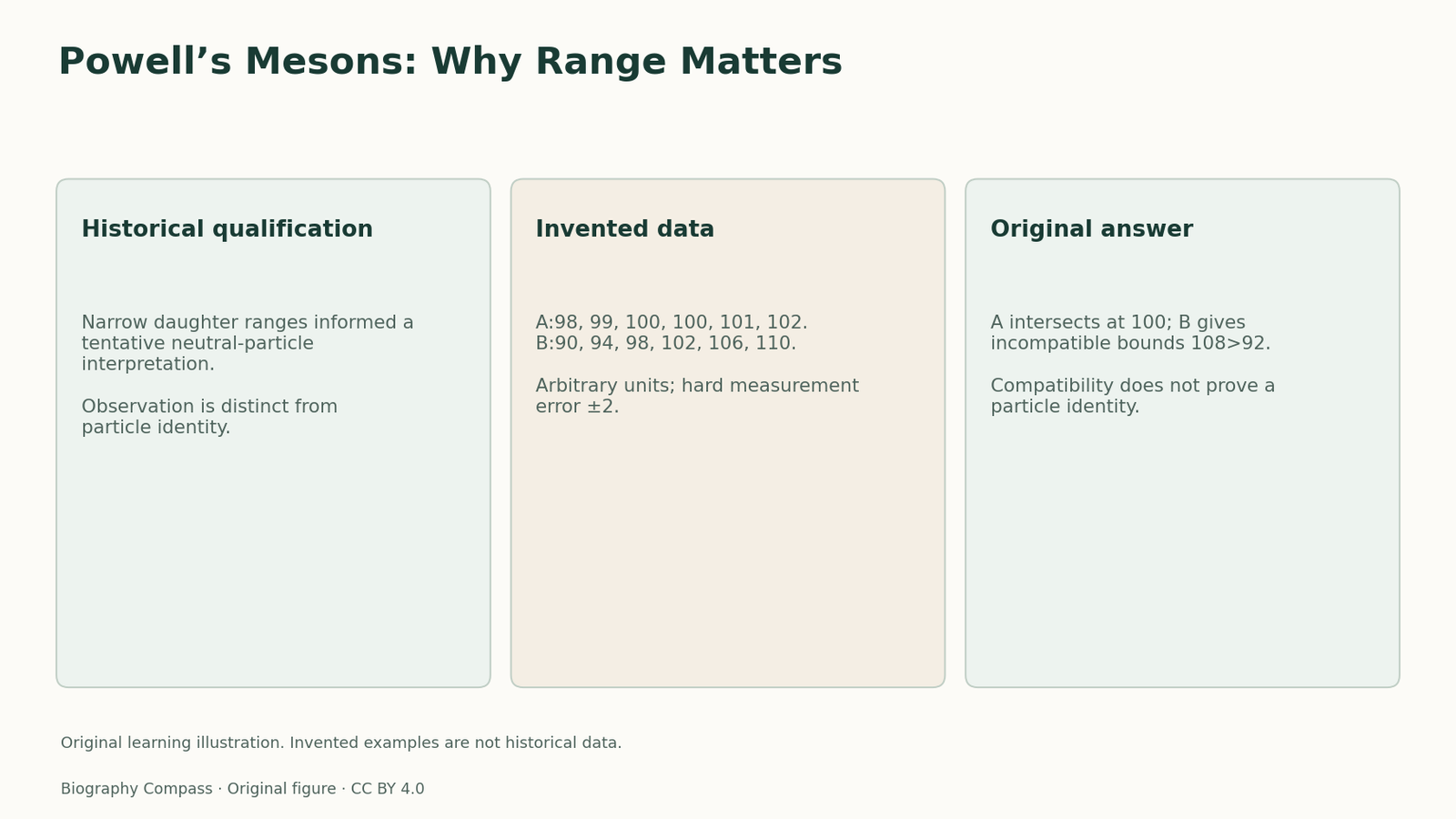
Stipulate one-dimensional range measurements in arbitrary units with a hard error bound ±2 per observation. Set A is 98, 99, 100, 100, 101, 102; set B is 90, 94, 98, 102, 106, 110. Test whether each set can arise from a single common true range R0 under that error rule.
For each measured r, the admissible interval is [r−2, r+2]. A common R0 must lie in every interval. This is a bounded-error compatibility test, not a probability model, an emulsion calibration or a measurement of a real decay energy.
Sources for this section: [1]
Reference answer
For A, the greatest lower endpoint is 100 and the smallest upper endpoint is 100. Their intersection is the single value 100, so the common-range hypothesis is compatible. For B, the greatest lower endpoint is 108 while the smallest upper endpoint is 92. The intersection is empty, so that hypothesis fails under the stipulated errors.
Failure does not identify the cause. The bound might be wrong, there might be multiple processes, or the one-range model might be inappropriate. Compatibility for A is likewise not a proof of an unseen particle’s identity.
Sources for this section: [1]
Return to the physical record
The historical interpretation used more than a narrow cluster of arbitrary numbers: stopping, particle assignments and decay reasoning were part of the account. Our fixture isolates only the consistency question. It does not reproduce straggling statistically, determine a neutral mass or distinguish every possible decay mechanism.
Sources for this section: [1]
Continue the chronology
Related history guides
Biography context
Explore United Kingdom through connected lives
Connected biographies
The researcher behind the record
Quick answers
Common questions
- Does compatible mean the hypothesis is proved?
- No. It survives this test under the stipulated error bound.
- Does an empty intersection identify the unseen particle?
- No. It rejects one common-range model with those errors, not every physical alternative.
Primary and institutional sources
How this history was checked
Read the selected historical passages alongside the labelled original analysis. Invented inputs are not reconstructed measurements. This article was reviewed on 31 October 2026.