
The short answer
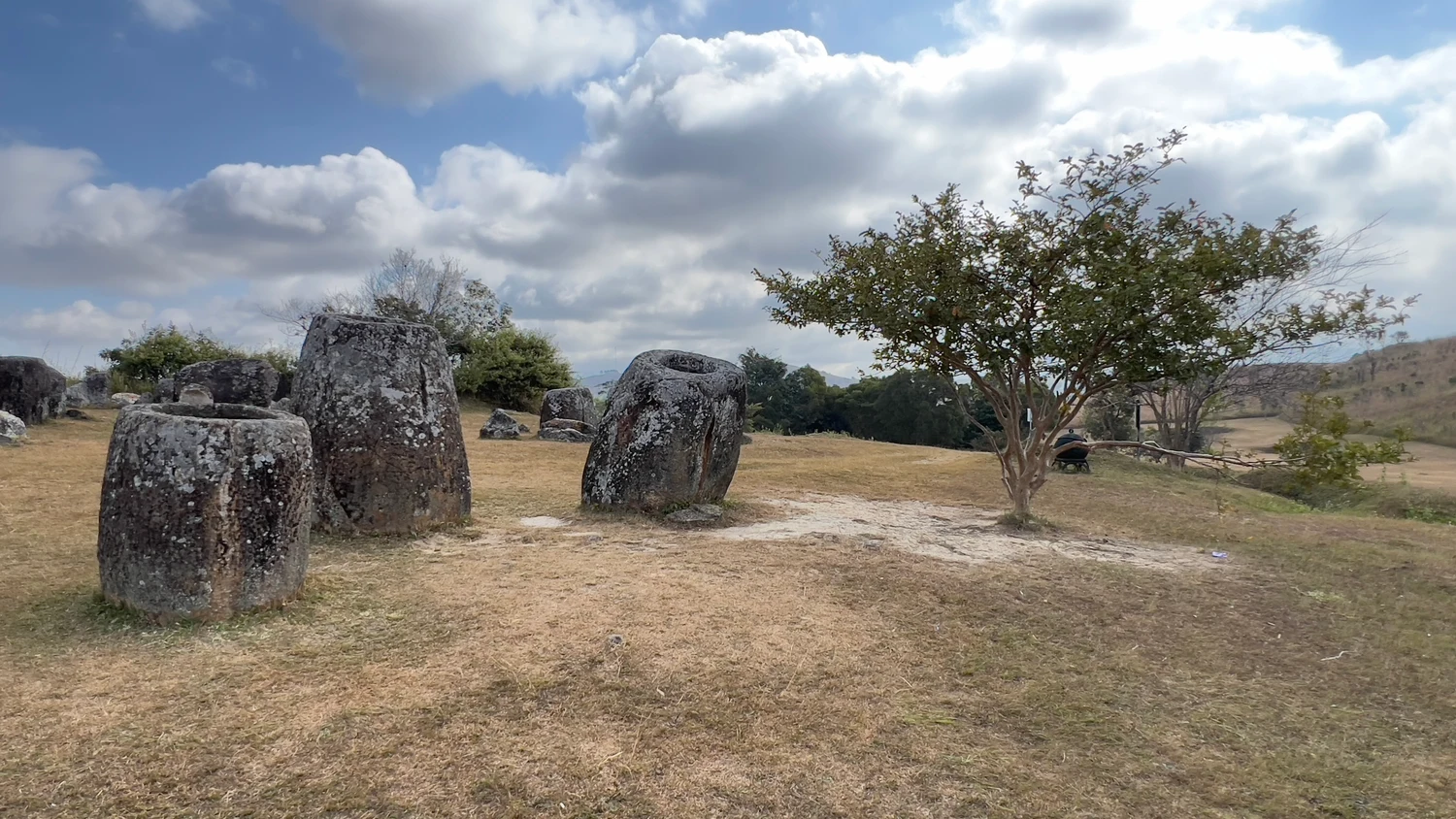
The Plain of Jars is a landscape of many sites in Xiengkhuang, Laos, where large vessels were carved from stone. UNESCO's 2019 inscription joins 15 components in one serial property. Jars, burials and manufacturing traces together provide evidence of Iron Age funerary practice.
Compare the records
Why the location of a find matters
Different categories of evidence support different kinds of claims about the jars.
| Feature | What it records | Question to ask |
|---|---|---|
| Stone vessels | Form, scale and distribution | How do size and workmanship vary between places? |
| Burials and grave goods | Direct traces of funerary practice | What evidence places the jar in its burial setting? |
| Quarries and unfinished work | Production and material selection | Where and how was stone worked? |
| Inscribed component maps | Known locations and boundaries | Which locations are included in the serial property? |
Chronology
A timeline of the turning points
Funerary practices develop at the sites
The committee’s date range extends to sometime after 500 CE.
Jars and associated features are used
Burials and grave goods provide evidence beyond the vessels.
UNESCO inscribes a serial property
The decision describes 15 inscribed components and their archaeological relationships.
Why archaeologists read the jars with the ground around them
A jar indicates choices about material, shape and scale. A burial or related object found nearby can also show how people used a site. UNESCO's assessment links the jar landscape to funerary practices using evidence from burials, markers and grave goods. A stone disc is a visible object, while its use as a lid requires interpretation. The inscription record describes that function as possible.
Why there are two jar totals
The committee describes more than 2,100 jars across the broader historical landscape and 1,325 in the inscribed serial property. The larger figure describes the distribution in the area, while the smaller figure counts the jars within the 15 components of the listed property. A reference to Site 1 identifies one location. A map showing all the inscribed components answers a different question about which places entered the World Heritage listing.
From quarry to funerary landscape
The property includes quarries and manufacturing sites as well as places where the jars were used. Those places help researchers ask how people obtained suitable stone and completed vessels on a substantial scale. The three types of evidence work together when researchers reconstruct the landscape: manufacture shows labor, mapped patterns show distribution, and archaeological context gives the strongest grounds for interpreting the jars' use.
Continue the chronology
Related history guides
Vat Phou: The Temple and Champasak Cultural Landscape
Compare an archaeological property whose monuments and waterworks align along a mountain-to-river axis.
Read the timeline2012–2023Tam Pà Ling: The 86–68 ka Fossil Evidence from Laos
Follow another Lao archaeological case where context changes how an object is interpreted.
Read the timelineConnected biographies
People connected to this history
Quick answers
Common questions
- How many components does the World Heritage listing contain?
- UNESCO inscribed 15 components as a single serial property in 2019.
- How many jars does the UNESCO property contain?
- The committee counted 1,325 jars in the inscribed property. It cited more than 2,100 across the wider landscape.
Primary and institutional sources
How this history was checked
Dates, legal milestones and historical claims are checked against the official and institutional records below. This article was reviewed on 19 November 2026.