
The short answer
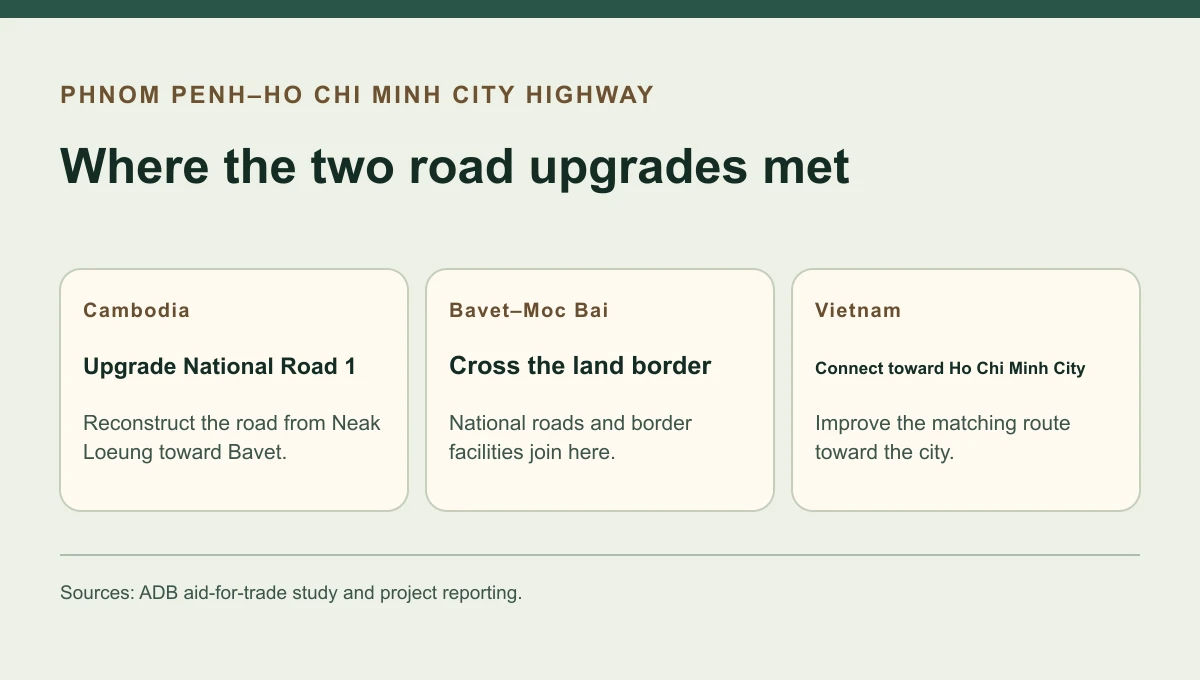
A 1998 Asian Development Bank highway project improved the road between Phnom Penh and Ho Chi Minh City on both sides of the Cambodia–Vietnam border. In Cambodia, its main road works reconstructed 105 kilometres from Neak Loeung toward Bavet. ADB dates completion of that National Road 1 work to 2005. At the Mekong end of the section, vehicles still used the Neak Loeung ferry for another decade.
A two-country highway project
Follow the upgrade across the border
The project improved national roads that meet at one international gateway.
| Segment | Route | Role in the wider network |
|---|---|---|
| Cambodia | National Road 1 via Neak Loeung and Bavet | The 105-kilometre reconstruction focused on the road from Neak Loeung to the border. |
| International crossing | Bavet in Cambodia and Moc Bai in Vietnam | The gateway joins the two national road systems. |
| Vietnam | Moc Bai to Ho Chi Minh City | Traffic enters a Vietnamese highway network continuing toward regional markets. |
Chronology
A timeline of the turning points
The two-country financing is approved
Separate allocations support works on the Cambodian and Vietnamese sections.
The Cambodian road upgrade is complete
The rebuilt section supports travel toward Bavet, including cross-border bus links.
A separate bridge project closes the river gap
The Tsubasa Bridge replaces the Neak Loeung ferry at the Phnom Penh end of the upgraded section.
What the 1998 financing covered
ADB’s regional case study records a combined US$140 million in approved financing, with US$40 million for Cambodia and US$100 million for Vietnam. The governments supplied additional financing. Separating the two allocations helps explain why an international route also has separate road projects, construction schedules and administrative responsibilities.
On the Cambodian side, the main reconstructed section ran from Neak Loeung to Bavet. ADB’s later account associates the completion of national road work in 2005 with improving travel and trade, including bus links. The road investment on one side became more useful when vehicles could continue on the other side.
Sources for this section: [1]
Where the project sits in the corridor
The ADB action plan traces the central subcorridor from Phnom Penh through Svay Rieng to Bavet, then from Moc Bai to Ho Chi Minh City. This frontier pair differs from the Poipet–Aranyaprathet gateway on the Thai side of Cambodia. The route running close to the coast uses another alignment again, connecting different provincial centres and border facilities.
Why the 2005 and 2015 dates both matter
In 2005, the upgraded pavement and road structures could improve travel between Neak Loeung and the border. The crossing of the Mekong at Neak Loeung still depended on a ferry. Replacing it required a separate project that opened in 2015. Following the two dates explains how a highway can show measurable travel gains before the full journey becomes possible entirely by road.
Continue the chronology
Related history guides
How Cambodia’s Tsubasa Bridge Replaced a Mekong Ferry
Read how the Tsubasa Bridge replaced the separate Mekong ferry crossing.
Read the timeline2007–2026How the Mekong Southern Coastal Corridor Was Upgraded
Compare the different road alignment closer to the Gulf of Thailand.
Read the timeline2013–2023How Cambodia Upgraded National Road 5 Toward Thailand
Follow the Cambodian highway upgrades west of Phnom Penh toward Poipet.
Read the timelineConnected biographies
People connected to this history
Quick answers
Common questions
- When did the Cambodian road works finish?
- ADB dates completion of the National Road 1 work to 2005. The later bridge at Neak Loeung opened in 2015.
- Which border crossing serves the highway?
- It crosses between Bavet in Cambodia and Moc Bai in Vietnam.
Primary and institutional sources
How this history was checked
Dates, legal milestones and historical claims are checked against the official and institutional records below. This article was reviewed on 19 November 2026.
- Asian Development BankAid for trade in ASEAN: Phnom Penh–Ho Chi Minh City highway case study
- Asian Development BankRoad improvements in Cambodia: National Road 1, 2010
- Asian Development BankStrategy and Action Plan for the Southern Economic Corridor
- Japan International Cooperation AgencyAkihiko Tanaka’s report on the Tsubasa Bridge opening