
The short answer
Suppose one Philippine bank owes another for a payment. A message can tell the recipient what is due, but the obligation still has to be discharged. The peso real-time gross settlement system provides a place for that to happen in central bank money. Its history explains why a change in the format of a message and a transfer of money are two separate events.
Reading the records
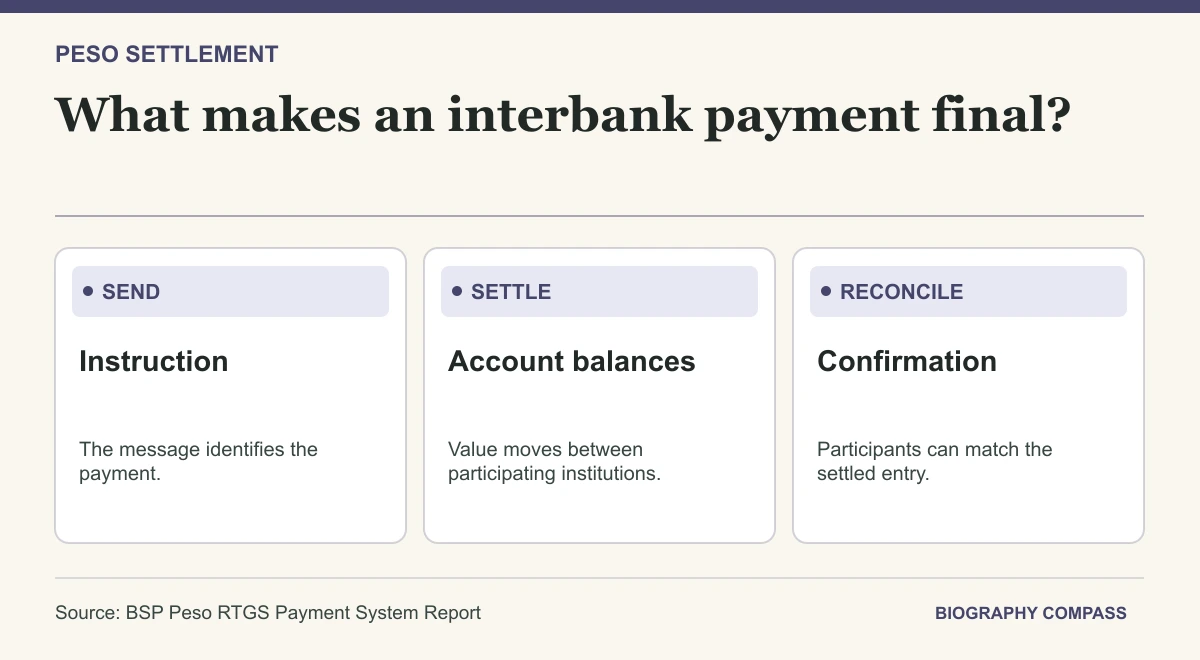
Read a transfer in three steps
This simplified example follows two participating institutions. Their customer-facing services may have their own timetables.
| Step | Object | What it tells the bank |
|---|---|---|
| Instruction | Structured message | The payer, receiving participant and amount can be identified. |
| Settlement | Central bank account balances | The obligation is settled between participants. |
| Confirmation | Status information | The institutions can reconcile what actually settled. |
Chronology
A timeline of the turning points
Earlier settlement arrangements
The central bank’s retrospective describes manual processes and their gradual automation.
PhilPaSS
The original platform became the means of settling qualifying peso payments.
Migration instructions
A BSP memorandum set out preparations for participants.
Launch and designation
PhilPaSSplus went live on the 26th. A Monetary Board resolution on the 29th designated the peso RTGS system systemically important.
What gross settlement changes
In a net arrangement, several payments can be offset and a balance settled later. Gross settlement processes individual obligations for their full amounts. Once a qualifying payment settles through the central bank’s accounts, the receiving participant can treat that transfer as final. A bank still needs sufficient settlement funds. A customer sending an instruction, a bank accepting it and final interbank settlement can have different timestamps.
Why a new message standard mattered
A free-text instruction leaves more work for the receiving institution when it tries to match a payment with its purpose. ISO 20022 provides named fields and supports richer information accompanying a transfer. The central bank’s 2020 implementation memorandum gave participants a timetable for migration. It is evidence of what banks had to prepare for, while the later system report records the date when they actually moved.
A launch followed by a designation
The BSP records the start of PhilPaSS in November 2002 and its replacement on 26 July 2021. Three days later the Monetary Board designated the peso RTGS system systemically important. That description concerns the consequences a disruption could have for other institutions. It is a regulatory decision about the wider system. An account of the first day of operation should cite the launch date separately.
Continue the chronology
Related history guides
Why Philippine Central Banking Has Two Founding Dates
Read about the independent central bank that operates the settlement platform.
Read the timeline2017–2018PESONet and InstaPay: Two Designs for Philippine Transfers
See how two retail clearing schemes handle a customer’s instruction.
Read the timelineConnected biographies
People in this history
Quick answers
Common questions
- Is PhilPaSSplus a consumer transfer app?
- It is the central bank’s settlement platform for participating institutions. Consumers typically encounter the service offered by their own provider.
- When did PhilPaSSplus go live?
- The BSP’s system report records replacement of PhilPaSS on 26 July 2021.
Primary and institutional sources
How this history was checked
Dates, legal milestones and historical claims are checked against the official and institutional records below. This article was reviewed on 19 November 2026.