
The short answer
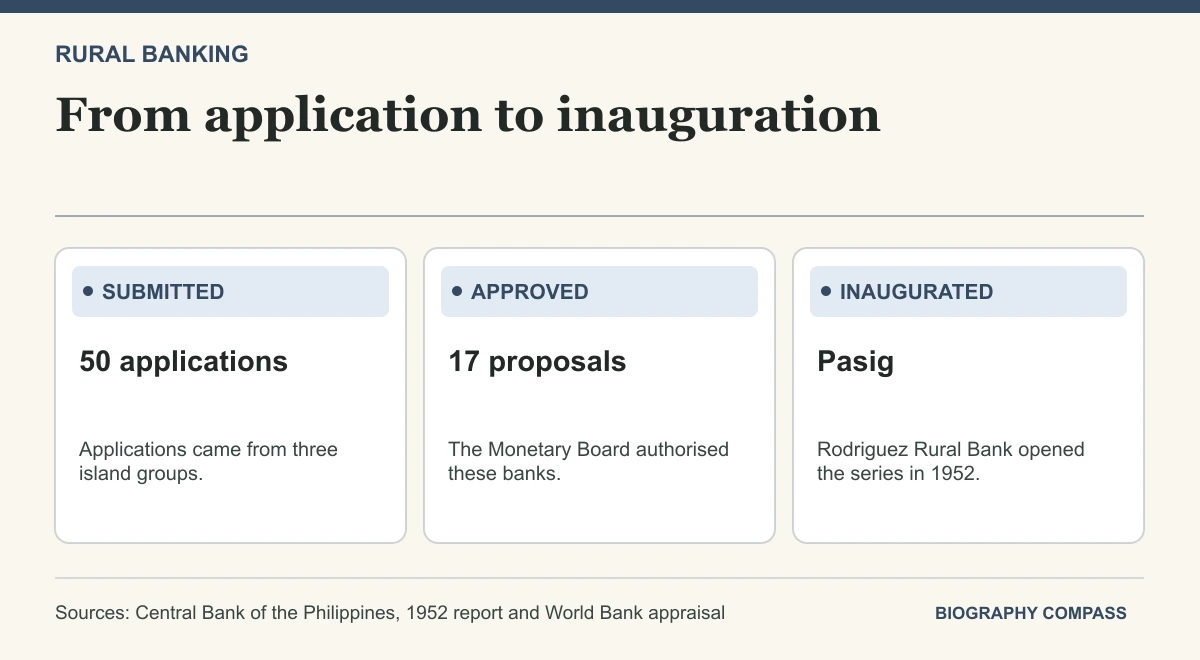
The Central Bank of the Philippines reported receiving 50 rural bank applications in the months after the Rural Banks Act became law in 1952. By year-end it could name one bank already inaugurated, the Rodriguez Rural Bank in Pasig, then part of Rizal province. The gap between those numbers shows how many steps lay between a proposal and a local banking office.
Reading the records
Where the first applications came from
The central bank counted applications by island group. These numbers describe proposals and cannot be used as a map of operating branches.
| Area | Applications | Share of the 50 |
|---|---|---|
| Luzon | 37 | 74 percent |
| Visayas | 6 | 12 percent |
| Mindanao | 7 | 14 percent |
Chronology
A timeline of the turning points
The enabling law
Republic Act 720 set out how rural banks could be organised and capitalised.
Applications examined
The central bank counted applicants from Luzon, the Visayas and Mindanao.
Pasig inauguration
The World Bank’s rural credit appraisal records the day.
Other approvals pending opening
The central bank expected the other sixteen approved banks to open in early 1953.
Who was supposed to supply the capital?
Small local producers needed access to finance in places where a private investor might hesitate to establish a bank. Republic Act 720 let the Rehabilitation Finance Corporation supplement private investment when the Monetary Board certified a need. The public subscription was capped by the private equity invested. The statute treated those public shares as non-voting and gave them preference over assets in liquidation. Capital support and voting control were therefore separate questions.
One certificate in Pasig
The central bank’s contemporary report identifies Rodriguez Rural Bank as the first to receive authority to register its incorporation papers. A later World Bank appraisal dates its inauguration to 11 December 1952. Reading the two records together supplies both the nature of the initial authorisation and the day the new institution was publicly inaugurated. Calling all applications received that year newly opened banks would erase that distinction.
What the first figures can establish
Seventeen of the 50 applications had received Monetary Board approval in the period described. The central bank expected the other sixteen approved institutions to open in early 1953. An expectation recorded in a 1952 report cannot establish that each one opened on schedule. The figures do, however, show demand beyond Pasig, including thirteen applications from the Visayas and Mindanao together. A history of an individual branch would need its own opening record.
Sources for this section: [2]
Continue the chronology
Related history guides
Philippine Deposit Insurance and the First Payout in Nabua
Read the deposit insurer’s account of a rural bank closing in Camarines Sur.
Read the timeline1946–1958How the Development Bank of the Philippines Began
Trace the development of the public corporation that could subscribe rural bank shares.
Read the timelineConnected biographies
People in this history
Quick answers
Common questions
- Which was the first bank organised under the 1952 act?
- The Rodriguez Rural Bank in Pasig, Rizal, inaugurated on 11 December 1952.
- Did 50 rural banks open in 1952?
- The 50 were applications. The central bank reported 17 approvals and identified the Pasig bank as already inaugurated.
Primary and institutional sources
How this history was checked
Dates, legal milestones and historical claims are checked against the official and institutional records below. This article was reviewed on 19 November 2026.