
The short answer
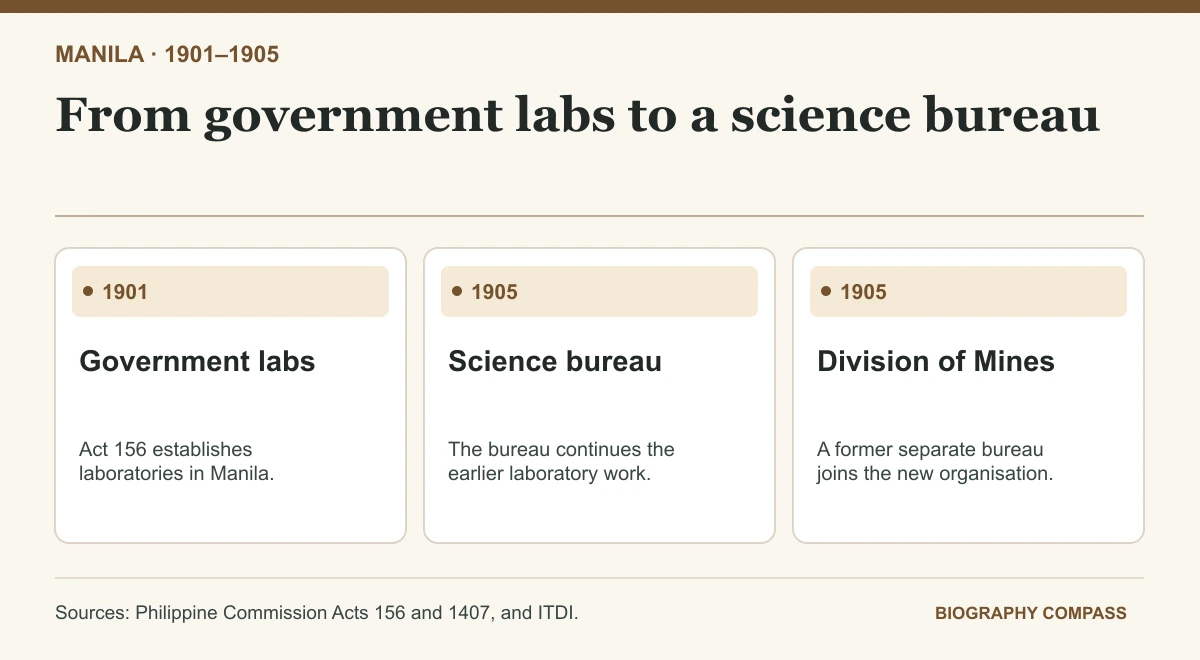
The Philippine Commission established government laboratories in Manila in 1901. A wider administrative reorganisation in 1905 placed their work within the Bureau of Science and added the former Mining Bureau as a division. The legislation shows how research and public analytical services came under one administrative body.
Compare the records
How to read the laboratory succession
Follow the work as well as the institution’s name.
| Activity | 1901 framework | 1905 framework |
|---|---|---|
| Government laboratories | A set of laboratories under a superintendent | Laboratory functions continue under the Bureau of Science |
| Mining | Separate Mining Bureau before consolidation | Division of Mines under the science bureau |
| Public analytical work | Laboratory capacity established for government needs | Act 1407 explicitly provides for selected analyses for governments and the public |
Chronology
A timeline of the turning points
Act No. 156
The Philippine Commission provides for government laboratories in Manila.
Act No. 1407
The wider colonial reorganisation creates a Bureau of Science structure and incorporates existing work.
Mines becomes a division
The former separate Mining Bureau’s duties move into the new bureau.
From separate facilities to a government laboratory service
Act No. 156 set up government laboratories with a superintendent in Manila. The successor institute’s institutional history records chemistry and biology facilities and a scientific library among their components. Housing these functions together created an administrative unit that could support several kinds of inquiry. Readers looking for the earliest institutional records can search for the Bureau of Government Laboratories, even when later histories discuss those records under the name Bureau of Science.
Why mines appears in a science bureau’s records
Section 7 of Act No. 1407 creates the bureau structure and places the separate Mining Bureau within it as the Division of Mines. The law directs the science bureau to carry on the older laboratory duties. This means that a 1905 administrative filing may trace a new chain of authority for work that had already been done under another name. It also explains why mining and laboratory records can both appear in the early bureau’s history.
How public analytical work became visible
Act 1407 allowed the bureau to carry out analyses and examinations for provincial or municipal governments and members of the public. It also provided for how payments were credited. These provisions show an administrative service relationship alongside research. For a historian, a laboratory publication can tell what investigators found, while the reorganisation law reveals who could request certain work and how the bureau accounted for it.
Continue the chronology
Related history guides
How the Philippines Set Up Its National Measurement System
Follow a later national role for technical measurement and calibration under ITDI.
Read the timeline1964–1981How the Philippines Established Its Textile Research Institute
Compare a later institute built to serve a particular industrial sector.
Read the timeline1865–1901How Manila Observatory Began Warning of Typhoons
Compare the separate reorganisation of the colonial weather service in 1901.
Read the timelineConnected biographies
People connected to this history
Quick answers
Common questions
- When were the Manila government laboratories created?
- Act No. 156 dates their establishment to 1 July 1901.
- What changed in 1905?
- Act No. 1407 carried the laboratory functions into the Bureau of Science and placed the Mining Bureau within it as a division.
Primary and institutional sources
How this history was checked
Dates, legal milestones and historical claims are checked against the official and institutional records below. This article was reviewed on 19 November 2026.