
The short answer
A political appeal is evidence of what its author asked for. Read Phan Châu Trinh’s letter to Paul Beau by separating accusations, requests and the cooperation he made conditional on reform.
Documentary comparison
A request is not an enacted reform
Read the voice and function of each passage before assigning it a legal effect.
| Record or test | What the evidence establishes | What it does not establish |
|---|---|---|
| Accusation | Trinh’s criticism of officials and colonial policy | An independently adjudicated finding about every official |
| Closing requests | The reforms he wanted, including publication and education | A decree granting those reforms |
| Conditional cooperation | His stated argument about what changed policy could achieve | Unconditional approval of colonial administration |
Chronology
A timeline of the turning points
Composition in the institute account
The online reproduction also dates the letter to 1906; exact day is withheld.
Publication and dating question
The institute describes a French publication in 1907; a later scholarly account uses that year for the letter.
Later transmission
The institute records Chinese reprinting and Vietnamese versions; complete printed issues were not inspected.
Identify the document before interpreting it
Phan Châu Trinh addressed the governor-general of French Indochina, Paul Beau, in the work known as Đầu Pháp chính phủ thư. The institute’s introduction identifies an original written in classical Chinese, a French translation and later Vietnamese versions. The text used here is an online Vietnamese reproduction. It offers access to the argument, but it is not a photograph of the signed original, and its editorial notes should not be confused with Trinh’s own words.
The reproduction labels the letter 1906, while Bùi Ngọc Sơn’s constitutional-history article dates it 1907. The institute’s before-France account places its composition in 1906 and French publication in 1907. This provides a possible distinction between composition and publication, without proving every edition’s exact date. The guide therefore withholds a precise day and asks what the retained text says.
Separate an accusation from a reform request
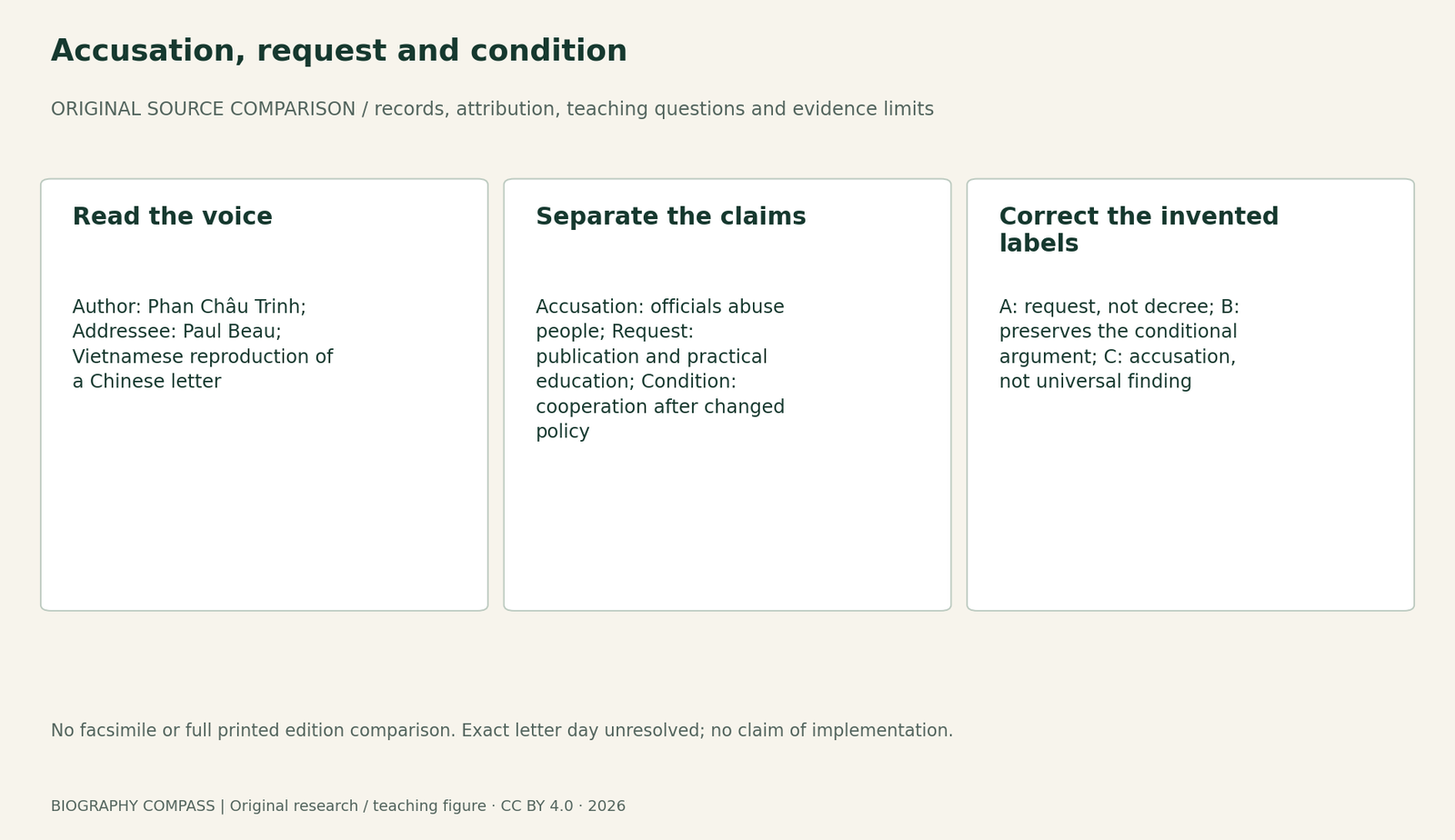
Trinh opens by acknowledging material works such as roads and communications, then attacks the administration’s neglect of abuses. He accuses Vietnamese officials of exploiting people and French authorities of sheltering them. Elsewhere he argues that contempt and poor communication between ruler and ruled create opportunities for intermediaries to conceal wrongdoing. These passages establish his diagnosis and rhetoric; they are not a completed investigation of every official he describes.
The closing programme is more specific than a general wish for modernisation. It asks for capable officials, wider opportunities to speak and publish, changes to law and examinations, schools and teacher training, practical commercial and industrial education, and reform of taxation. Those requests connect public knowledge with administrative accountability and livelihoods. Calling the letter only a complaint about corruption loses the positive programme at its end.
Sources for this section: [1]
Read the conditional argument
Trinh suggests that cooperation could follow if the protectorate changed its policies. The condition matters. A summary saying that he approved everything the colonial government did would remove the accusations and demands that make the appeal intelligible. A summary saying that this letter ordered an immediate armed uprising would also substitute a different programme for the one being read.
His approach differed from Phan Bội Châu’s strategy of revolutionary organisation and the search for support abroad. Their disagreement helps explain why education and public capacity occupy such a central place in this document. It does not make every promise of benevolent reform by a colonial power credible. The letter remains an intervention addressed to an authority with unequal power over its author.
Exercise: edit three invented catalogue labels
Imagine an archive has three proposed labels. A reads: “The governor-general’s decree creates a free press.” B reads: “Trinh asks for wider publication and administrative reform, and argues that cooperation depends on changed policy.” C reads: “A neutral inquiry proves that all Vietnamese officials are corrupt.” Which label is supported by the document, and how should the others be corrected?
Worked answer: B preserves the author, the document type, a concrete request and the conditional argument. A should become “A political letter requests wider opportunities for publication”; a request does not prove that a decree was issued. C should become “Trinh accuses officials of abuse and criticises the administration’s protection of them.” His sweeping allegations are evidence of his political diagnosis, not a finding about every individual. The exercise’s labels are invented; none is a historical archive caption.
Sources for this section: [1]
What a further investigation would need
To establish implementation, a researcher would need a response, a decree, administrative files or evidence of actual practice after the appeal. To resolve transmission, one would compare the Chinese text with identified French and Vietnamese editions. The institute records reprinting in Nam Phong in 1926 and Vietnamese publication, but this guide has not inspected those complete printed issues.
The useful result is a narrower, testable description: Trinh used a political letter to criticise colonial administration and seek changes to the conditions of public life. Its argument can be analysed without turning advocacy into an enacted statute or reducing a conditional appeal to unconditional endorsement.
Continue the chronology
Related history guides
How Did the 1946 Amendment Rule Work?
Read Articles 32 and 70 of Vietnam’s 1946 Constitution, distinguish the two-thirds request from later steps, and solve a worked fictional-seat exercise.
Read the timeline1980–1992Collective Council or Separate President?
Compare Vietnam’s original 1980 and 1992 constitutional offices, distinguish adoption from later elections, and correct three fictional archive captions.
Read the timelineBiography context
Explore Vietnam through connected lives
Connected biographies
People in this documentary history
1872–1926
Phan Châu Trinh
Reform advocate, public intellectual and speakerPhan Châu Trinh argued that education, public rights and changes to administration were foundations for Vietnam’s political renewal under colonial rule.Read biography1867–1940
Phan Bội Châu
Anticolonial organiser and political writerPhan Bội Châu built overseas networks, sent Vietnamese students to Japan and revised his political programme from monarchist mobilisation to republican independence.Read biography1876–1947
Huỳnh Thúc Kháng
Reform activist, newspaper editor and government ministerHuỳnh Thúc Kháng moved from classical scholarship and Duy Tân activism through imprisonment to journalism, representative politics and government service.Read biographyQuick answers
Common questions
- Is the text used here the original Chinese letter?
- No. It is a Vietnamese online reproduction, read with an institutional account of its transmission.
- Why not use an exact day for the letter?
- The retained sources differ in dating and distinguish composition from later publication incompletely. The guide preserves that uncertainty.
Primary and institutional sources
How this history was checked
Read the historical texts alongside the contextual sources below; each supplies a different part of the comparison. This article was reviewed on 29 October 2026.
- Wikisource; historical letter by Phan Châu TrinhĐầu Pháp Chính phủ thư: Vietnamese reproduction
- Phan Châu Trinh InstituteGiới thiệu về tác phẩm Đầu Pháp chính phủ thư
- Phan Châu Trinh Institute; edited by Chu HảoPhan Châu Trinh trước khi sang Pháp
- National Taiwan University Law Review 7(2), 423–463Bùi Ngọc Sơn, The Introduction of Modern Constitutionalism in East Asian Confucian Context (2012)