
The short answer
How did cyclic ether geometry help explain selective complex formation without making cavity size the sole determinant?
Read the evidence
Different records within the same investigation
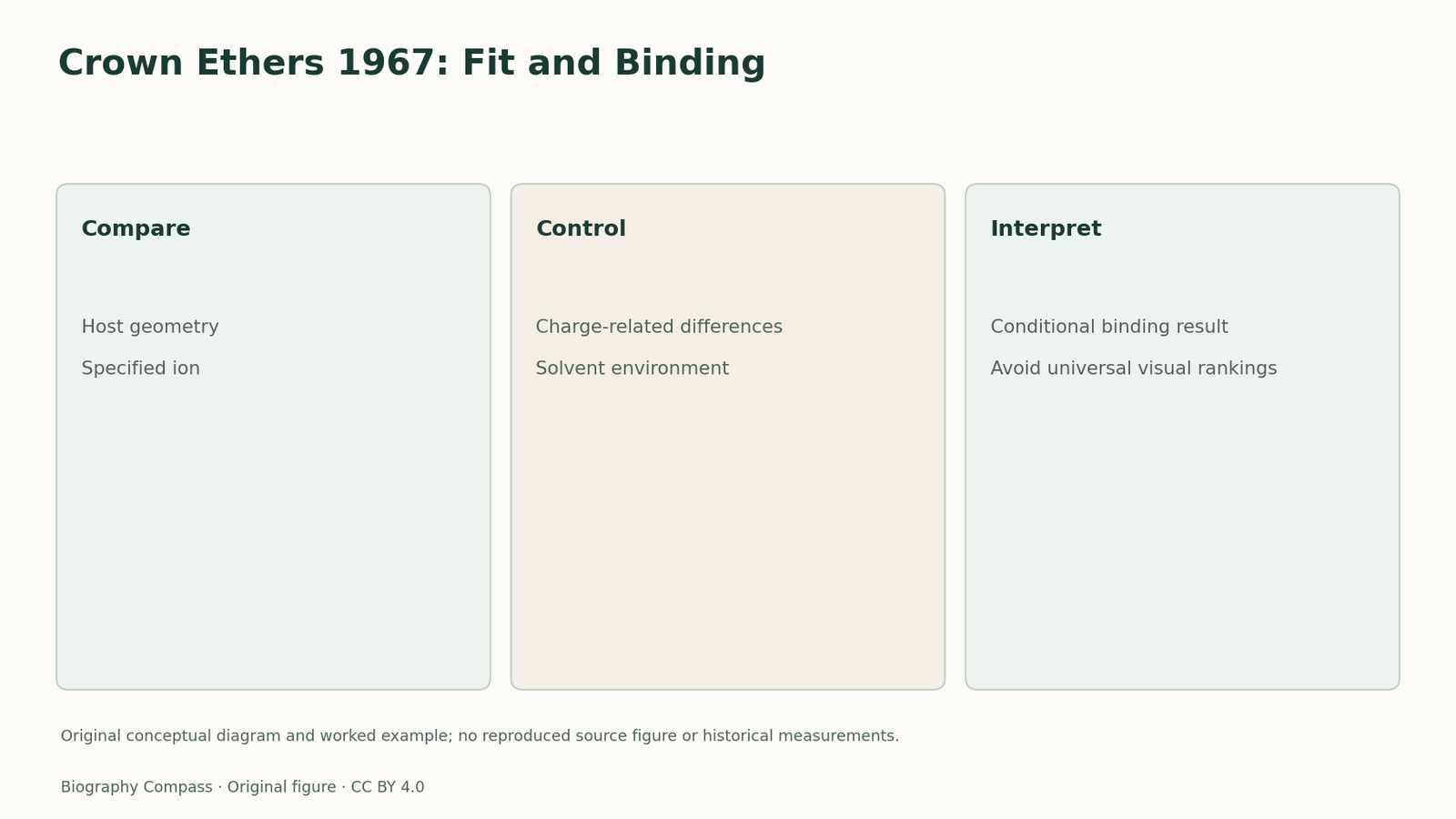
The following comparison distinguishes the specific questions answered by the inspected records.
| Record or test | What it establishes | What remains different |
|---|---|---|
| Cavity fit | Supplies a structural reason for differences. | Is not the only contribution to stability. |
| Ion properties | Include charge-density differences. | Should be specified for the comparison. |
| Solvent | Changes the chemical environment of binding. | A ranking in one medium need not be universal. |
The question concerns selective binding, not just ring shape
Pedersen’s 1967 cyclic-polyether paper described a family of compounds capable of forming complexes with metal salts. The concrete issue is why one host–ion combination behaves differently from another. A molecular drawing can show a cavity and potential donor atoms, suggesting possible interactions. It cannot alone state how strongly a complex will form in every environment. The original programme matters because a family of related compounds makes comparisons possible, rather than leaving the claim at the level of one appealing structural picture.
Sources for this section: [1]
Fit supplied an important structural explanation
Pedersen and Frensdorff’s 1972 review identifies the fit between a cation and a polyether ring as an important determinant of complex stability. The arrangement of oxygen-containing groups around a ring can support interactions with the cation. This makes cavity geometry chemically meaningful. Nevertheless, the same review explicitly adds other variables. A useful explanation should preserve those qualifications within the mechanism itself, rather than announcing a perfect lock-and-key rule and adding vague uncertainty only at the end.
Sources for this section: [2]
Charge and solvent can change the comparison
The review also names cation charge density and the solvating power of the medium. Binding in solution competes with interactions already stabilising the participants. Changing solvent therefore need not leave a comparison unchanged, even when the host’s drawing is identical. Pedersen’s wider industrial background involved ligands, metals and organic materials, making such environmental dependence part of a practical chemical problem. This guide uses those factors to clarify inference; it does not supply a synthesis procedure or numerical constants absent from the inspected records.
The historical claim is wider than a single isolated compound
The 1967 report’s range of cyclic polyethers established scope for investigating structural differences. The Nobel record subsequently recognised selective structure-specific interactions, not merely the visual identification of a ring. These are related levels of evidence: molecular structure proposes potential contacts, experiments establish complex formation under stated conditions, and comparisons test selectivity. None requires the stronger assertion that the same host must always prefer the same ion regardless of medium. Keeping the conditions visible makes the historical achievement more useful for understanding molecular design.
An original comparison exercise and answer
Imagine two fictional hosts, H and J, tested with ions X and Y. In solvent S, H binds X more strongly than Y. A student predicts the same ranking for H in solvent T and concludes that J must behave identically because its cavity looks similar. Which claims need more evidence? Both extensions do. The observation supplies a conditional ranking for H in S; it does not remove solvent effects or establish the full geometry and interactions of J. These letters are invented and no historical binding constants are reproduced. A better comparison measures the relevant combinations under matched conditions, then changes one factor at a time. The answer preserves the value of structural reasoning while refusing to make an unmeasured environmental comparison look like an observation.
Continue the chronology
Related history guides
Biography context
Explore United States through connected lives
Connected biographies
Researchers and related approaches
1904–1989
Charles J. Pedersen
Industrial organic chemistCharles Pedersen discovered crown ethers during a long DuPont career, connecting ring-shaped molecular structures with selective metal-ion complexation.Read biography1901–1994
Linus Pauling
Chemist, structural theorist and peace campaignerLinus Pauling connected quantum chemistry with molecular structure, helped propose the alpha helix and became a prominent campaigner against nuclear testing.Read biographyQuick answers
Common questions
- Does a matching cavity guarantee universal selectivity?
- No. Ion properties and solvent also matter.
- What did the 1972 review add to a simple fit explanation?
- It explicitly discussed charge density and the solvating medium alongside fit.
Primary and institutional sources
How this history was checked
The references below distinguish the original study from later explanations. The worked exercise and comparison are newly written for this article. This article was reviewed on 8 November 2026.
- Charles J. Pedersen, Journal of the American Chemical Society, 1967Cyclic polyethers and their complexes with metal salts
- C. J. Pedersen and H. K. Frensdorff, Angewandte Chemie International Edition, 1972Macrocyclic Polyethers and Their Complexes
- Nobel Prize OutreachCharles J. Pedersen — Facts
- Nobel Prize OutreachCharles J. Pedersen — Biographical