
The short answer
Simultaneous observing requires more than three numbers on a chart. Each channel has a route from arriving radiation to a recorded mark, so a timing comparison needs a stated model of that route.
Selected evidence and original reasoning
Recorded and corrected lags
A common clock and known fixed delays are stipulated.
| Channel | Recorded/receiver delay | Inferred arrival |
|---|---|---|
| A | 10/1 s | 9 s |
| B | 15/4 s | 11 s |
| C | 19/8 s | 11 s |
Chronology
A timeline of the turning points
Separate receiver records
Solar bursts compared across frequencies.
Timing fixture
Subtract fixed receiver delays before comparing arrivals.
What was compared
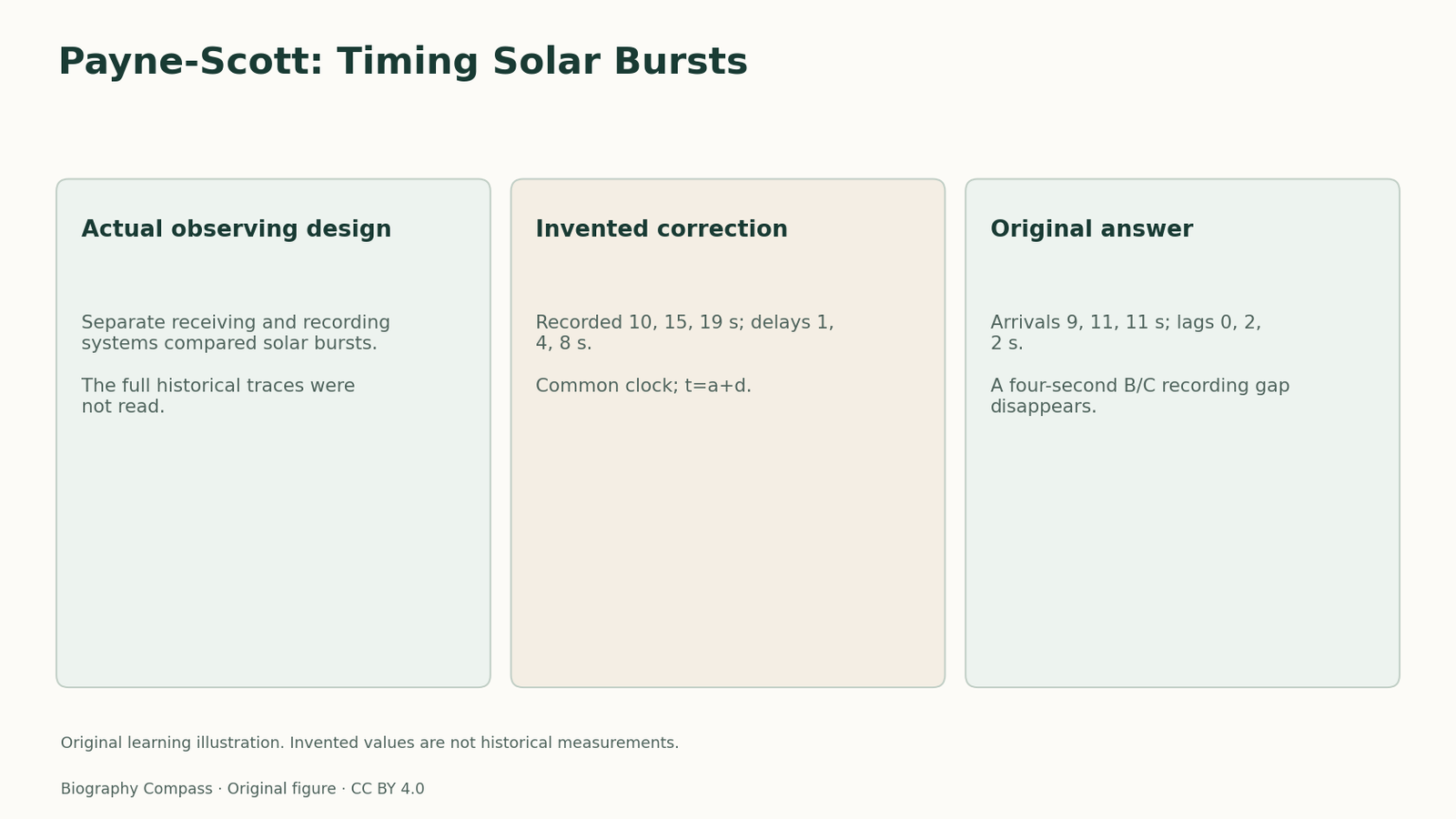
The public abstract describes observations mainly from July and August 1946 at 200, 75 and 60 Mc/s, with a few at 30 Mc/s. Each frequency had a separate receiving system and recording meter. Loudspeakers supplied aural confirmation.
The historical unit Mc/s means millions of cycles per second, the same frequency scale now written MHz. The inspected abstract establishes this multi-channel design; it does not supply every trace or a complete calibration record.
Sources for this section: [1]
An original timing equation
For this fixture define recorded time tᵢ=arrival time aᵢ+known receiver delay dᵢ. Assume one common clock, no clock drift, and exact fixed delays. Invent recorded times 10, 15, 19 seconds for channelsA, B, C, and delays 1, 4, 8 seconds respectively. Channel labels and values are ours, not the historical traces.
Find the arrival times and lags relative to A. Compare them with the raw recorded lags. Which apparent difference disappears after correction?
Sources for this section: [1]
Reference answer
Subtract the delays: a=(9, 11, 11) seconds. Relative to A, the corrected lags are (0, 2, 2) seconds. Raw recorded lags were (0, 5, 9) seconds. B and C were four seconds apart on the recordings but have equal inferred arrival times in this model.
The correction does not make all three arrivals simultaneous: A still precedes the other two by 2 seconds. Nor does equal corrected timing mean equal intensity, shape or source position. Those quantities were not supplied.
Sources for this section: [1]
What an unexplained residual needs
A remaining lag could be investigated only after the assumed clock and receiver behaviour were tested. If delays varied or clocks were offset, the simple subtraction would be inadequate. No propagation speed or coronal height follows from these invented times alone. The task isolates a timing comparison rather than reproducing the historical observation or its full astrophysical interpretation.
Sources for this section: [1]
Continue the chronology
Related history guides
Biography context
Explore Australia through connected lives
Connected biographies
Researcher and context
Quick answers
Common questions
- Are the three times from the original paper?
- No. The fixture is original; only the selected public abstract was inspected.
- Does a corrected lag give a source speed?
- Not without a propagation model, geometry and further observations.
Primary and institutional sources
How this history was checked
Selected records ground the historical explanation. Original models have their own stated assumptions. This article was reviewed on 31 October 2026.