
The short answer
A platform can make voices visible without turning its posts into a representative population survey. Nyabola’s interview and the Kiswahili digital-rights lexicon offer different kinds of evidence for thinking about public discussion, inclusion and the units counted in a digital claim.
Original source comparison
What can each record establish?
Keep the source’s purpose, unit and limit attached to its information.
| Record | Evidence supplied | Limit or next question |
|---|---|---|
| Written interview | A dated account of political agency and information environments. | Not a representative platform dataset or complete verification of every example. |
| Lexicon and project account | Concepts, contributors and a described translation process. | Not an independent measurement of adoption or public understanding. |
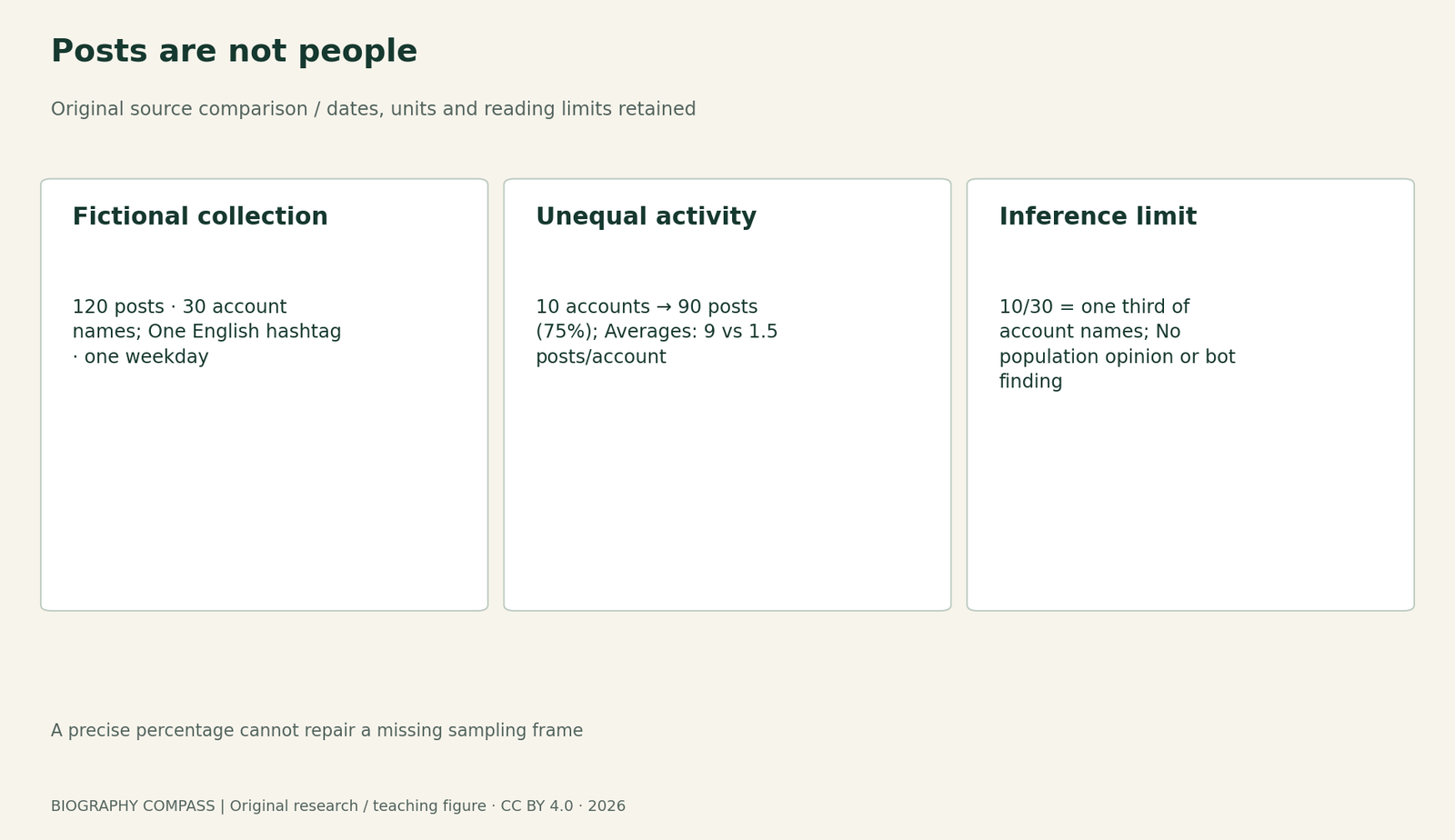
| Fictional post collection | A measurable distribution of posts among account names. | Not a verified distribution of opinions among residents or a bot detector. |
Chronology
A timeline of the turning points
Interview
Nyabola discussed digital politics with Tony Roberts at IDS.
Collective resource
The lexicon credits Nyabola as coordinator and names its contributors.
Fictional observations
Post/account arithmetic is separated from claims about a town’s residents.
The interview asks how technology meets existing power
In her IDS conversation, Nyabola places online activity within older political and media institutions. She discusses information silos as well as opportunities for people to organize and tell their own stories. These are parts of a dated analysis, not a rule that every platform inevitably liberates or harms every user. A useful reading asks which claim is being made, about which people and period, and what evidence would evaluate it. The transcript is not a newly collected dataset of Kenyan internet use. Its historical political examples would require additional sources before being used to settle current empirical or legal questions.
Sources for this section: [1]
A lexicon supplies concepts rather than an adoption measure
The 2021 lexicon names Nyabola as coordinator and ten people as contributors, with separate assistance and design credits. Selected entries define concepts including algorithmic bias, bots and civic space in a bilingual format. The project account explains expert workshops and efforts to circulate vocabulary. Those records establish a resource and its stated purpose. They do not measure how many people understood, used or trusted it. A translation project can be valuable without its existence being offered as proof that every language barrier has disappeared. Evaluating adoption would require observations beyond a cover, glossary entry or project description.
Choose the unit before drawing a conclusion
A post, an account and a person are different units. Several posts may come from one account; several accounts may belong to one person or an organization. A bot is an automated program, as the lexicon explains, but a high posting rate alone does not prove automation. Likewise, an English-language hashtag collection has a language and access boundary even if its contents are publicly visible. These distinctions turn a general concern about digital inclusion into a research habit: define the target public, describe how observations entered the collection, and separate recorded units from the people or experiences one hopes to understand.
Original exercise: audit a claim about a fictional town
A fictional researcher collects 120 public posts under one English-language hashtag during one weekday. The posts come from thirty distinct account names. Ten accounts produced ninety of the posts; the remaining twenty produced thirty. A draft says, “Seventy-five percent of the town’s people expressed this position, and the ten busiest accounts are bots.” Calculate the shares of posts and accounts attributable to the ten-account group and each group’s average posts per account. Identify which parts of the draft follow from the observations. Then list the information needed before studying the views of adult residents. These are invented numbers, not a Kenyan survey or platform audit.
Compare the purposes of the two sources
The interview offers a participant’s analysis of agency and power. The lexicon offers terminology created through a credited collective process. Neither is a substitute for the fictional dataset’s missing recruitment and measurement details. The comparison is useful because it allows both claims to remain specific: creating vocabulary can widen the tools for participation, while measuring representation requires a study designed for that question. A future evaluation might examine how different language groups use the resource, with consent and a stated sample. That would add new evidence; it should not be claimed as something the published glossary has already demonstrated.
Continue the chronology
Related history guides
Biography context
Explore Kenya through connected lives
Connected biographies
People in this guide
Contemporary
Nanjala Nyabola
Writer, researcher and political analystNanjala Nyabola is a Kenyan writer and political analyst whose work examines technology, migration, identity and structural inequality. Her books include Digital Democracy, Analogue Politics, Travelling While Black and Strange and Difficult Times.Read biographyQuick answers
Common questions
- Are the 120 posts actual observations from Kenya?
- No. All dataset values are fictional teaching inputs.
- Does repeated posting prove that an account is automated?
- No. Rate alone cannot establish that; account behaviour and other evidence would need careful assessment.
Primary and institutional sources
How this history was checked
Sources are listed with exact reading scopes. No complete novel, translation collection, album, film, music video or stage performance was inspected. This article was reviewed on 27 October 2026.
- Institute of Development Studies; Tony Roberts and Nanjala NyabolaDigital Democracy, Analogue Politics: conversation transcript, 2019
- Kiswahili Digital Rights Project; coordinated by Nanjala NyabolaMsamiati wa Teknolojia Dijitali: A Lexicon of Key Words in Kiswahili, 2021
- Nanjala WritesDigital Rights Projects