
The short answer
The National Science Foundation established NSFNET so researchers could reach powerful computing centres from a distance. As regional networks connected, its backbone carried traffic between many institutions as well as to the centres. The federal backbone was retired in 1995 after commercial providers built wider infrastructure.
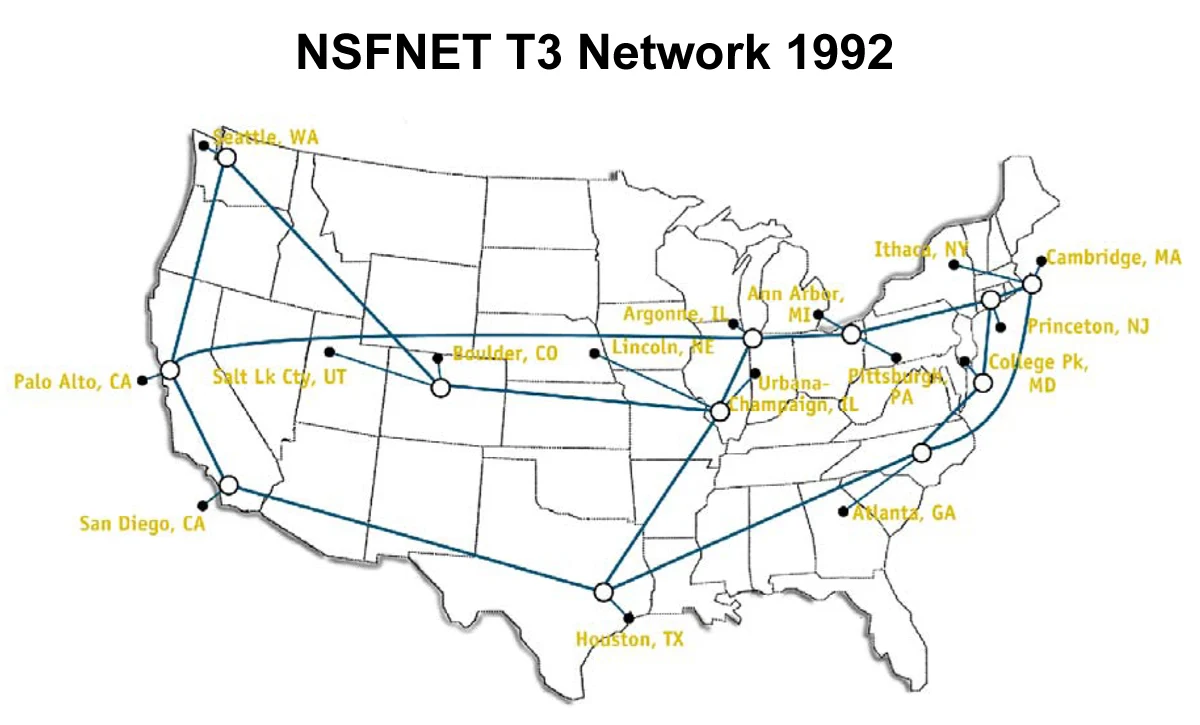
Reading the network map
How the backbone fitted into the research network
A backbone link connects important points. The map shows only that layer of access.
| Layer | Function | What the backbone map can show |
|---|---|---|
| Institution | Connects users and computing facilities | A university’s own distribution requires a local map. |
| Regional network | Aggregates institutions and reaches a backbone connection | A backbone node can stand in for links to many campuses. |
| National backbone | Carries traffic among major network connection points | The T3 map traces this layer. |
| Commercial providers | Operate networks that took on a growing share of traffic | An NSFNET map describes the network before its dedicated backbone was retired. |
Chronology
A timeline of the turning points
NSF backs national supercomputing centres
Access from distant universities becomes an infrastructure problem.
NSFNET begins operation
The backbone links centres and supports access from researchers elsewhere.
The Merit map records the T3 network
A later map shows a higher-capacity backbone connecting many points.
NSF retires its dedicated backbone
Commercial networks take on backbone traffic as part of the wider Internet.
Why remote access was part of the supercomputing investment
A university could host a lab whose work needed much more processing power than its own computers could provide. NSF’s effort included centres with the machines and a network through which other researchers could reach them. The network made access to a centre a possibility for researchers based elsewhere.
As regional networks joined, the same national paths served wider academic traffic. This is why descriptions of NSFNET sometimes emphasise the original supercomputer programme and sometimes call it a general research backbone.
What the Merit map shows and leaves to other records
The fall 1992 map is a snapshot of the T3 backbone. Merit’s account puts the T3 upgrade at about 45 Mbit/s per backbone link. The map traces paths between backbone nodes. To tell whether a specific department had access or at what speed, look for the regional or campus network through which it reached the backbone.
NSF and the Internet Society describe cooperation with regional providers as part of this expansion. The map gives the geographical picture. The project history supplies the institutional relationship between campuses, regional networks and the national service.
What ended in 1995
Merit’s account dates the end of the backbone transition to April 1995 and describes new network access points where providers could connect their networks. That arrangement matters to the history of the change. Providers needed ways to exchange traffic if users served by one network were to reach services on another.
NSF continued funding networking research. The retirement date therefore marks a change in who carried backbone traffic and how networks interconnected. It falls after browsers had started making more use of an infrastructure built for earlier purposes.
Continue the chronology
Related history guides
Connected biographies
People connected to this history
Quick answers
Common questions
- What was NSFNET built for?
- It provided network access to NSF supercomputing centres and grew into a backbone for a wider research community.
- What shut down in 1995?
- NSF retired its dedicated backbone. Commercial and other connected networks continued carrying Internet traffic.
Primary and institutional sources
How this history was checked
Dates, legal milestones and historical claims are checked against the official and institutional records below. This article was reviewed on 19 November 2026.