
The short answer
What did automatic filling replenishment automate?
A worked comparison
What each part contributes
Use the specific distinctions developed in the study.
| Part or record | What it establishes | Why the distinction matters |
|---|---|---|
| Filling replenishment | Fresh bobbin replaces spent supply | Normal consumable exhaustion |
| Warp stop motion | Stops for a failed or slack thread | Fault response |
| Commercial introduction | Mid-1890s supply and promotion | Not identical to a patent date |
What did automatic filling replenishment automate?
The Northrop loom addressed a recurring interruption in weaving: the shuttle’s supply of filling yarn became exhausted and needed replacement. A federal manufacturing account identifies Northrop patents of 1891 and 1894 and describes supplying another bobbin without stopping the loom’s operation. The mechanism did not replace every action in textile production. Its significance lies in automating a particular transfer at the right point in an existing sequence. Studying that operation gives a more precise explanation than calling the machine simply automatic and leaving the reader to imagine what no longer needed attention.
Sources for this section: [3]
Replacing the bobbin differed from replacing the shuttle
The 1901 Commercial and Financial Chronicle compared Northrop’s arrangement with another system that exchanged the shuttle itself. Its account states that the Northrop loom retained the shuttle and put fresh filling into it. This is a functional distinction between two routes to a similar purpose: restoring the yarn supply. The comparison explains why the design of the receptacle, transfer action and timing mattered. It also shows that an industrial problem can produce competing mechanisms, so the existence of one successful design should not erase the alternatives under discussion.
Sources for this section: [5]
A stop motion solved a separate failure condition
Northrop’s 1899 warp stop-motion patent describes detectors whose abnormal position could cause the loom to stop when a thread failed or became improperly slack. That is different from replenishing a normally exhausted filling supply. The two functions can belong to the same overall machine while responding to different conditions. One action allows work to continue by replacing a consumable; another interrupts work to prevent a thread fault from continuing unchecked. Distinguishing them makes the engineering contribution of each mechanism intelligible and avoids attributing all the loom’s functions to a single patent.
Sources for this section: [6]
Dates describe development, commercial supply and display
The patent sequence, the marketing of looms in the mid-1890s and the demonstration film catalogued in 1899 are different records of development and circulation. The film catalogue gives 1895 for introduction, while other inspected histories identify commercial activity in 1894. This topic therefore uses 1891–1895 as a development period rather than forcing all those events onto one founding date. A patent establishes a disclosed mechanism and legal claim; a commercial history concerns supply to mills; a filmed demonstration concerns presentation. Each makes a useful contribution when its actual function is retained.
Mechanism-matching exercise and checked answer
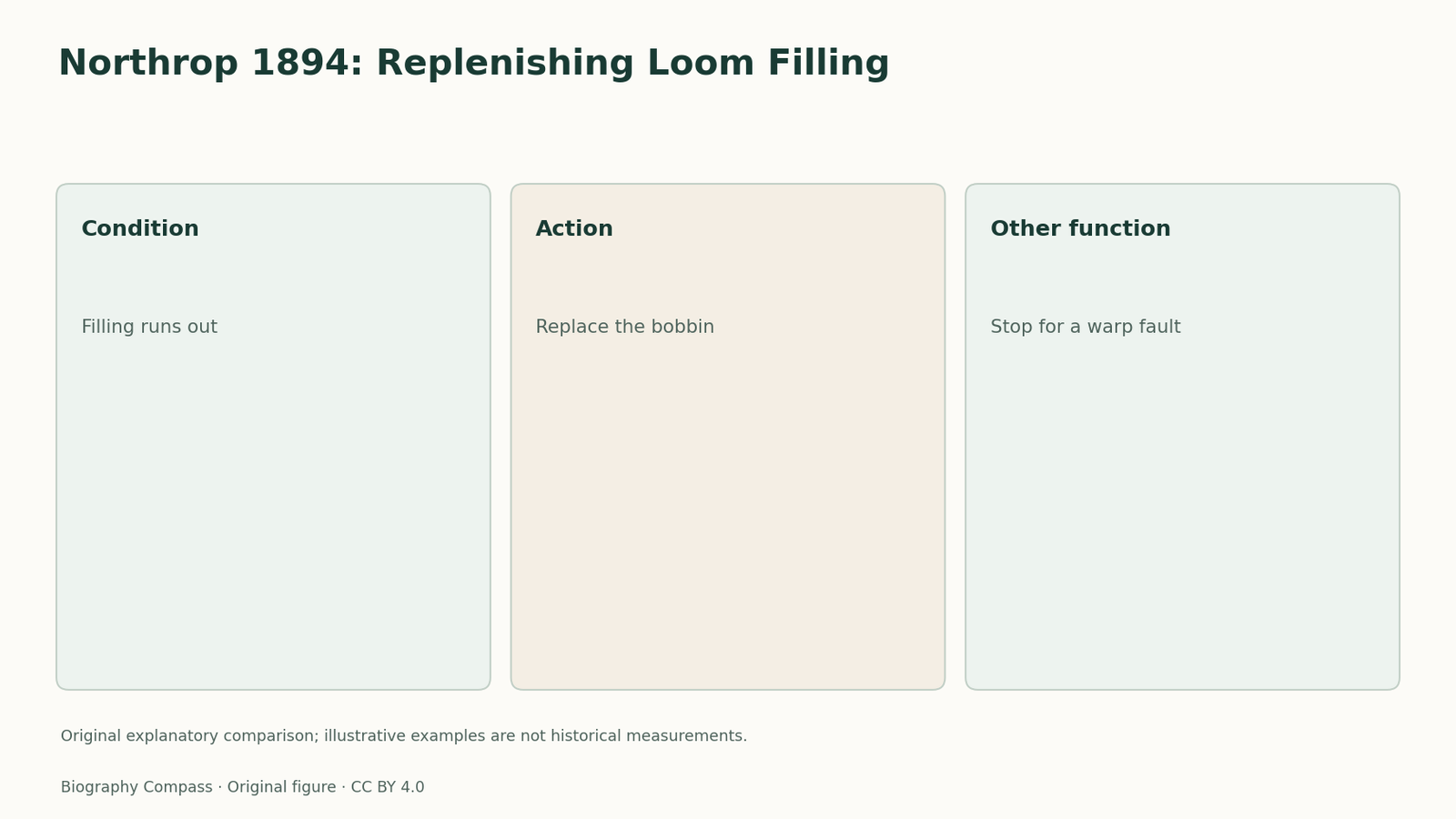
A fictional loom presents two conditions: its filling bobbin is nearly empty, and, on another occasion, a warp thread has broken. Which response belongs to each? The checked answer assigns replenishment to the exhausted filling supply and stoppage for attention to the broken warp. Reversing the responses would confuse a normal consumable change with a fault condition. The exercise explains why several coordinated mechanisms could improve continuity without making the machine entirely unattended. It also gives a practical reading method for patent descriptions: identify the triggering condition, the mechanical action and the intended effect before making a broad claim about automation.
Continue the chronology
Related history guides
Biography context
Explore United States through connected lives
Connected biographies
People and wider context
1856–1940
James Henry Northrop
textile-machinery inventorJames Henry Northrop was a textile-machinery inventor, known for the filling-replenishment mechanism associated with the Northrop loom.Read biographyQuick answers
Common questions
- Did the replenishing mechanism make every loom task automatic?
- No. It automated a specific filling-supply operation; thread faults and other work required different mechanisms or attention.
Primary and institutional sources
How this history was checked
The source notes distinguish original records, institutional descriptions and later historical interpretation. Exercises and comparisons are original editorial analysis. This article was reviewed on 8 November 2026.
- University research repository, COREInnovation, diffusion and technology: Northrop passage
- History of Hopedale, Mendon and MilfordThe Northrop Loom: historical accounts and December 1940 notice
- United States census manufacturing report, historical volumeManufactures: weaving inventions
- American Film Institute CatalogDemonstrating the Action of the Northrop Looms (1899)
- Commercial and Financial Chronicle, FRASERAutomatic looms, 20 July 1901
- United States patent recordWarp stop-motion for looms, US621310A