
The short answer
On 18 November 1883, North American railroads began using a system of Standard Railway Time. The shared schedule reduced the need to translate between local clock readings at stops and interchange points. The change began as an industry agreement, decades before the United States put standard time into federal law.
What different records establish
A timetable, an agreement and a law
Railway operation, local practice and statutory time need their own evidence.
| Record | What it shows | What remains a separate question |
|---|---|---|
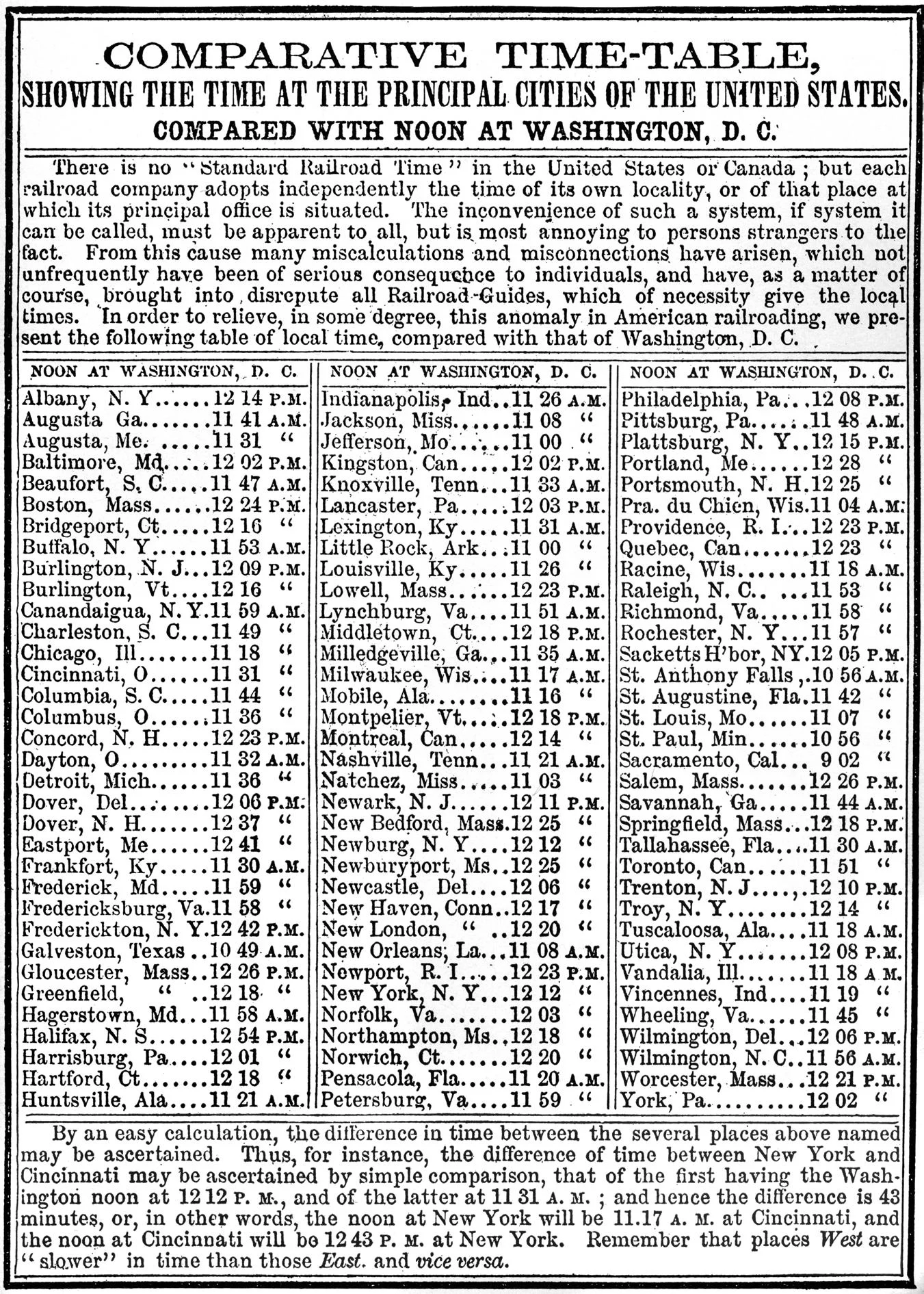
| Earlier railroad guide | Why travellers needed lists of local times | When a particular station changed its clock. |
| Standard Railway Time adoption | When the rail industry changed its operating reference | When a town or government made it official for other uses. |
| 1918 Standard Time Act | How the United States established a federal framework | How railroads had already managed time before the law. |
Chronology
A timeline of the turning points
Local times shape timetables
Rail companies and passengers compare multiple local clock readings.
Railroads reset their clocks
Rail operations switch to standard time zones.
United States Congress legislates
The Standard Time Act provides a federal framework and also addresses daylight saving.
Why local time was hard to use on a railway
A clock set by local solar time suited a town’s daily routine. As trains began passing through many towns in a day, a change in longitude implied a different clock reading. Guides such as Dinsmore’s listed differences so passengers could interpret schedules.
For a dispatcher or a passenger changing trains, many clock references made it easier to misread when a service was due. A shared reference for a region let schedules be compared before a traveller reached the next town.
What happened on the day of two noons
The Library of Congress dates the railroads’ switch to 18 November 1883. Station clocks were reset as standard noon reached their zones. The phrase day of two noons recalls how a community might mark local noon and then experience another noon on the new clock.
The standard changed the reference used on the railway. It did not make every passenger cross a zone at once, and municipal adoption was a distinct decision.
What the 1918 law added
The Standard Time Act dates to March 1918. It established standard time in a federal statute and included daylight-saving provisions. That is a separate milestone from the agreement used by the railroads in 1883.
The different dates also help when reading an older timetable or a legal document. A company timetable can use a shared time before the country adopts a statutory framework for it.
Continue the chronology
Related history guides
How Ottawa Turned Star Transits into Official Time
Compare the observational work needed to maintain a time reference.
Read the timeline1868How New Zealand’s Telegraph Helped Set a Common Time
Compare another transport and communications network that exposed differences among local clocks.
Read the timelineConnected biographies
People connected to this history
Quick answers
Common questions
- When did the railroads adopt Standard Railway Time?
- The Library of Congress dates the coordinated switch to 18 November 1883.
- Did the 1918 act introduce standard time to the railroads?
- The railroads had adopted it in 1883. The 1918 act established a federal basis for standard time in the United States.
Primary and institutional sources
How this history was checked
Dates, legal milestones and historical claims are checked against the official and institutional records below. This article was reviewed on 19 November 2026.