
The short answer
How does lacquer turn a folding screen into a continuous image?
Compare the records
What the sources allow us to say
Read the object record alongside the contextual account.
| Record | Evidence | Reading limit |
|---|---|---|
| Vietnam museum record | Standing Screen dates to 1939 and has two decorated sides. | One frontal image cannot show the entire object. |
| National Gallery interpretation | Explains lacquer and the screen’s broader setting. | Material context does not replace each side’s imagery. |
An image carried by a two-sided object
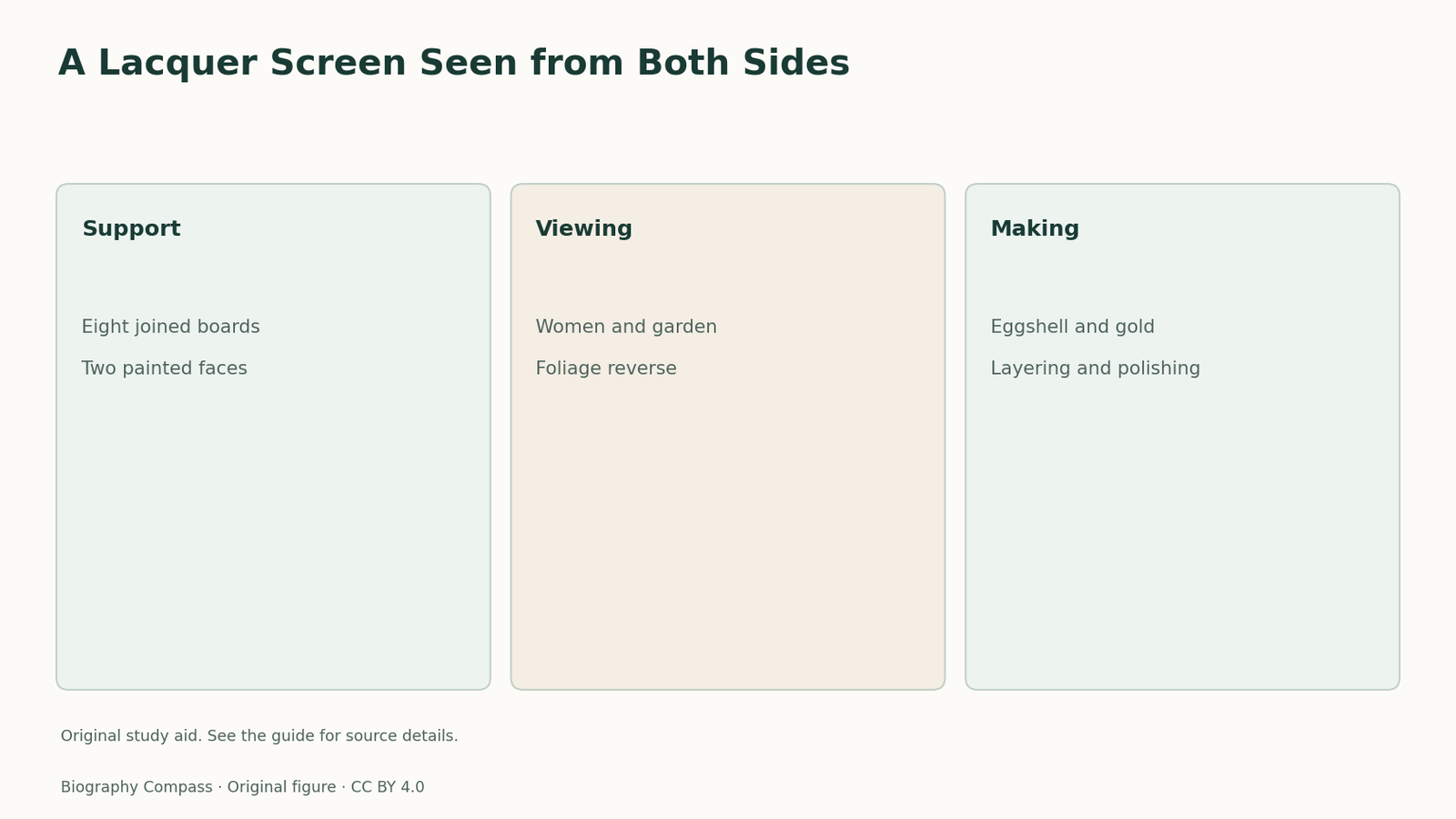
The Vietnam National Fine Arts Museum identifies Standing Screen as a 1939 lacquer work on eight joined boards. One side presents women within a garden, while the other develops a landscape of foliage. Both faces belong to the same object. This matters for viewing because the screen cannot be understood completely from one fixed position. A description of its support should precede any claim about a single continuous scene, since the two faces organise different images for a moving spectator.
Material operations create pictorial differences
The museum lists procedures including gilding, polishing and eggshell inlay. The National Gallery’s discussion of Trí’s wider practice explains how opaque and translucent lacquer, gold and eggshell could describe different kinds of forms. Use that material account to ask how a surface establishes light, texture and the distinction between a figure and its environment. The techniques offer a range of effects, rather than a fixed code in which one material always stands for the same kind of object.
A floor-plan exercise with a clear answer
Draw a neutral row of eight rectangles and place a viewer on either side. Label the first face with the women-and-garden subject and the second with foliage. Add a separate key for material operations. A strong answer distinguishes the support’s construction from the two compositions and from the techniques used to make them. It also explains why walking around the object changes the available evidence. The exercise captures the screen’s viewing problem without reproducing its images or claiming to reconstruct their exact arrangement from a short description.
Continue the chronology
Related history guides
Biography context
Explore Vietnam through connected lives
Connected biographies
Read the artist’s biography
1908–1993
Nguyễn Gia Trí
Lacquer painterA Vietnamese artist who expanded lacquer into ambitious modern painting and multi-panel images.Read biographyQuick answers
Common questions
- Is Standing Screen painted on both sides?
- The museum identifies two painted faces on the eight-board screen, with different garden and landscape imagery.
Primary and institutional sources
How this history was checked
The listed records support the facts. Observation exercises and arguments are Biography Compass editorial interpretations. This article was reviewed on 7 November 2026.