
The short answer
Steam makes the working stroke possible by changing pressure. In an atmospheric engine, the force that moves the piston comes from the difference between the cylinder and the outside air.
Reading the evidence
Read the working stroke in order
Keep the pressure difference, piston force and beam motion distinct.
| Stage | What changes | What to mark |
|---|---|---|
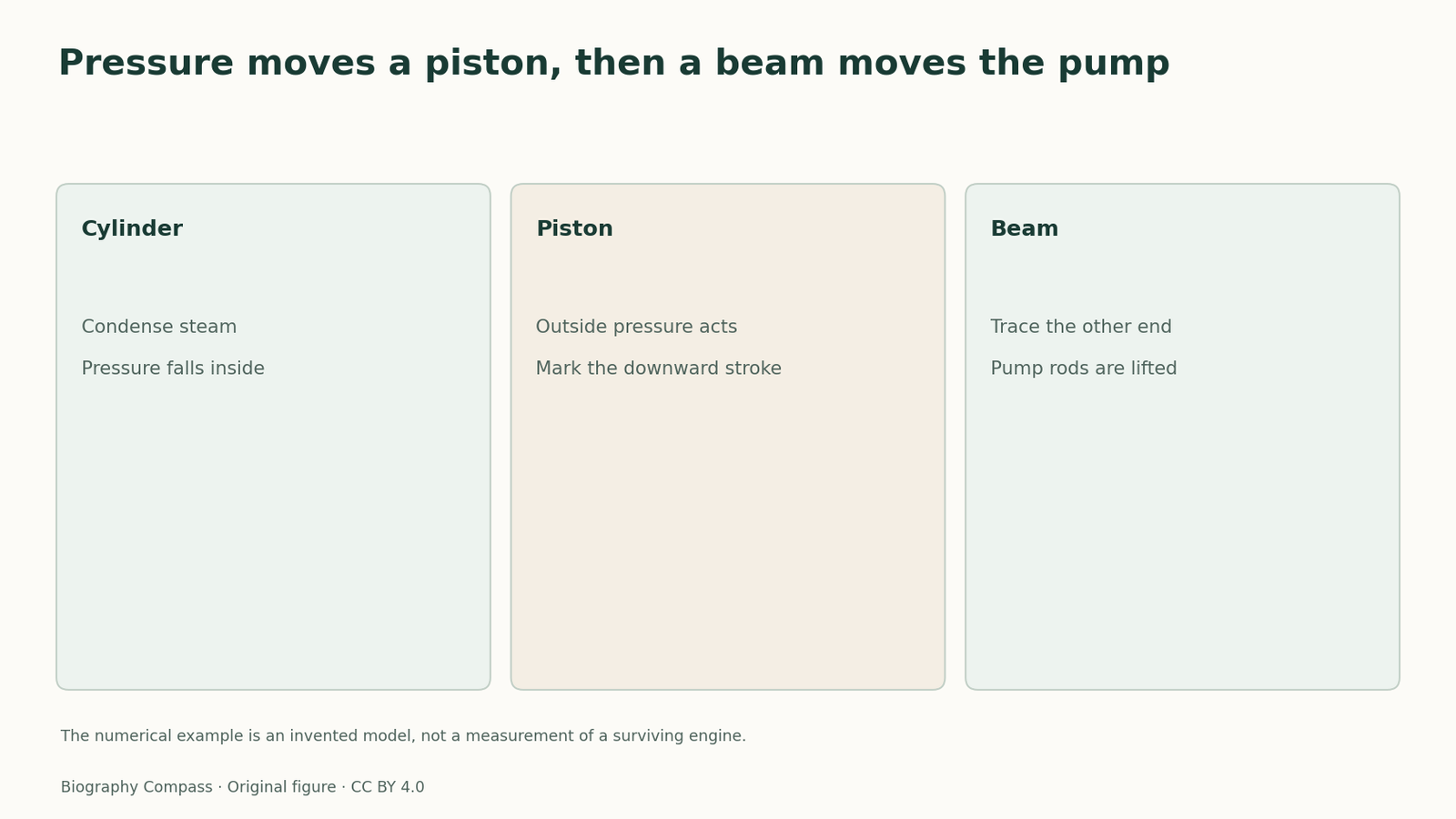
| Condensation | Cylinder pressure drops. | Where steam is cooled. |
| Piston | The pressure difference drives the piston down. | Piston area and direction. |
| Beam | Motion reaches the pump rods. | Pivot and opposite movement. |
Put the drawing and the object on separate dates
The Science Museum’s catalog describes Henry Beighton’s 1717 engraving of the Griff engine erected in 1714. Its dates refer to a print and a pictured installation, respectively. A different record at National Museums Scotland describes the engine ordered for Caprington in 1811. Both help explain the principle. They do not depict a single unchanged object.
Look at the beam as a connection between a cylinder and a pump. Its use makes sense only if you trace both sides of the pivot. Mark the piston’s working direction first and then ask what happens at the pump end.
Follow a pressure change through the beam
Steam enters the cylinder. Condensation reduces the pressure below the piston. With higher pressure outside, the piston moves down during the useful stroke. The beam converts that movement into a lift of the pump rods at its other end. The sequence separates a change in the fluid inside the cylinder from the motion of solid parts.
Try drawing the mechanism with the beam held fixed. The pressure difference could still load the piston, but without movement the pump would receive no useful stroke. The model helps show why a vacuum alone does not drain a mine.
Use an invented force example
If the outside pressure is 10 units and the inside pressure is 3, the difference is 7. For a teaching piston with 2 units of area, this gives 14 force units before other loads. That is a calculation for the piston, not the pump. To estimate the pump force, you would also need the relative arm lengths and the loads in the beam and rods.
Continue the chronology
Related history guides
Biography context
Explore United Kingdom through connected lives
Connected biographies
People in the records
c. 1664–1729
Thomas Newcomen
Ironmonger and atmospheric-engine inventorNewcomen helped develop an engine that used atmospheric pressure to pump water out of mines.Read biographyQuick answers
Common questions
- Why does the beam matter to the pumping stroke?
- It transfers the piston’s downward movement to an upward movement at the pump end.
Primary and institutional sources
How this history was checked
Dates, legal milestones and historical claims are checked against the official and institutional records below. This article was reviewed on 5 November 2026.