
The short answer
The New Colombo Plan made Australian undergraduate study and work experience in the Indo-Pacific part of a foreign-policy initiative. Its December 2013 launch preceded a four-location pilot in 2014 and wider expansion in 2015. The design combined education, professional connections and regional engagement, with responsibilities extending well beyond the foreign minister who championed it.
Chronology
A timeline of the turning points
Launch
The government launches the initiative at Parliament House for the following year’s pilot.
Initial locations
Indonesia, Japan, Singapore and Hong Kong host pilot study experiences.
Two funding streams
Scholarships and university-led mobility grants support different forms of study and practical experience.
ASEAN participation announced
All ten ASEAN members agree to participate from 2015.
Expansion
DFAT records rollout to 38 eligible locations, informed by the pilot.
The name recalled earlier educational links but changed the direction of travel
Bishop’s launch address explicitly contrasted the new initiative with the older Colombo Plan, which had helped students from the region study in Australia. The New Colombo Plan instead supported Australian undergraduates going into the region.
That comparison explained a diplomatic ambition, not an institutional merger or the revival of an unchanged scholarship scheme. The intended relationship was two-way: existing connections with regional students and institutions would be supplemented by Australians acquiring experience overseas. Education was presented as a way to build familiarity and networks over time.
A December launch prepared a pilot for the following year
The Canberra launch took place on 10 December 2013. The pilot year was 2014, with Indonesia, Japan, Singapore and Hong Kong as the initial locations. These dates are often compressed together, but the announcement and the students’ supported experiences were separate stages.
Starting with a limited set of locations allowed departments and partners to test arrangements before expansion. The government described the pilot as an opportunity to refine the model. That intention did not mean every administrative or educational challenge had already been resolved at launch.
Scholarships and mobility grants served different forms of participation
The early program had two components. Scholarships supported longer periods of overseas study, including opportunities for internships or mentorships. Mobility grants enabled universities to develop a wider range of short- and longer-term projects.
Practical experience was important to the design because the government wanted study to connect with professional relationships. University partnerships and host organisations therefore mattered alongside funding. A scholarship award, a short mobility project and an internship were related opportunities, not interchangeable experiences that can be counted or evaluated in exactly the same way.
Expansion demonstrated activity, while longer-term benefits required further assessment
Contemporary reporting recorded ASEAN countries’ agreement to join from 2015. DFAT’s 2014–15 program report then described rollout to 38 eligible locations and recorded pilot-related performance measures. These establish expansion and departmental reporting, rather than proving that every participant achieved the same educational or diplomatic benefit.
The historical pilot also should not be treated as current application guidance. DFAT records reforms announced in 2025 and a later three-program structure. The enduring institutional question is how student experience, professional links and regional understanding are supported and assessed, not simply how many destinations appear on an eligibility list.
Biography context
Explore Australia through connected lives
Julie Bishop
Place the initiative alongside diplomatic work, aid-budget disputes and later institutional roles.
Explore the biographiesGovernment contextTony Abbott
Read the premiership during which the pilot began and the wider regional rollout followed.
Explore the biographiesLater foreign-policy contextPenny Wong
Compare a later foreign minister’s career without projecting later program changes back into the pilot.
Explore the biographiesConnected biographies
The minister who championed education diplomacy
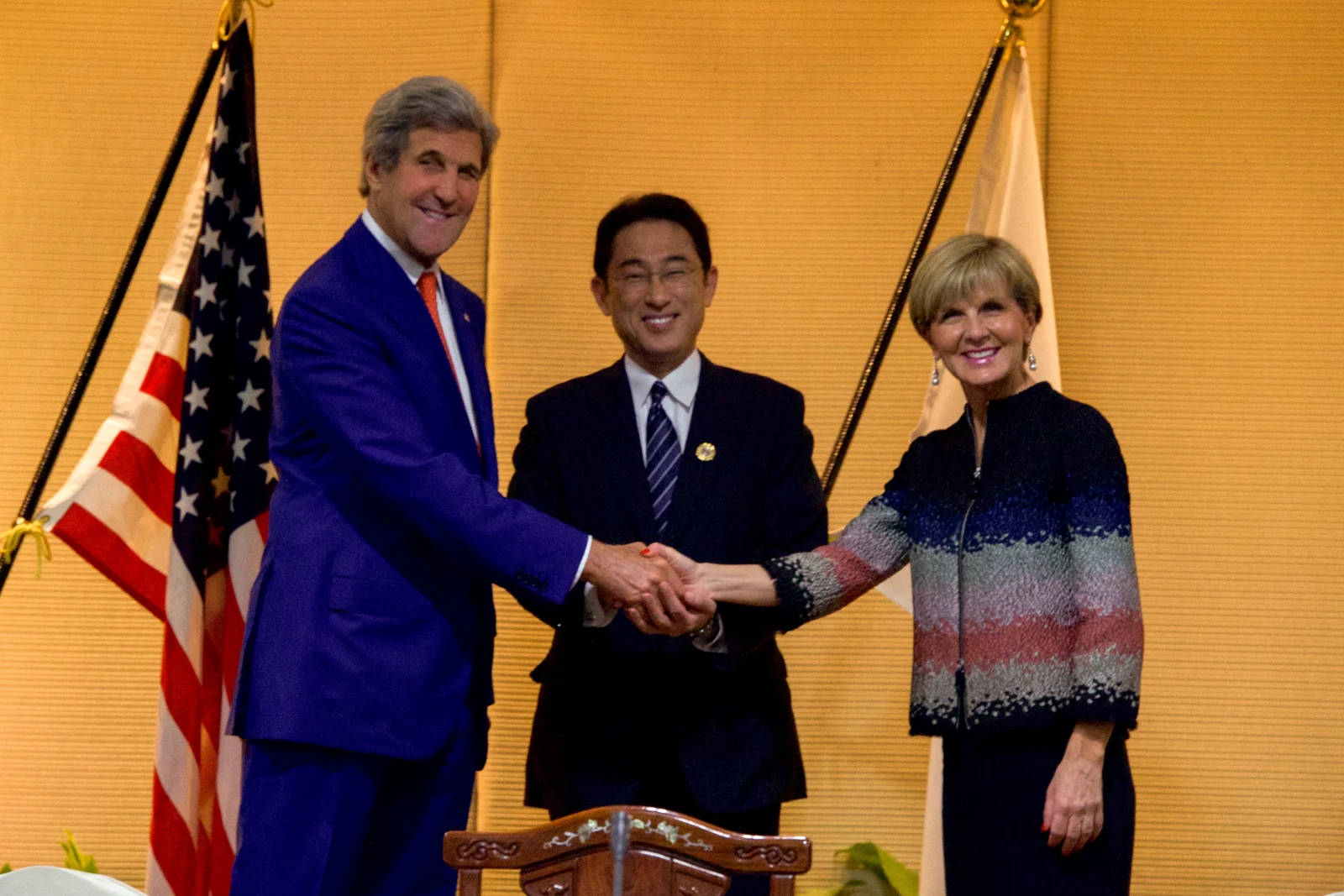
1956–
Julie Bishop
Former foreign minister and UN Special Envoy on MyanmarJulie Bishop moved from commercial law into Parliament, becoming Australia’s first woman foreign minister in 2013. Her career includes the New Colombo Plan, contested aid budgets, an unsuccessful leadership bid and later university and United Nations roles.Read biographyQuick answers
Common questions
- Was the New Colombo Plan launched in 2014?
- The Canberra launch was on 10 December 2013; the pilot operated in 2014.
- Where did the pilot operate?
- Indonesia, Japan, Singapore and Hong Kong.
- Was it only a scholarship scheme?
- No. It also included university-led mobility grants and opportunities connecting study with work experience.
- Are the pilot’s arrangements current eligibility rules?
- No. The program later expanded and changed; this article explains its historical design rather than advising applicants.
Primary and institutional sources
How this history was checked
The launch address supplies stated design, not proven long-term benefits. The selected annual-report program section and contemporary reporting establish activity and expansion. The ANAO item is a proposed audit in a work program, not a completed audit finding. The photograph shows Bishop in July 2016, not the pilot launch. This article was reviewed on 24 October 2026.
- Australian Minister for Foreign Affairs archiveBishop’s New Colombo Plan launch address, 10 December 2013
- Department of Foreign Affairs and TradeAnnual Report 2014–15: New Colombo Plan program section
- ABC NewsASEAN participation and the 2014 pilot, 9 August 2014
- Australian National Audit Office2015 audit work program: Managing the New Colombo Plan proposal
- Department of Foreign Affairs and TradeAbout the New Colombo Plan: purpose and later program reform
- U.S. Department of StateBishop, Kishida and Kerry in Vientiane, 25 July 2016: public-domain item