
The short answer
The commission, public display and acquisition of Shonibare’s model describe related but distinct events. A collection entry preserves the evidence needed to tell them apart.
Reading the evidence
What each record establishes
Keep the subject of each record and the conclusion it can support in separate columns.
| Record | Establishes | Does not establish |
|---|---|---|
| Commission | Programme and initial public context. | The later owner. |
| Object record | Replica scale and printed sails. | A complete account of Trafalgar. |
| Acquisition | Museum ownership event and support. | The date the artist was commissioned. |
Chronology
A timeline of the turning points
Trafalgar Square display
The Fourth Plinth programme displays the commissioned work.
National Maritime Museum acquisition
The museum profile dates its acquisition to 2012.
Read the commission as an invitation
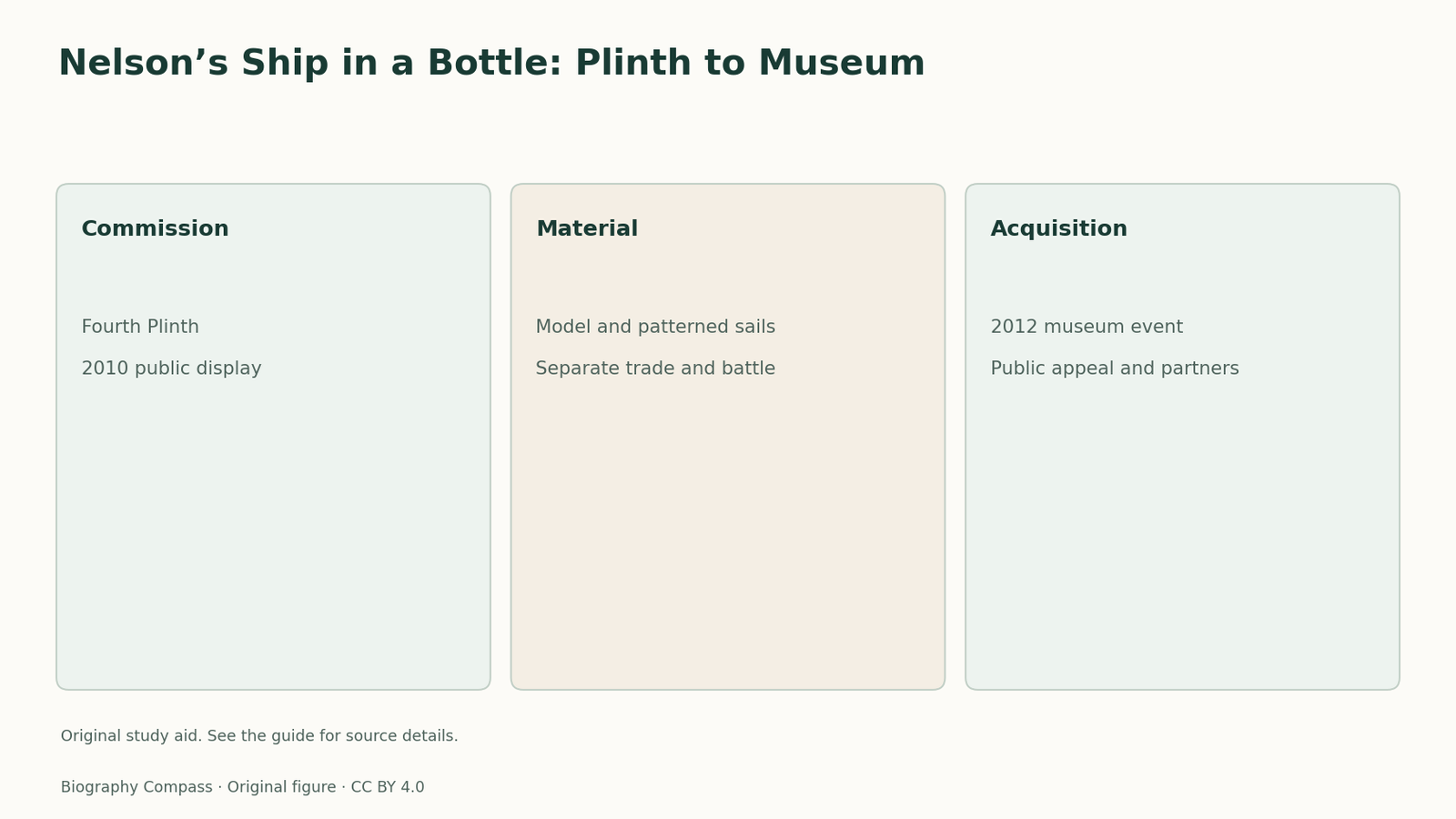
Royal Museums Greenwich dates the initial Trafalgar Square display to 2010 and identifies the Fourth Plinth programme in the commission credit. That places the model in a public programme with a temporary exhibition site. It does not mean the National Maritime Museum commissioned it or acquired it at that moment.
Record the venue and the person or programme commissioning the work on different lines. Doing so prepares a reader to follow the object even after it leaves the place for which it was first shown.
Read the material as a second history
The museum describes a one-to-thirty model of HMS Victory and identifies printed canvas among the materials. It explains the patterned sails through a history of design, manufacture and sale that passed through Indonesia, the Netherlands and West Africa. That route changes how one might interpret the model’s reference to naval history.
The ship depicted, the date of the artwork and the historical travel of a textile pattern are three separate subjects. A caption that supplies only Trafalgar risks making the cloth appear incidental. A caption that supplies only the cloth loses what it means to put the patterns on this particular ship.
Sources for this section: [2]
Read the acquisition as a new event
The profile dates acquisition to 2012. The object credit records an appeal and several contributors. Practice writing a label that uses one sentence for the object, one for the Fourth Plinth and one for the museum’s later acquisition. The label will still make sense if the object is eventually displayed in another location.
Continue the chronology
Related history guides
Biography context
Explore Nigeria through connected lives
Connected biographies
Explore the people behind the records

b. 1962
Yinka Shonibare
Visual artistA British-Nigerian artist raised in Lagos who uses fabric, sculpture and historical staging to reconsider empire.Read biographyQuick answers
Common questions
- Did the museum acquire the sculpture in 2010?
- No. It was first displayed on the Fourth Plinth in 2010 and acquired by the National Maritime Museum in 2012.
Primary and institutional sources
How this history was checked
Selected first-person, exhibition and collection records support the factual claims. The reading exercise and comparison are editorial interpretations. This article was reviewed on 5 November 2026.