
The short answer
Why are July 1997, April 1998 and March 1999 all important dates in the same enlargement, and which one marks membership?
Source comparison
Keep a procedural event attached to its actor
Identify the question a record answers before using it to support a wider claim.
| Record or concept | What it establishes | What needs other evidence |
|---|---|---|
| Invitation | Negotiations may begin. | All accession steps completed. |
| American resolution | A national decision. | Applicants’ formal entry. |
| Deposit | Membership begins in this record. | Every prediction fulfilled. |
Chronology
A timeline of the turning points
Madrid invitation
Negotiations are invited.
American decision
The Senate acts on 30 April.
Formal accession
Instruments are deposited on 12 March.
The sequence before membership
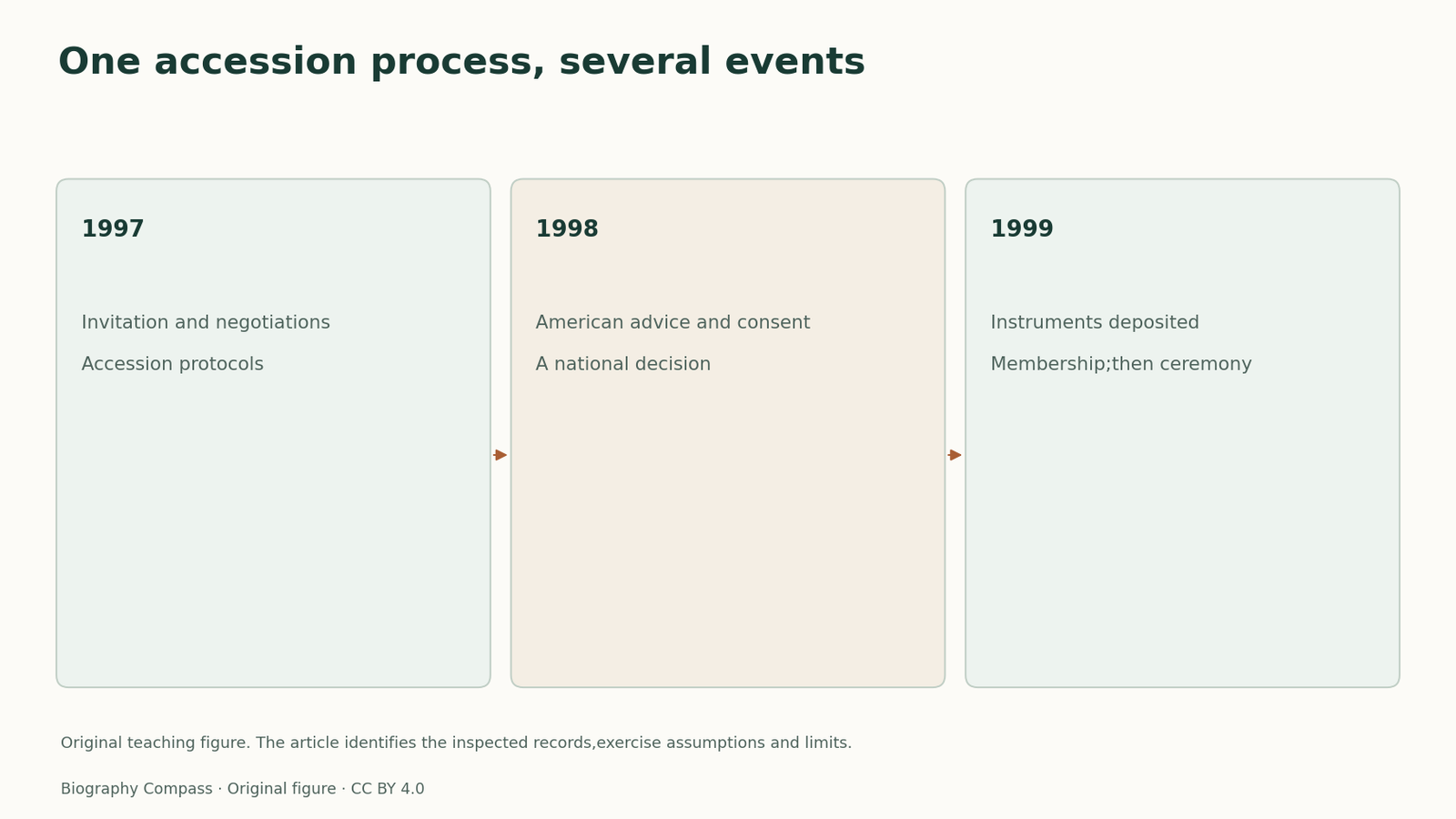
NATO’s historical account places the invitation to begin accession negotiations at the July 1997 Madrid summit. It dates the signing of accession protocols to 16 December 1997. Negotiation and the approval of a route into an organisation are stages in a process; they do not establish that every later condition has already been met.
For a chronological database, the event field therefore matters as much as the date. A single column headed joined would silently turn different actions into competing answers to one question.
Sources for this section: [1]
What the American vote actually records
The Congressional Record for 30 April 1998 reports 80 ayes and 19 noes on the accession resolution, Rollcall 117. An earlier vote that evening, Rollcall 115, rejected an amendment by 23 to 76. The latter concerned conditions on further enlargement; it was not the final accession resolution. Matching by date alone would retrieve the wrong decision.
The contemporary CRS report also describes disagreement about costs, Russia and NATO’s future mission. Approval of a resolution does not erase dissent or turn the supporters’ predictions into demonstrated consequences. A roll call measures a decision at a particular time.
The event that marks formal entry
On 12 March 1999, the foreign ministers of the Czech Republic, Hungary and Poland deposited their instruments at the Truman Presidential Library in Independence, Missouri. NATO’s account identifies that event as entry into the Alliance. The flag-raising at headquarters followed on 16 March.
Albright’s diplomatic career supplies a connection to this process, but neither her advocacy nor a photograph of a ceremony can replace the institutional sequence. The relevant records involve applicants, existing allies and national procedures.
Build a defensible event record
Task: make four fields for each event—date, actor, action and effect. Explain why a dataset containing two Senate votes on the same date needs a question or vote identifier. Then decide whether the later flag ceremony should change the membership date. Finally, identify evidence needed to test an enlargement-cost prediction.
Reference answer: keep the amendment distinct from the accession resolution, and retain separate entries for invitation, a national decision and deposit. A later ceremony can illustrate membership without dating its legal beginning. Testing a cost prediction requires defining category, period, price basis and comparison, then examining expenditure records; a vote tally cannot supply that evidence.
The scope is this historical accession round. It is not a complete statement of current NATO membership or a causal account of later wars.
Continue the chronology
Related history guides
Biography context
Explore United States and Europe through connected lives
Connected biographies
People behind the institutional history

1937–2022
Madeleine Albright
U.S. Secretary of State,1997–2001Madeleine Albright moved from scholarship and political staff work to the UN and the leadership of American diplomacy.Read biographyQuick answers
Common questions
- Does the 1998 vote mean the countries joined in 1998?
- No. It records U.S. legislative action on the accession protocols.
Primary and institutional sources
How this history was checked
The access notes distinguish selected transcriptions, official registers and later accounts. This is a historical study, not an assertion about present legal powers. This article was reviewed on 31 October 2026.
- NATOHungary and NATO: selected 1997–1999 accession record
- U.S. Congressional Record30 April 1998, Senate S 3907: Rollcall 117 and ratification resolution
- Congressional Research Service / EveryCRSReportNATO: Senate Floor Consideration of the Accession of the Czech Republic, Hungary, and Poland (98-669)
- U.S. Department of State, Office of the HistorianMadeleine Korbel Albright
- U.S. SenateRoll Call 115,30 April1998:amendment on future enlargement and the Strategic Concept