
The short answer
Students were already studying at Universidade Nacional Timor Lorosa’e a decade before the government issued the university’s 2010 statute. The apparent gap makes sense once the institution’s teaching history is read beside its legal history. UNTL began by bringing the staff and programmes of two earlier institutions together.
Compare the records
What changed between the merger and the statute?
The university dates its foundation through teaching and people. The government dates formal steps through legal instruments.
| Year | Evidence | What it dates |
|---|---|---|
| 2000 | Five faculties and thirteen departments. | The opening academic organisation. |
| 2004 | First graduation of 300 students. | Completion of study by an early cohort. |
| 2010 | Decree-Law No. 16/2010. | A legal framework for an operating institution. |
Chronology
A timeline of the turning points
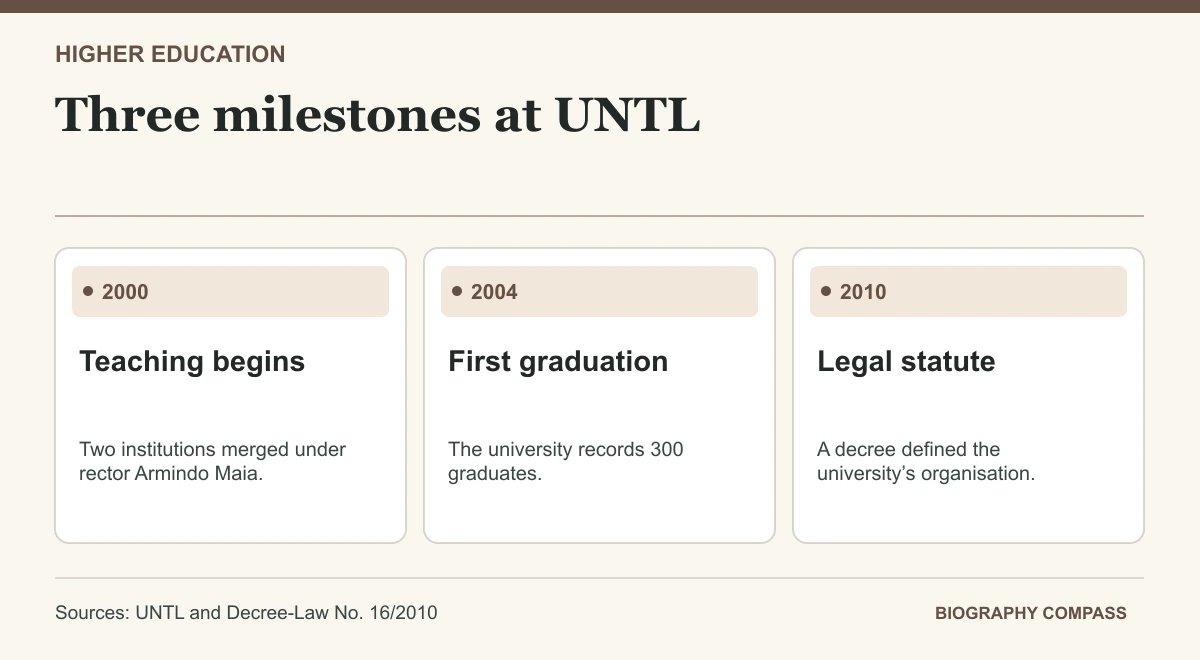
Two institutions joined
Universitas Timor Timur and Politeknik Dili were reorganised into UNTL under rector Armindo Maia.
First graduates
The university records 300 students graduating in its first ceremony.
New faculties
Medicine and law were added.
Statute adopted
The decree-law established a framework for the public university.
How the merger shaped the subjects
The two predecessors brought together university teaching and technical education. The first five faculties covered agriculture, political and social sciences, education, economics and engineering. Courses ranged from agronomy and public administration to civil and mechanical engineering. That combination gives a more precise picture of the new institution than its national title alone. It had to teach practical and academic disciplines while rebuilding the means to deliver them.
Where the first graduates fit
According to the university’s chronology, approximately five thousand students could be accommodated by November 2000. Its first graduation in 2004 involved three hundred students. The figures refer to different groups at different moments. They cannot be used to calculate a graduation rate for an entering class. They do show that courses and early graduations were already part of the institution’s history before its formal statute appeared.
Why the government issued a statute in 2010
In its explanation of the statute, the government credited teachers from the earlier establishments and support from the UN transitional administration. It also acknowledged that UNTL had been functioning without a legally valid statute. The 2010 decree dealt with the status and organisation of an existing university. Dating the foundation to the decree would leave out the merger, the work of the first rector and an entire generation of early students.
Continue the chronology
Related history guides
Connected biographies
People connected to this history
Quick answers
Common questions
- Which institutions formed UNTL?
- Universitas Timor Timur and Politeknik Dili merged and reorganised in 2000.
- Did the national university begin in 2010?
- It began in November 2000. The 2010 decree-law issued its statute.
Primary and institutional sources
How this history was checked
Dates, legal milestones and historical claims are checked against the official and institutional records below. This article was reviewed on 19 November 2026.