
The short answer
An identifiable fragment can signal where to search. A specimen record grows as the surrounding material and its position are documented.
Evidence at a glance
What connects a first fragment to a partial skeleton?
Match each piece of evidence to a specific inference.
| Evidence | What it supplies | How to read it |
|---|---|---|
| First fragment | A finder identifies a promising piece. | Record person, place and date. |
| Associated remains | Recovery adds parts and context. | Distinguish position from proximity. |
| Later analysis | Bones and teeth support separate inferences. | Keep the specimen identifier visible. |
Chronology
A timeline of the turning points
First fragment
Kimeu recognizes fossil material at Nariokotome.
Specimen reconstructed
Recovery and analysis contribute to the KNM-WT 15000 record.
A surface observation starts a question
The Smithsonian lists Kamoya Kimeu as finder of KNM-WT 15000 at Nariokotome in 1984. The Leakey Foundation’s field history describes how a skull fragment began the search for associated pieces. The first observation was valuable because it located a possibility. A researcher reading the eventual skeletal record still needs to distinguish that moment from later collection, anatomical description and reconstruction.
Make the location a testable part of the record
Imagine two fossil fragments reported from the same square on an invented site grid. One lies within the original sediment and one lies loose on the surface. A map showing the square alone may make them appear equally associated. Add a column for depth, condition and whether each object is embedded or loose. Now another reader can see why location supports different claims for the two pieces and decide what should be checked next.
Name evidence for an individual separately
The Smithsonian’s record describes a partly recovered skeleton and discusses dental development as a line of evidence for the individual’s age. A tooth observation comes from an anatomical comparison, not from a discovery date on a field record. Preserve both pieces of metadata. One helps identify where the specimen entered the research process; the other concerns what the remains can tell scientists about an individual.
Sources for this section: [1]
Write a three-part discovery label
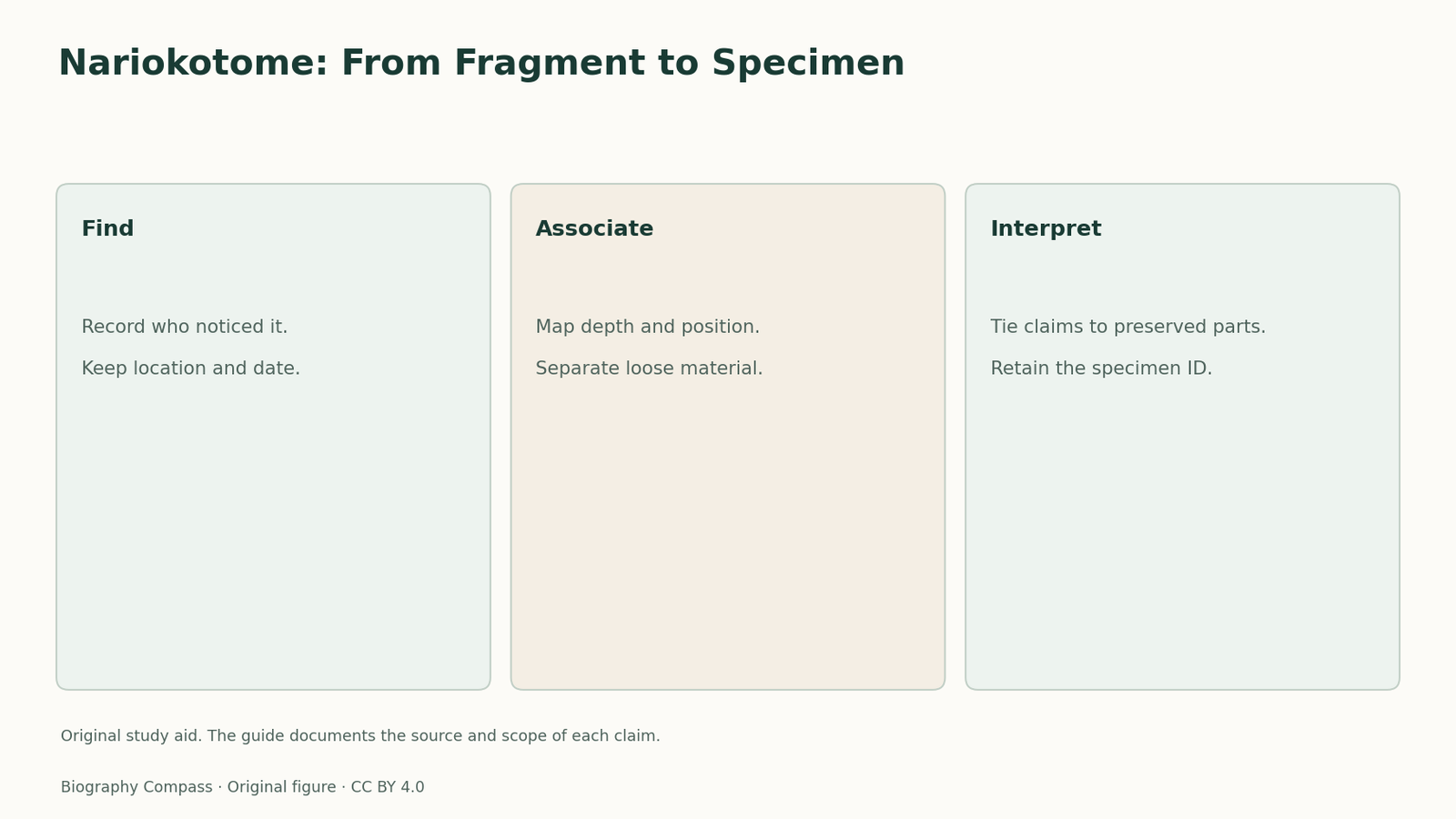
Try a label with one sentence for the person who noticed the first fragment, one for the subsequent recovery and one for an interpretation of the preserved anatomy. Include the specimen identifier so a reader can match the label to the catalogue. This exercise keeps Kimeu’s contribution visible and allows later anatomical interpretations to be revised without changing the identity of the find.
Continue the chronology
Related history guides
Biography context
Explore Kenya through connected lives
Connected biographies
The researcher behind the records
c. 1939–2022
Kamoya Kimeu
Field palaeontologist and fossil finderKimeu spent decades locating and recovering fossils, including the skeleton known as Turkana Boy.Read biographyQuick answers
Common questions
- Is the first fragment the entire KNM-WT 15000 record?
- No. The original fragment began the search; the specimen record includes the partial skeleton recovered in subsequent work.
Primary and institutional sources
How this history was checked
Publication dates and specimen records describe different events. Invented exercises are labelled. This article was reviewed on 5 November 2026.