
The short answer
A field of lines can suggest order without giving a viewer a repeating grid to follow. The Art Canada Institute entry places the 1956 Inner Structure among related paintings. That makes variation a useful way to read one work, provided the differences among the paintings remain visible.
Evidence comparison
Three aspects of the field
Give each observation its own variable.
| Element | Question |
|---|---|
| Lines | Where do they gather and where are they sparse? |
| Ground | How does colour alter contrast and apparent depth? |
| Related work | Which features remain comparable after a change? |
Start with the particular work
The Art Canada Institute entry describes a 1956 painting with a pale network of lines in a blue field. The lines can appear difficult to organise at first. That response is useful because it gives the viewer a task. Look for areas where marks accumulate and areas where the field is easier to see through. The goal is to describe how the distribution appears before deciding what it represents. This order of description can preserve an important quality of the work. A viewer may feel that the picture has a structure without being able to reduce it to a simple repeating unit.
Sources for this section: [2]
A visual resemblance does not establish a direct source
The scholarly entry makes comparisons with atmospheric painting and other artistic traditions. A resemblance can help a viewer describe a quality of looking, but an argument about who influenced a particular painting requires other evidence. Keeping that distinction visible is useful for a painter whose interests extended across local experience, art and science. A viewer can say that a field seems hazy and then ask which property produces the effect. That is an observation to test against the surface or a reproduction. It is a separate claim from a documentary statement about where the painter encountered a technique.
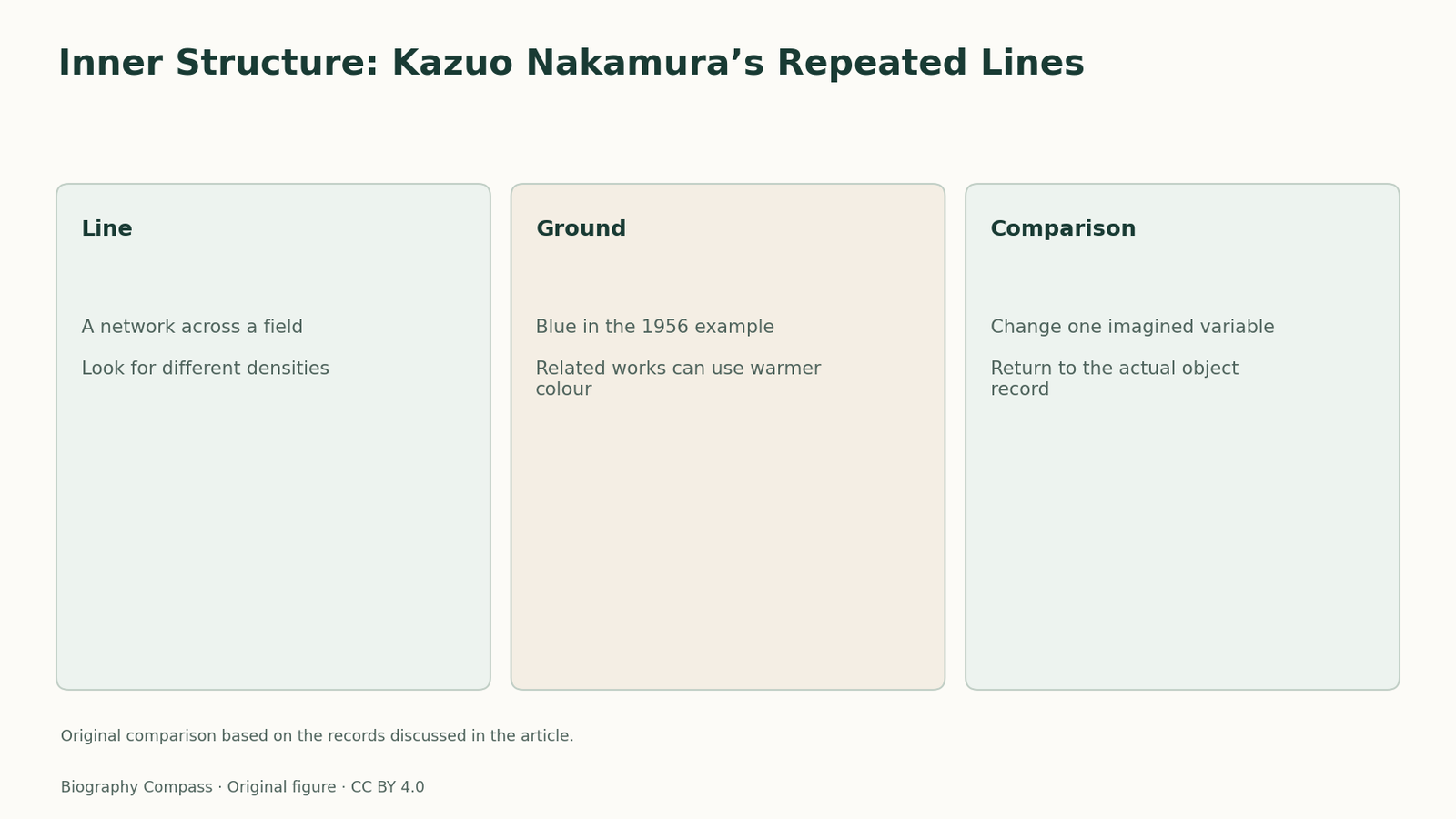
Try an original comparison of line and field
Place the same imaginary network of lines on two differently coloured grounds. Then change the density of the lines on only one ground. Record which change makes it easier to see repeated intervals and which makes the surface feel more crowded. This exercise separates two variables that can be experienced together. It does not reproduce Nakamura’s picture or assume that a digital model captures its paint. It gives a viewer precise terms for comparing line density and colour when returning to the 1956 work and to a documented related example.
Let the work title open the question
Inner Structure gives a reader a reason to look for organisation, but its title is only a starting point. A useful description names which features can be observed, then says which relation a viewer infers from them.
Biography context
Explore Canada through connected lives
Connected biographies
People connected to the work
1926–2002
Kazuo Nakamura
Painter and sculptorKazuo Nakamura moved among landscape, abstract painting and sculpture. He pursued recurring problems of line, field and underlying structure across a long Canadian career.Read biography1909–1977
Jack Bush
Painter and commercial artistJack Bush developed an abstract painting career alongside commercial art. His Sash format allows readers to follow the relation between colour and edge across several works.Read biographyQuick answers
Common questions
- When was the Inner Structure discussed here painted?
- The work entry dates it to 1956.
- What can be tested by comparing related paintings?
- A viewer can compare how the background colour and density of lines change the experience of the field.
Primary and institutional sources
How this history was checked
Dates, legal milestones and historical claims are checked against the official and institutional records below. This article was reviewed on 13 November 2026.