
The short answer
What did the 1832 sheathing patent protect a ship against?
A worked comparison
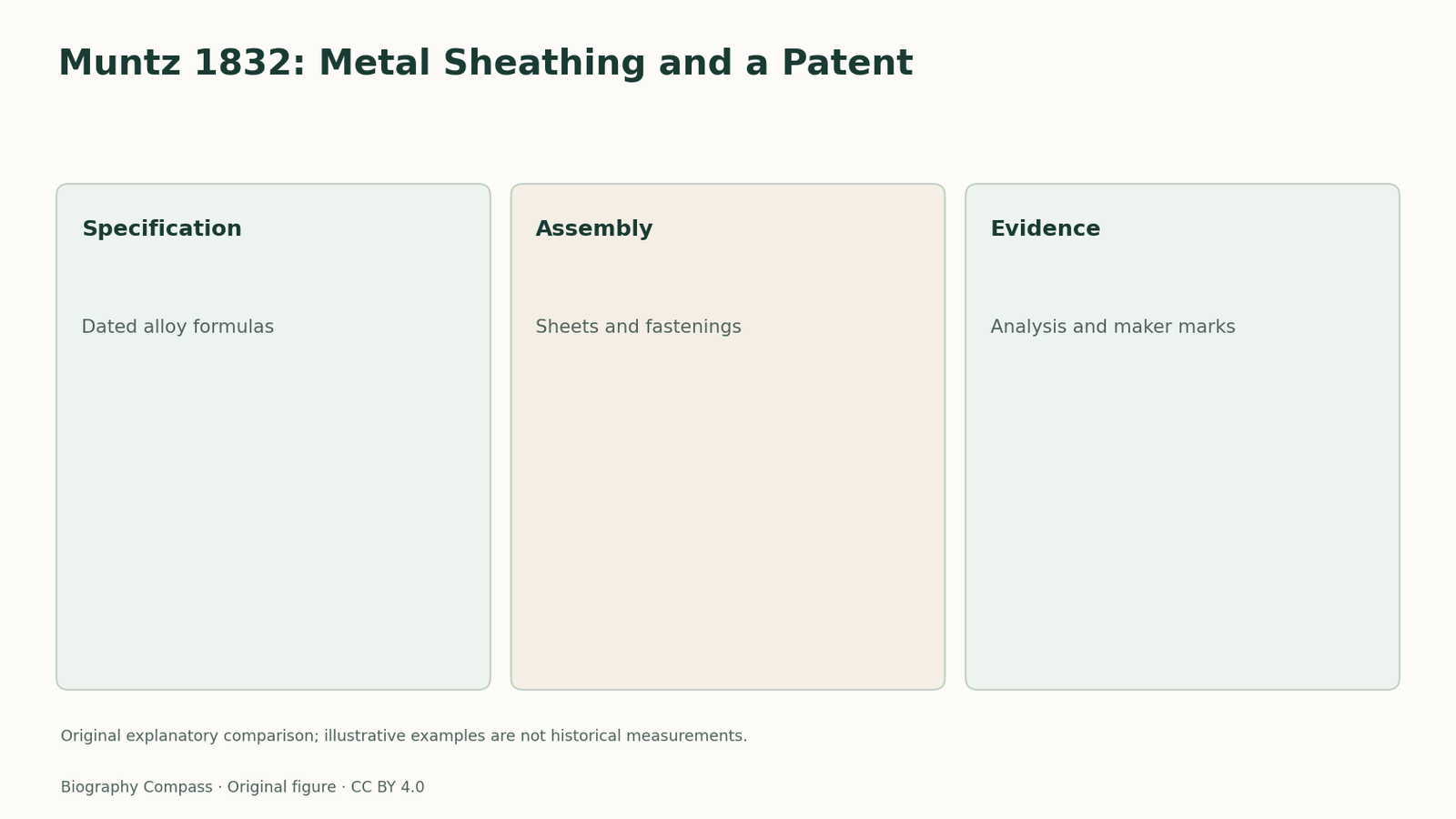
What each part contributes
Use the specific distinctions developed in the study.
| Part or record | What it establishes | Why the distinction matters |
|---|---|---|
| Sheathing sheet | Protective hull covering | Not the hull’s entire structure |
| Fastening | Attachment component | A separate patent function |
| Archaeological sample | Composition, mark and context | More than colour alone |
What did the 1832 sheathing patent protect a ship against?
Muntz metal belonged to the history of metal sheathing applied to ships’ hulls. It should not be confused with making the ship itself from iron or steel. The copper-zinc alloy supplied sheets for a protective covering, while a separate patent concerned fastenings. A useful study asks how material, attachment and hull structure related to one another. The historical patent table and later archaeological analysis provide concrete evidence for those distinctions, allowing the product to be explained without claiming that a familiar trade name identifies every feature of a vessel.
The familiar sixty–forty formula is a shorthand
The conservation study’s patent table describes the preferred 1832 proportion as sixty parts copper to forty zinc, while recording a permitted range. It also distinguishes an 1846 formula that added lead and changed the proportions. This matters when an archaeological sample is analysed: a composition should be compared with the appropriate historical specification, not forced into one rounded formula. The name Muntz metal can identify a product family or commercial tradition, while the actual chemistry of a specimen remains an empirical question.
Sources for this section: [2]
Fastenings and sheets answered connected but different needs
A sheet must be secured to the hull, which makes the material of its fastenings relevant to the sheathing system. The separate December 1832 patent for fastenings is therefore more than a duplicate date in a list of inventions. It addressed another component in the assembly. Nevertheless, a patent description does not establish the fastening arrangement of every ship that later used yellow metal. For a particular vessel, surviving material, construction records or archaeological context would be needed to connect the general product with its actual application.
Sources for this section: [2]
A stamped fragment adds evidence beyond a product name
The inspected maritime archaeological study describes a sheathing fragment with traces of a Muntz patent stamp and a number associated with the sheet’s weight grade. The authors connect that mark with material analysis and the wreck’s wider context. This is a useful chain of evidence: a maker’s mark, a measured composition and an archaeological setting contribute different information. None should be replaced by the assumption that all yellow metal is identical. Nor does a fragment alone establish the complete identity or operating history of the vessel from which it came.
Sources for this section: [3]
Material-identification exercise and checked answer
Suppose a fictional wreck yields a yellow-coloured sheet and a copper-zinc laboratory result. Is the colour alone enough to identify it as a particular Muntz patent product? No. A stronger assessment compares composition, marks, date and context with the relevant specification. If a sample contains an additional element, should it automatically be rejected? Not necessarily: first check whether the comparison uses the correct historical formula and whether corrosion or sampling affects interpretation. The checked answer explains a research method rather than supplying an invented identification. It turns the changing patent record into a practical aid for reading material evidence.
Continue the chronology
Related history guides
Biography context
Explore United Kingdom through connected lives
Connected biographies
People and wider context
1794–1857
George Frederick Muntz
metal manufacturer and political reformerGeorge Frederick Muntz was a metal manufacturer and political reformer, known for Muntz metal sheathing and Birmingham parliamentary reform politics.Read biographyQuick answers
Common questions
- Was Muntz metal a single unchanging formula throughout its history?
- No. The inspected patent table distinguishes the preferred 1832 composition, a permitted range and a later lead-containing formula.
Primary and institutional sources
How this history was checked
The source notes distinguish original records, institutional descriptions and later historical interpretation. Exercises and comparisons are original editorial analysis. This article was reviewed on 8 November 2026.