
The short answer
Ask which edition a record describes before using its colour as evidence about K. Asif’s original production.
Evidence comparison
Three objects that carry the film’s title
Write down the edition or artifact before comparing its colours.
| Object | What the record establishes |
|---|---|
| 1960 original release | Monochrome and selected originally coloured material |
| Later digital presentation | Colourisation and changes to the presentation format |
| Showcard | A surviving publicity object associated with the film |
Establish what a 1960 audience could see
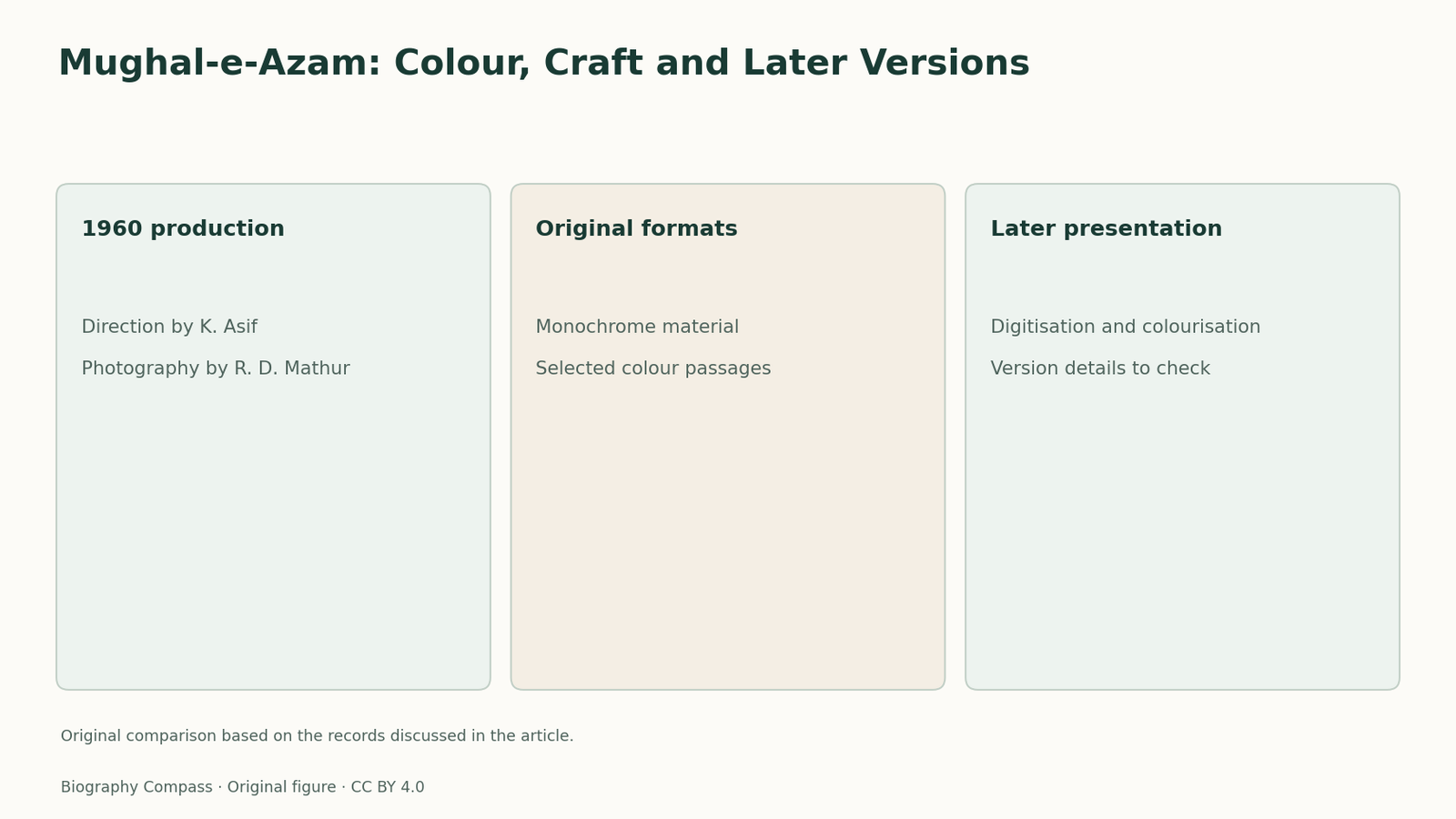
The original Mughal-e-Azam was released in 1960 and used monochrome with selected sequences photographed in colour. The Rotterdam programme describes the mixture while discussing a later screening version. That makes it important to avoid treating all colour in a modern copy as evidence of the original palette. Look first for a programme that identifies the print or digital edition and whether its colour belongs to the original photography. A version label helps a reader write more precise notes about a costume, set or transition without needing to solve the entire restoration history in advance.
What the later digital version changes
The Rotterdam programme describes a later version that was digitised, colourised and presented with changes in projection and sound. Those are related processes with different consequences. Digitisation creates material that can be processed or screened digitally. Colourisation adds a palette to footage whose original record may be monochrome. A new presentation format changes how an audience receives an edition. A programme may group them together when describing a release, but the distinctions matter for viewers investigating what choices were available to Asif and which ones belong to a subsequent team.
Read the film credits alongside the version
The cast includes Prithviraj Kapoor as Akbar, Dilip Kumar as Salim and Madhubala as Anarkali. The programme gives R. D. Mathur the cinematography credit and Naushad the music credit. Write these production roles in a separate part of a note from the details of the edition being seen. A later picture treatment does not move an actor out of an original scene or transfer the original music credit. It does affect what a viewer can reasonably infer from a present-day screen image. This small distinction keeps the people involved at different stages visible.
What a cinema showcard can document
The Tuli centre records a showcard associated with the original film. A publicity object documents how a production was presented to a potential audience. It supplies neither the whole screening order nor an automatic guide to how the film was printed. For example, colour on an advertising object is a property of the object and cannot establish colour in a particular projected sequence. The useful comparison brings a programme or technical description alongside the advertising record, then asks what the film’s production and later circulation meant for each form of evidence.
Make a version-aware viewing note
Choose a scene you can access in two editions. Record both version labels, write one observation about the image arrangement that survives across them and another about a difference associated with colour or presentation. Then ask which source supports the claim that the difference is part of the later version. A viewing note can remain useful even when it cannot settle the origin of a single detail. It will say exactly what comparison was made. That is a stronger basis for discussing craft than assuming a modern presentation exactly matches the film’s first release.
Continue the chronology
Related history guides
Biography context
Explore India through connected lives
Connected biographies
People connected to the work
1922–1971
K. Asif
Film director, writer and producerK. Asif was an Indian filmmaker whose historical romance Mughal-e-Azam brought together a large cast and a long production before reaching cinemas in 1960.Read biography1925–1964
Guru Dutt
Film director, producer, actor and former choreographerGuru Dutt moved from dance and studio work into directing, producing and acting in Hindi cinema. His short career included popular comedy, suspense and the films about artistic disappointment for which he is especially remembered.Read biographyQuick answers
Common questions
- Was Mughal-e-Azam originally all in colour?
- The 1960 release combined monochrome photography with selected original colour passages.
- Who composed the film’s music?
- Naushad is credited for the music in the Rotterdam programme.
Primary and institutional sources
How this history was checked
Dates, legal milestones and historical claims are checked against the official and institutional records below. This article was reviewed on 13 November 2026.