
The short answer
A location is more than scenery. It can make an action plausible by showing what lies nearby, what can be reached and what remains out of sight. A production account can reveal why a team searched for a particular view, even without our claiming to have watched the finished scene.
Records and working decisions
Compare the choices
The records frame a new practical problem; the task makes its own assumptions explicit.
| Question | Consulted record | New working proposal |
|---|---|---|
| Location | Distance and a desired viewpoint | State the relation the scene needs to make clear. |
| Rewriting | Changed character relationships | Keep a received idea distinct from its later form. |
Chronology
A timeline of the turning points
The production context
Marlina, third feature.
A written reflection
MovieMaker interview.
Space was part of the dramatic problem
Surya told MovieMaker that Marlina needed to show the distance between houses to make the character’s situation intelligible. Production designer Franz Paat found an opposite hill for a view she had nearly abandoned. Cinematographer Yunus Pasolang helped develop the visual approach.
Her account also describes island access and seasonal limits, with material shot on location combined with studio work. The production constraint and the narrative purpose were connected decisions, rather than a beautiful landscape simply added to an otherwise finished film.
Sources for this section: [1]
Two accounts of changing a story
In the cléo interview, Surya described rewriting an earlier group confrontation into relationships among particular women from different generations. That explanation concerns dramatic structure; the location account concerns how an action becomes visible. Both place decisions between the received idea and the finished work.
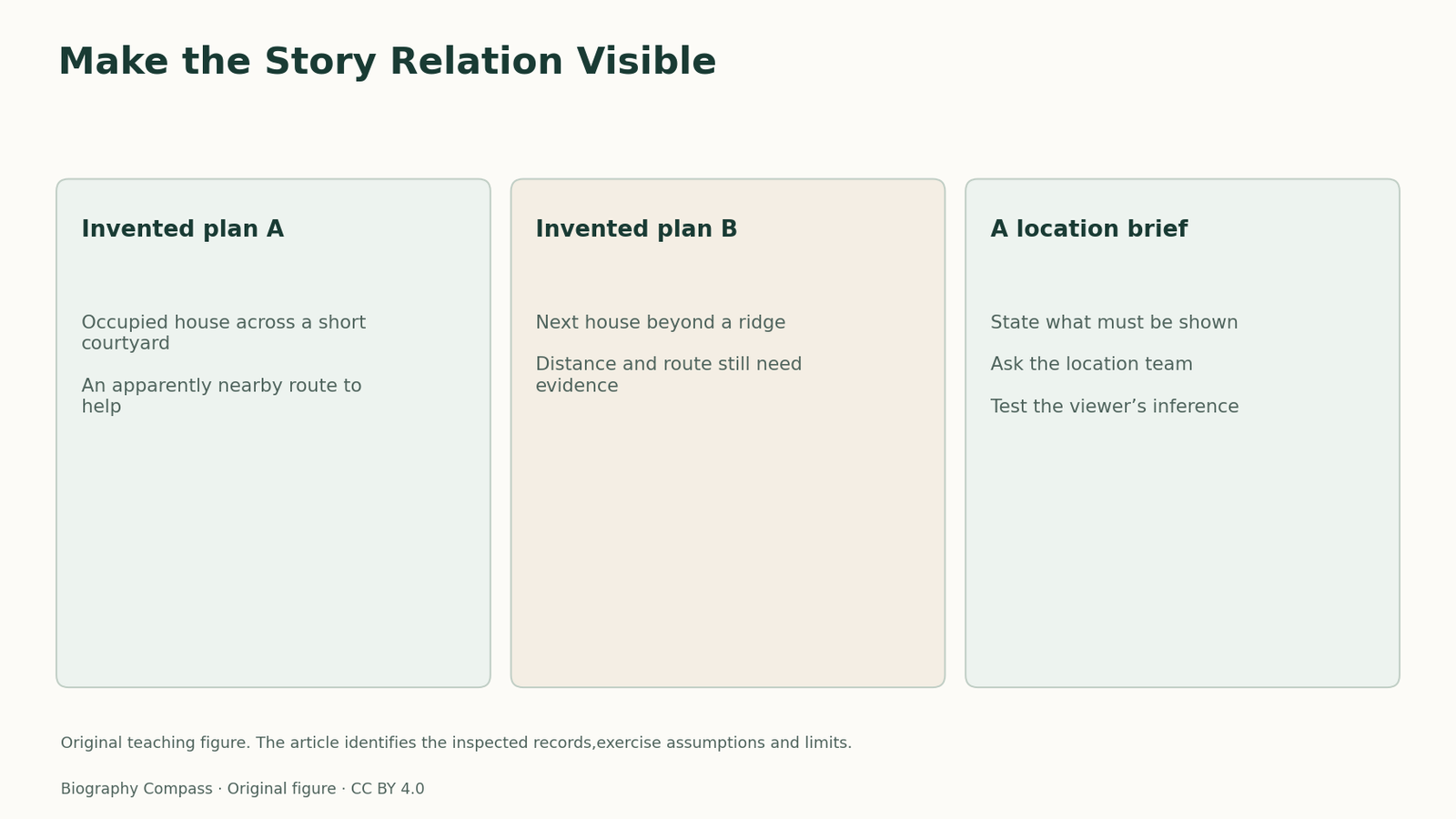
For a new scene, a location brief should specify the relation the viewer needs to understand. “An impressive wide view” is less exact than “the next occupied house must be visibly distant.” The latter can be checked against a plan and eventually tested with viewers.
Original setting-brief task
Invent a scene in which a character considers going to a neighbour for help. Plan A puts an occupied house across a short, open courtyard. Plan B puts the next house beyond a ridge, with no direct view of it. Choose one plan for a story that needs the journey to feel difficult. Write one thing the scene must establish, one question for the location team and one audience-test question. Do not copy a shot from Marlina.
Sources for this section: [1]
Reference answer
Plan B better supports the proposed difficulty, but the ridge alone does not prove distance, travel time or danger. The scene must establish enough of the route or its consequences to make the character’s hesitation legible. The location team might ask which approach and sight line can be shown clearly; viewers can be asked what they believe the character’s available options are and why.
Plan A can work for a different story, or if another obstacle is established. The brief should therefore preserve the intended dramatic relation rather than declare one landscape universally superior. Our setting and scene are new, and the test has not actually been conducted.
Sources for this section: [1]
Continue the chronology
Related history guides
Biography context
Explore Sumba, Indonesia through connected lives
Connected biographies
Follow the working life
Quick answers
Common questions
- Does an isolated site prove an audience understood the scene?
- No. A location choice and an audience response are different evidence.
Primary and institutional sources
How this history was checked
Compare the two written production accounts; no shot, screenplay or film is reproduced. This article was reviewed on 31 October 2026.