
The short answer
What did automated ion-exchange amino-acid analysis measure, and why did peak quantities not provide an intact protein sequence?
Read the evidence
Different records within the same investigation
The following comparison distinguishes the specific questions answered by the inspected records.
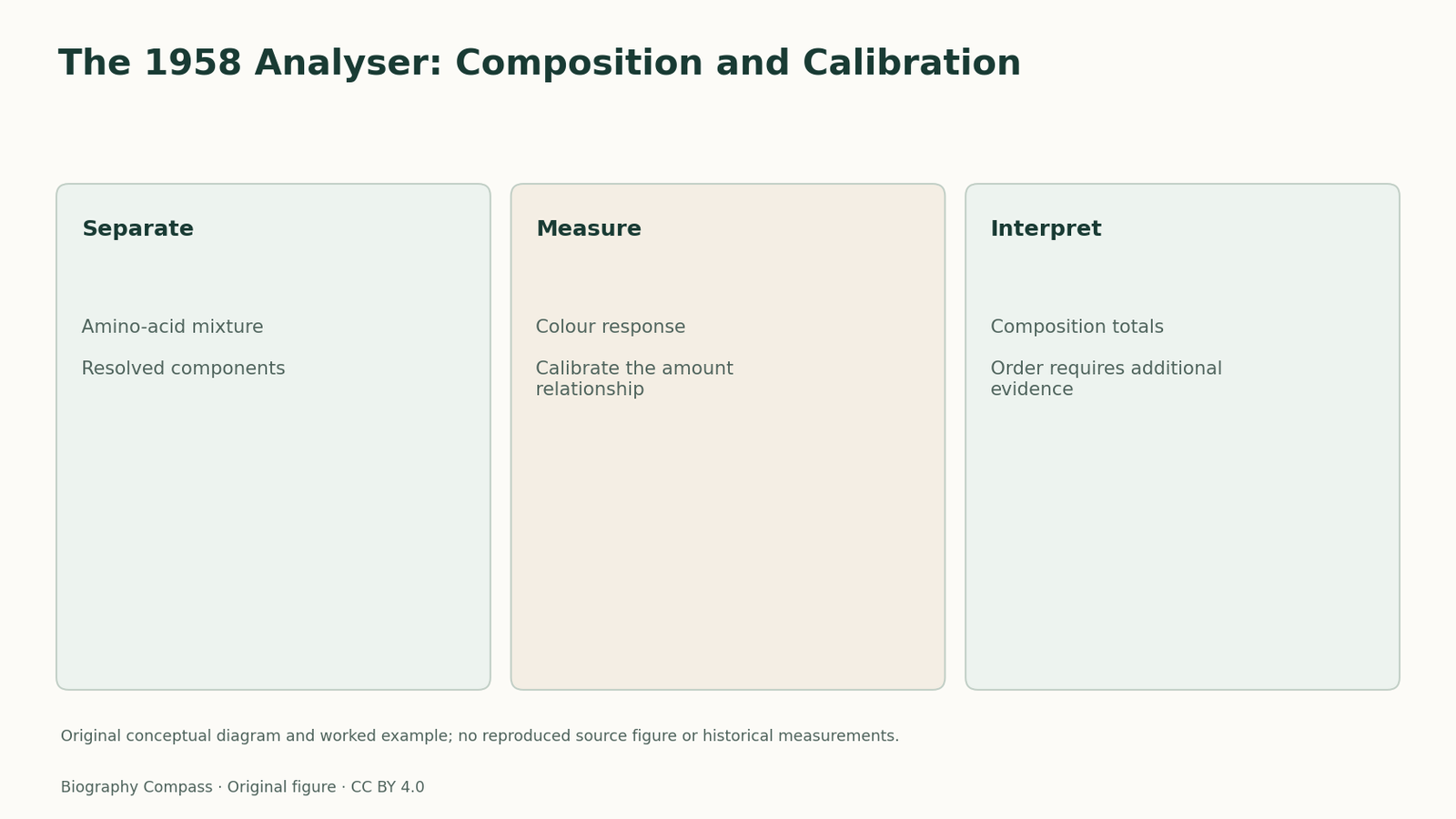
| Record or test | What it establishes | What remains different |
|---|---|---|
| Column separation | Helps distinguish components emerging from a mixture. | Unresolved components can contribute to a combined signal. |
| Calibrated detector response | Relates a measured response to an amount under stated conditions. | Different response factors can prevent direct raw-area comparison. |
| Peptide and overlap evidence | Adds relationships needed for an ordered sequence. | A composition total alone has lost much of that order. |
The publication concerned a measurement system
Spackman, Stein and Moore’s 1958 Analytical Chemistry paper described an automatic recording apparatus for amino-acid chromatography. The primary publication date is July 1958; a similarly titled Federation Proceedings record later that year should not be substituted for it. The programme combined several operations that had previously demanded substantial manual handling. Automation was therefore a particular reorganisation of a chemical measurement, not a machine that independently solved every problem of protein structure. Its output still needed an interpretation matched to the sample and assay.
Separation and detection contributed different information
The joint Nobel lecture describes ion-exchange separation followed by a ninhydrin colour response recorded as a flowing stream. The separation helped distinguish components, while the detector supplied a measurable response as material emerged. Moore’s later memoir of Stein independently recounts the development of these methods and their movement from starch columns to faster systems. A clear account keeps the two stages visible: a detector signal without adequate separation can combine components, and separated material without a quantitative readout does not yet supply the intended amounts.
A recorded area needs a quantitative relationship
A chromatographic trace becomes an amount estimate through the measurement’s response to the relevant substance and the way that response is calibrated. The memoir describes the effort required to make the colour measurement quantitatively useful. A taller or larger peak cannot automatically be compared across unlike substances without considering that relationship. This is a general analytical consequence of the instrument’s design, not a claim that the original apparatus had every calibration or correction used in a later commercial instrument. The specified material and procedure belong with the result.
Composition and sequence require different evidence
Rockefeller’s institutional account distinguishes the analyser programme from the subsequent ordering of ribonuclease’s residues. Hydrolysing a protein into an amino-acid mixture discards much of the order information an investigator wants from a sequence. Quantitative composition remains useful because it constrains how much of each component is present, but it cannot alone say which residue came before another. Peptide-specific evidence and overlaps supplied further relationships. This is why an important analytical instrument can enable a sequencing programme without itself being equivalent to a sequence determination.
An original calibration-and-order exercise and answer
Imagine two invented amino-acid responses. Substance A gives fifty response units per amount unit and produces a peak area of one hundred; B gives twenty-five per amount unit and produces an area of fifty. Both correspond to two amount units under the stated calibration. The larger A peak does not mean twice as much A. Now compare fictional chains A–B–C and C–A–B: both contain one of each symbol, although their orders differ. These numbers and chains are teaching devices, not historical analyser outputs or ribonuclease fragments. The supported answer separates calibrated quantity from sequence information. It also states the assumption that the peaks have been adequately separated and assigned; arithmetic cannot rescue a trace in which the identity of the signal remains unresolved.
Continue the chronology
Related history guides
Ribonuclease Sequencing: Why Overlaps Matter
Follow the ribonuclease sequence programme through peptide overlaps and later revisions, with an original assembly exercise separating order from composition.
Read the timeline1961–1962Ribonuclease Refolding: Sequence and Conditions
Read Anfinsen’s 1961 reoxidation study through its separate chemical and activity measurements, with an original exercise on recovery, timing and conditions.
Read the timelineBiography context
Explore United States through connected lives
Connected biographies
Researchers and related approaches
1913–1982
Stanford Moore
Biochemist and analytical-methods researcherStanford Moore developed quantitative amino-acid analysis with William Stein and Darrel Spackman, making protein chemistry more reproducible and widely usable.Read biography
1918–2013
Frederick Sanger
Biochemist and sequencing-method researcherFrederick Sanger developed ways to determine the order of components in proteins and nucleic acids. His two chemistry Nobel Prizes mark different stages of a research career whose continuity was the problem of sequence and whose methods depended on many collaborators.Read biographyQuick answers
Common questions
- Does the larger raw peak always mean more material?
- Only after the relevant separation, assignment and response relationship are established.
- Can identical composition describe different sequences?
- Yes. The same component totals can be arranged in different orders.
Primary and institutional sources
How this history was checked
The references below distinguish the original study from later explanations. The worked exercise and comparison are newly written for this article. This article was reviewed on 8 November 2026.
- Spackman, Stein and Moore, Analytical Chemistry, 1958Automatic Recording Apparatus for Use in Chromatography of Amino Acids
- Stanford Moore, National Academy of Sciences, 1987William H. Stein: A Biographical Memoir
- The Rockefeller University Hospital CentennialForm and Function: The First Sequence of an Enzyme, Ribonuclease
- Nobel Prize OutreachStanford Moore — Nobel lecture
- Nobel Prize OutreachStanford Moore — Facts
- Nobel Prize OutreachStanford Moore — Biographical