
The short answer
How did planning connect infantry, artillery, tanks and resupply?
Read the records together
Contributions,evidence and scope
Different records illuminate different parts of this particular undertaking.
| Record | What the record establishes | What remains distinct |
|---|---|---|
| Participant memorandum and account | Explain planned liaison and training. | A commander’s retrospective account has a standpoint. |
| Institutional battle summary | Supplies date and specific duration comparison. | One result is not a universal ranking of commanders. |
| Preparation/result table | Separates requests, work and outcome. | No stage substitutes automatically for another. |
Preparation linked separate arms before the operation
Monash’s Hamel memorandum described the need for training and close liaison between tank and infantry commanders. His subsequent account describes bringing infantry units into contact with tanks and their crews before the action. The significance is not merely the presence of several technologies on one battlefield. Participants needed familiarity and a shared understanding of how their roles related. This is the positive organisational point supported by the participant record. It also keeps the tank crews and infantry formations visible rather than making the commander’s name stand for all practical preparation.
Sources for this section: [4]
The plan depended on resources being available
The memorandum lists preparations and support to be arranged before the operation could take place. Engineer stores, air support and coordinated artillery belonged to the same planning framework. These items show that a timetable was conditional upon material and organisational work. The existence of a written plan was not equivalent to every required resource already being in position. This distinction is useful when reading military records: requests, orders, preparation reports and later outcomes describe different stages. The article remains a historical account, not a prescription for conducting a present-day military operation.
Sources for this section: [4]
A precise result should not become a universal legend
The Australian War Memorial gives a planned duration of 90 minutes and an outcome of 93 minutes for the 4 July 1918 action. That memorable comparison is evidence about this particular operation, not a measure of everything a commander did or a proof of sole causation. Monash’s own book places strong claims on behalf of his corps, as its preface openly states. Reading the institutional summary alongside the participant account preserves both the observed milestone and the standpoint from which the narrative was written. It avoids an unsupported claim that Hamel invented all coordinated warfare.
Read a preparation-and-result table
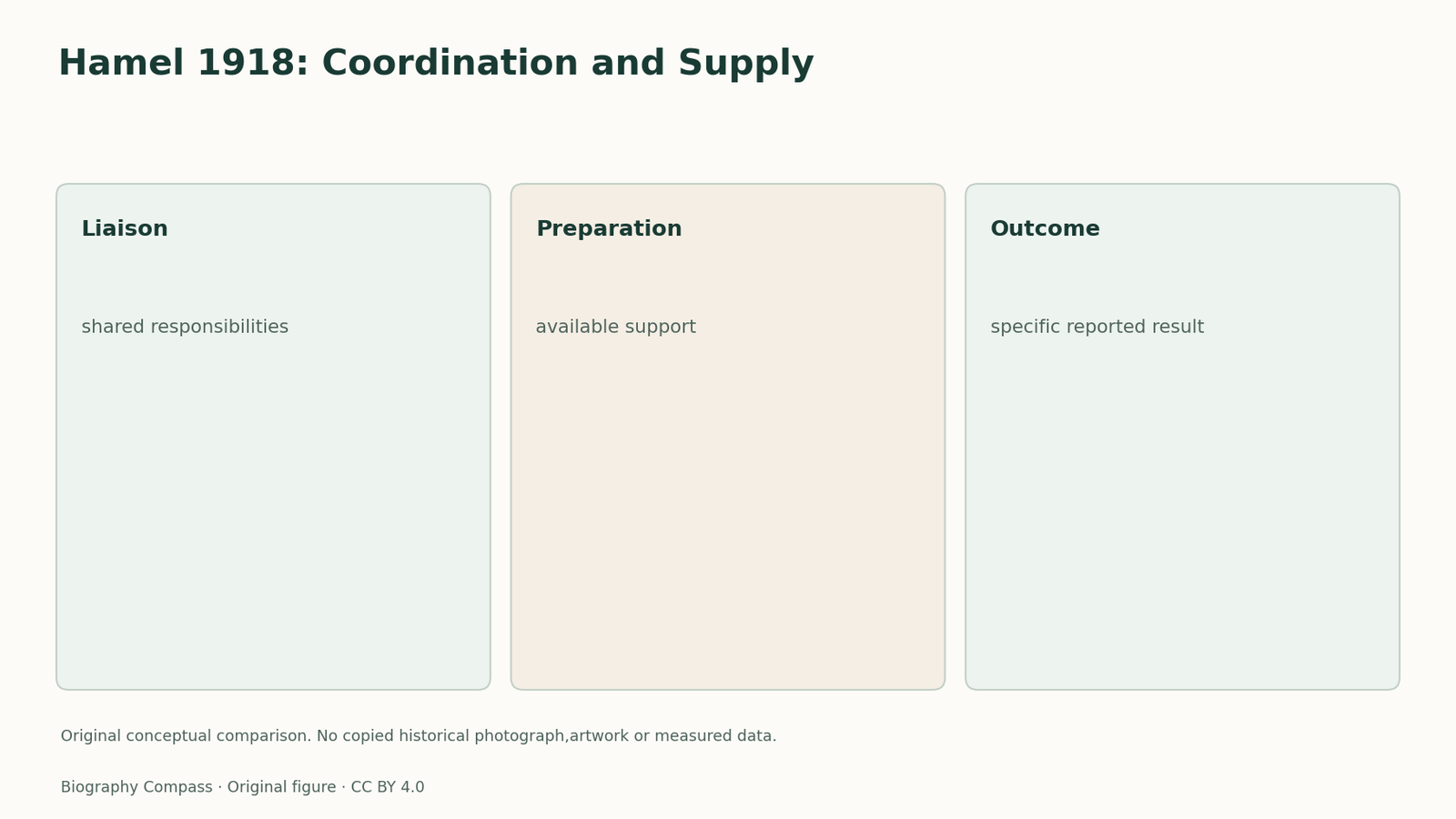
Create four rows: liaison, training, available resources, and reported outcome. Put the memorandum’s proposed coordination in the first, the described familiarisation in the second, and the requested support in the third. Keep the 90/93 minute comparison in the final row. The checked answer to “does a short successful duration prove that preparation was unnecessary?” is no: the participant account identifies extensive prior work. This original exercise also rejects the claim that a plan alone proves an outcome. It explains how different record types fit together while retaining the roles of soldiers, crews, staff and commanders within the documented collaboration.
Continue the chronology
Related history guides
Crimean Railway 1855: Building a Supply Link
Examine how the 1855 Crimean railway carried supplies, why its mixed power system mattered and how building a route differed from operating the service.
Read the timeline1855–1857Crimean Sanitary Commission: Works and Evidence
Compare the Crimean Sanitary Commission’s instructions, engineering works and later accounts, distinguishing environmental sanitation from clinical care.
Read the timelineBiography context
Explore Australia through connected lives
Connected biographies
People behind this work
1865–1931
John Monash
Civil engineer, military commander and public administratorJohn Monash is remembered for commanding the Australian Corps in 1918 and later leading Victoria’s State Electricity Commission.Read biography1894–1978
Robert Menzies
Constitutional lawyer, Liberal Party organiser and two-time prime ministerRobert Menzies rebuilt his career after wartime resignation, helped establish the Liberal Party and led a durable postwar coalition government.Read biography1849–1920
Edmund Barton
Federation organiser, first Commonwealth prime minister and High Court justiceEdmund Barton helped turn the federation movement into a constitutional settlement, led Australia’s first federal ministry and later joined the High Court.Read biographyQuick answers
Common questions
- What does the 90/93 minute Hamel comparison establish?
- It compares the plan and reported duration of one operation. It does not prove sole causation or invent all combined-arms warfare.
Primary and institutional sources
How this history was checked
The cited records distinguish contemporary accounts,official catalogues and later institutional or scholarly interpretation. The comparison and worked exercise are original editorial material. This article was reviewed on 7 November 2026.