
The short answer
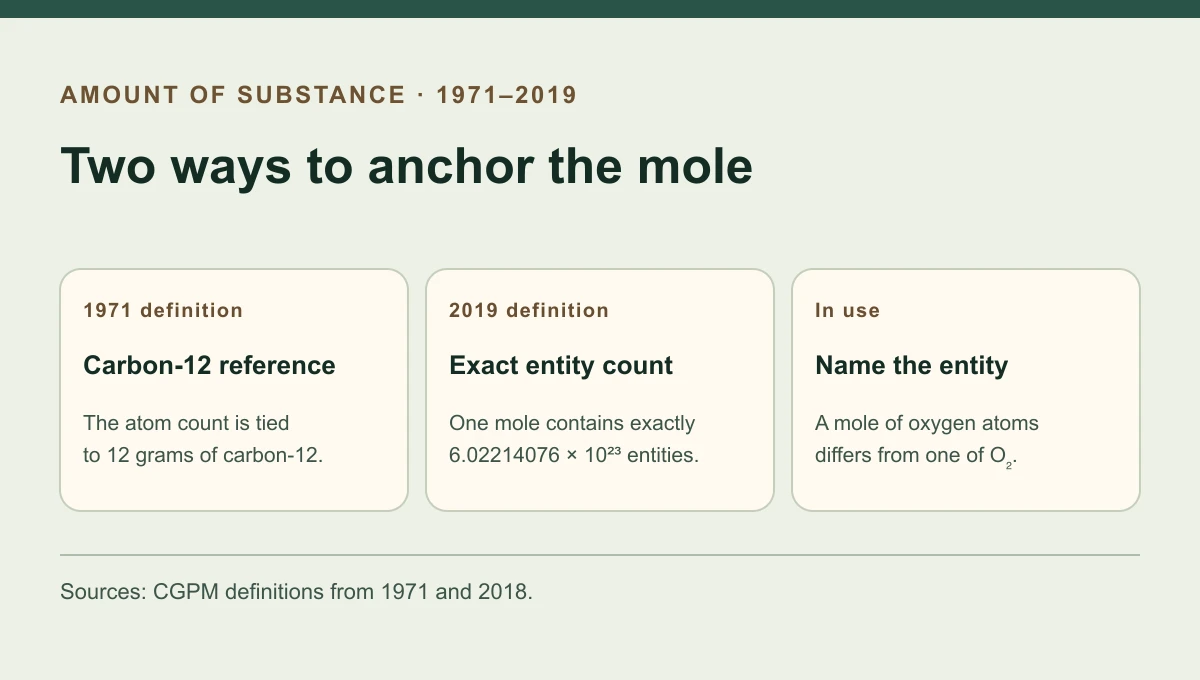
When the mole entered the SI in 1971, its reference was the number of atoms in 0.012 kilogram of carbon-12. Since 20 May 2019, a mole contains exactly 6.02214076 × 10²³ specified entities. The unit describes an amount of substance. Its meaning in a calculation also depends on whether the entities are atoms, molecules, ions or other specified particles.
Amounts and particles
What is one mole counting?
Equal counts can refer to different entities and correspond to different sample masses.
| Example | Entity counted | What the equivalent count means |
|---|---|---|
| 1 mol of O atoms | Individual oxygen atoms | There are 6.02214076 × 10²³ atoms. |
| 1 mol of O₂ molecules | Oxygen molecule, made of two atoms | There are 6.02214076 × 10²³ molecules. |
| O atoms in 1 mol of O₂ | Two constituent atoms in each molecule | The sample contains 2 mol of oxygen atoms. |
Chronology
A timeline of the turning points
Carbon-12 supplies the reference
The General Conference defines the mole under the SI and requires the entity to be specified.
The conference adopts a fixed Avogadro constant
An exact number of entities becomes the basis of the new definition.
Revised definition takes effect
A mole no longer depends on the mass of a carbon-12 sample.
What the 1971 definition depended on
The earlier wording referred to the number of carbon-12 atoms in twelve grams of that isotope. This anchored amount of substance to a mass and to a specified kind of atom. The corresponding value of the Avogadro constant had to be determined experimentally.
The 1971 decision already required the elementary entity to be named. That instruction matters whenever two chemists use the same element symbol but intend to count different chemical entities.
What became exact in 2019
The revised SI fixes the Avogadro constant at 6.02214076 × 10²³ per mole. Multiplying an amount in moles by that constant gives the corresponding number of entities. The mass of one mole of carbon-12 remains extremely close to twelve grams, with a defined relationship whose value now comes from measurement instead of the old definition.
A chemist can still weigh a sample and use its molar mass to determine amount of substance. The new definition changes which link in the calculation supplies an exact number.
Why naming the entity makes a difference
One mole of O₂ specifies molecules, so it contains twice as many oxygen atoms as molecules. A mole of oxygen atoms specifies the smaller entity. The table shows why it is possible to describe the same molecular sample as one mole of molecules or two moles of constituent atoms.
Continue the chronology
Related history guides
Connected biographies
People connected to this history
Quick answers
Common questions
- How many entities are there in one mole?
- Exactly 6.02214076 × 10²³ specified elementary entities.
- Is a mole a fixed mass?
- Its mass depends on the entity and the material’s molar mass. The definition fixes the number of entities per mole.
Primary and institutional sources
How this history was checked
Dates, legal milestones and historical claims are checked against the official and institutional records below. This article was reviewed on 19 November 2026.
- General Conference on Weights and MeasuresResolution 1 of 2018 on the revision of the SI
- General Conference on Weights and Measures1971 resolution defining the mole
- International Bureau of Weights and MeasuresSI base unit: mole
- International Bureau of Weights and MeasuresPractical realisation of the mole
- National Institute of Standards and TechnologyRedefining the Mole