
The short answer
What did Miles’s elevator-door patent seek to prevent?
Compare the evidence
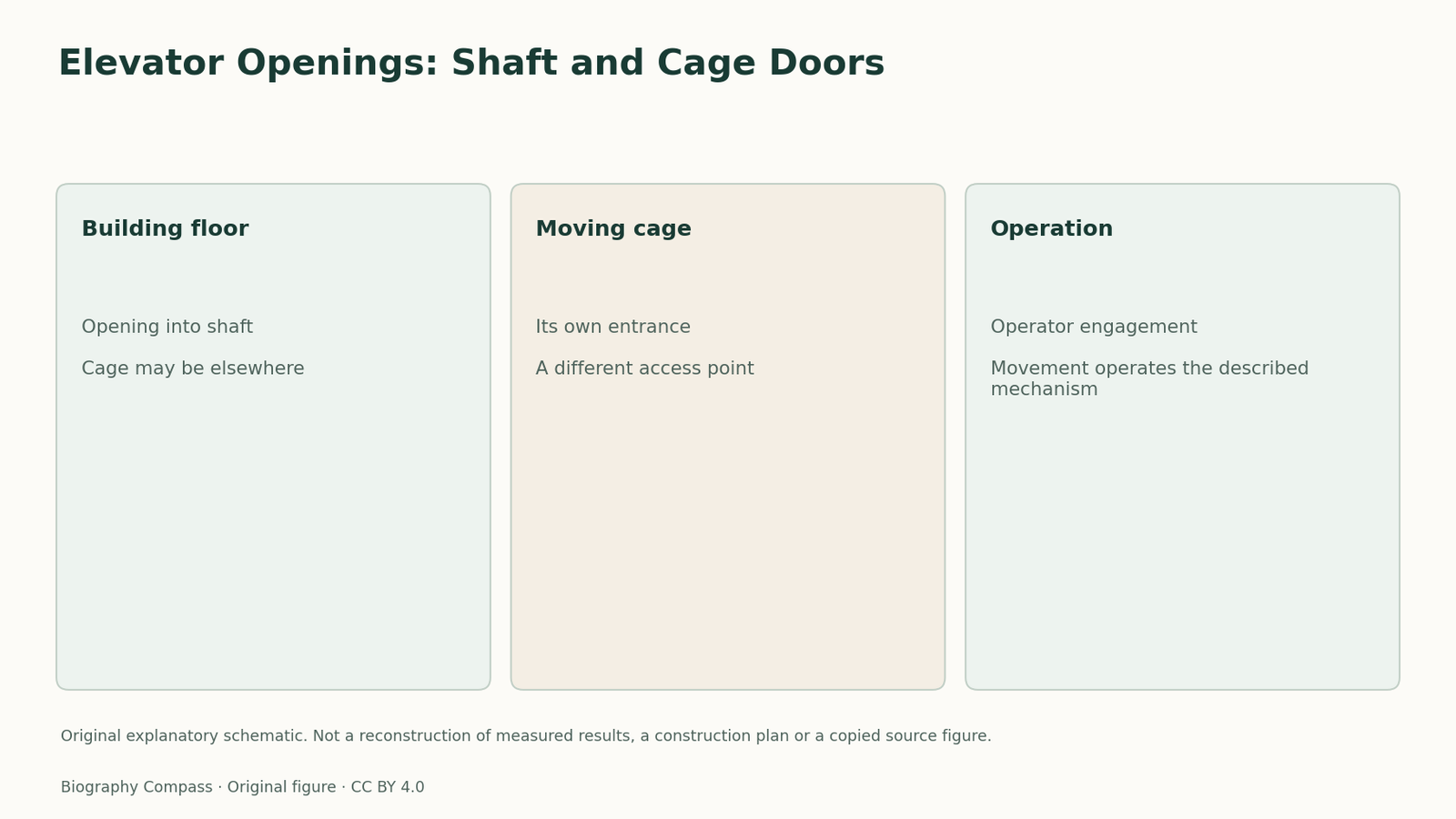
Elevator Openings: Shaft and Cage Doors
Compare what each inspected record establishes with the claim that remains separate.
| Record or observation | What it supports | What remains separate |
|---|---|---|
| Shaft-opening objective | Addresses an opening when the cage is not at that level | Is separate from the cage’s own entrance |
| Cage-door and engagement description | Combines movement with an operator-selected engagement | Does not describe a modern electronic interlock |
Separate the landing opening from the cage entrance
An elevator system has an opening into the shaft at a building floor and an entrance to the moving cage. Leaving the first unprotected creates a different problem from failing to operate the cage's own door. Miles's 1887 specification identifies both tasks. The distinction matters because a broad description such as automatic elevator doors can conceal which opening a mechanism closes and under what conditions it operates.
Movement and operator selection work together
The patent describes a flexible belt associated with closing shaft openings above and below the cage. It separately describes levers and rollers interacting with grooves as the cage approaches or leaves a floor. An operator can bring parts into engagement at a selected floor. The design therefore uses movement to perform a task without eliminating every human action. It should not be labelled a modern electronic door interlock merely because its purpose belongs to the wider history of elevator safety.
Sources for this section: [2]
Map the access states
Draw an original classroom diagram with one cage and two building floors. Label the cage entrance separately from each floor's shaft opening. Ask which opening would expose an empty shaft when the cage is elsewhere. Then add a separate mark for operator engagement and another for cage movement. The answer must distinguish the hazard, the opening and the action controlling it. This schematic does not reproduce Miles's mechanism or certify a safe lift design. It explains why the claim should be read as a particular mechanical response to particular access hazards.
Continue the chronology
Related history guides
Biography context
Explore United States through connected lives
Connected biographies
People behind the records
1838–1918
Alexander Miles
Inventor, barber and entrepreneurAn 1887 patented mechanism for elevator shaft openings and cage doors.Read biography1877–1963
Garrett Morgan
Inventor and entrepreneur in public-safety equipmentSafety-hood improvements and a manually operated traffic-signal design.Read biography
1844–1929
Elijah McCoy
Mechanical inventor and automatic-lubrication developerAutomatic lubricators that supplied oil to operating machinery.Read biographyQuick answers
Common questions
- What did Miles’s elevator-door patent seek to prevent?
- Miles addressed both shaft openings and cage doors. His specification uses mechanical movement and operator engagement; it should not be described as an autonomous modern electronic interlock.
Primary and institutional sources
How this history was checked
Sources distinguish individual patent or technical records from biographical and retrospective accounts. Their actual reading scope is retained in the biography source notes. This article was reviewed on 7 November 2026.