
The short answer
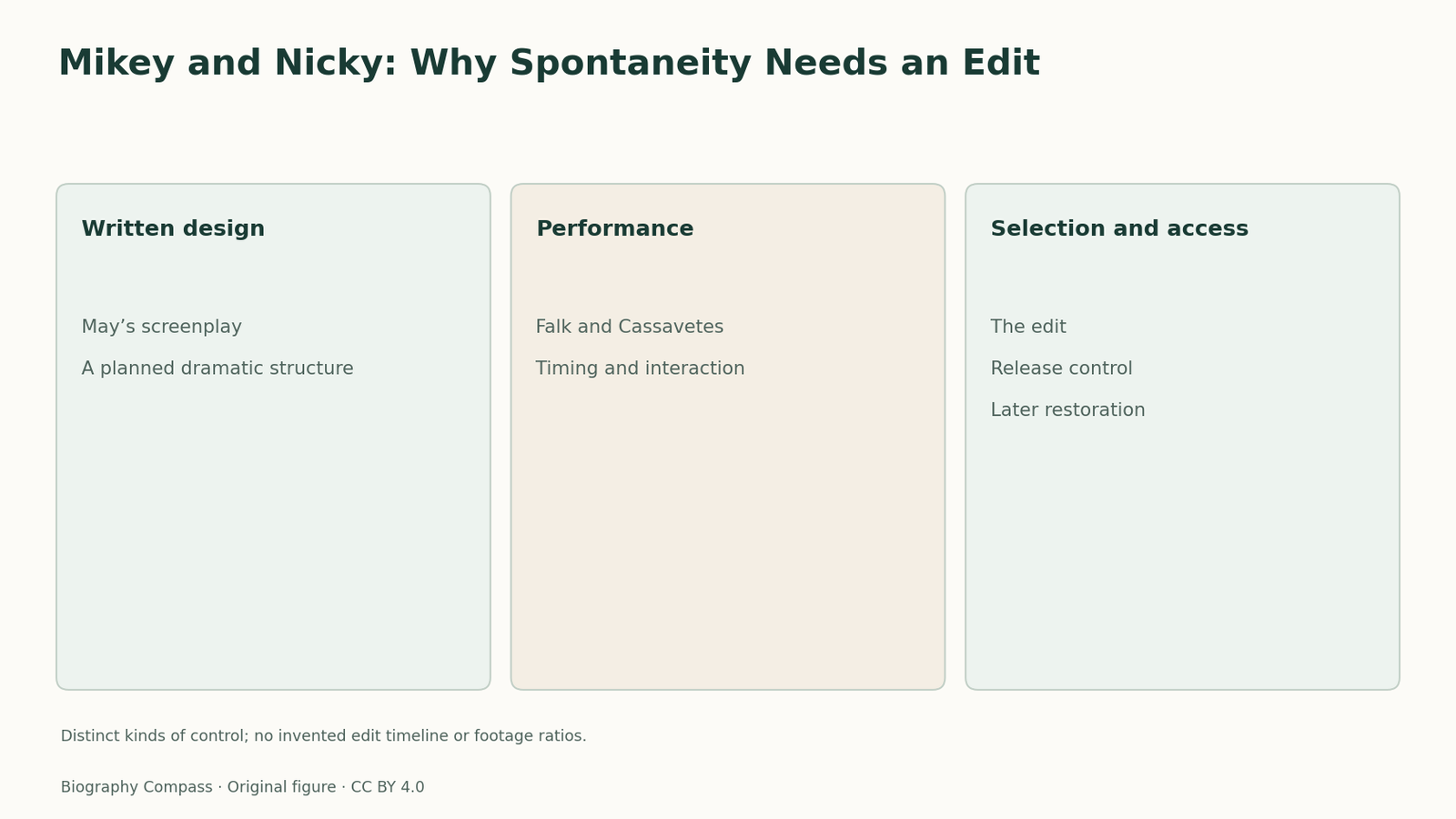
An apparently loose performance can be the result of exact preparation and selection. The written records for Mikey and Nicky offer a way to discuss that possibility without inventing an improvisation percentage or pretending an archive has settled every production dispute.
A working comparison
What changes between these records?
Use each record for the question it can answer. The distinctions below are our synthesis of the cited materials.
| Record or element | What it establishes | What remains separate |
|---|---|---|
| Performance | Falk and Cassavetes act in May’s film. | A familiar acting style is not a directing credit. |
| Structure | MoMA describes a carefully planned design. | The description does not identify every edit. |
| Restoration | May supervised the 2026 presentation. | Supervision does not date each earlier change. |
Whose film is it?
MoMA’s 1986 tribute describes Elaine May tailoring framing and dialogue to John Cassavetes and Peter Falk. It characterises the seemingly casual approach as disguising a carefully planned structure. That is a retrospective institutional interpretation of May’s direction, not evidence that Cassavetes directed the film.
Film at Lincoln Center’s 2026 programme identifies May’s third feature, its 1976 date and the two lead actors. It describes a single night in which friendship and betrayal share the screen.
A script, a shoot and a release
Nathan Rabin’s Criterion essay identifies the script as May’s first wholly original screenplay and distinguishes filming begun in 1973 from release in 1976. It also recounts the struggle with Paramount over control and the later purchase of the film by May, Falk and Julian Schlossberg.
The 2026 revival used a 4K restoration supervised by May. That credit identifies participation in a later presentation; it does not, on its own, provide a shot-by-shot history of changes among all earlier versions.
Three meanings of control
An actor can control the timing of a gesture, a director can arrange the scene, and an editor can decide which gestures survive and in what relation. A studio can also control access to the finished material. The same word therefore refers to distinct powers and should not substitute for an explanation of each.
A useful analysis begins with an observed effect—hesitation, interruption or a sudden change of allegiance—then asks what documentation supports a production explanation. An effect that feels improvised is not proof that its wording was invented on the day. The reverse inference is also weak: a script credit does not prove every performance detail was fixed in advance.
What a careful account can conclude
These records support a film written and directed by May, shaped through actors and a contested post-production history. They do not support a numerical claim about how much dialogue was improvised. The distinction keeps the collaboration visible without converting a compelling anecdote into a complete method.
Continue the chronology
Related history guides
Biography context
Explore United States through connected lives
Connected biographies
Explore the creators
b. 1932
Elaine May
Writer, director and performerA comedy performer whose career spans directing and screenwriting.Read biographyQuick answers
Common questions
- Can the film’s improvisation be expressed as a verified percentage?
- The consulted records do not support such a number. Spontaneity is an effect to analyse, not a measured production total here.
Primary and institutional sources
How this history was checked
Selected written records, with the scope of the comparison stated in the article. No complete performance or work is claimed to have been consumed. This article was reviewed on 4 November 2026.