
The short answer
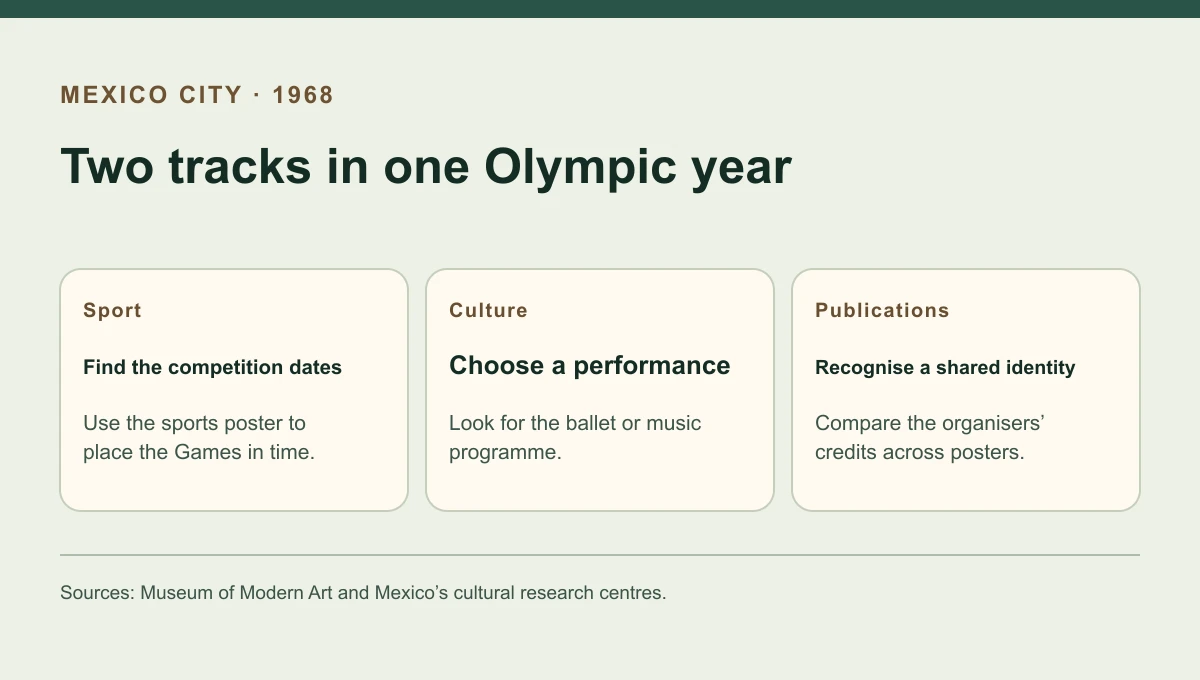
An Olympic programme in 1968 could lead someone to a ballet or a concert as well as a sporting venue. Mexico City’s Cultural Olympiad had its own events, audiences and publications. Posters for the Ballet of the Five Continents and an homage to Debussy offer two well-documented ways to see what the organisers put before the public.
Compare the publications
What different Olympic posters announced
A shared appearance can identify the organisers even when the events are different.
| Object | What it records | What a researcher should check next |
|---|---|---|
| Inaugural ballet poster | A named opening event for the cultural programme | Look for a cast or a programme to establish who performed. |
| Debussy homage poster | A music event and its named director | Look for a set list or review to establish what happened on stage. |
| Olympic Games poster | Dates for the sporting Games | Use separate cultural notices to date particular performances. |
Chronology
A timeline of the turning points
The cultural programme is publicised
The organising committee publishes the inaugural ballet poster.
The international arts festival is promoted
A poster records a homage to Debussy under Sir John Barbirolli.
The Games have a separate sporting calendar
A different organising committee poster publicises the dates of the athletic event.
The ballet as an opening event
MoMA catalogues an inaugural poster for the Ballet of the Five Continents as part of the cultural programme. The title speaks to the organisers’ international framing and gives a real event to investigate, whereas a general history of the Games might only mention culture in passing. The museum credits the organising committee’s Department of Publications and Urban Design along with Lance Wyman, Beatrice Trueblood, Huberto Batis and Eduardo Terrazas for that object. The collaboration can be tied to a specific publication.
The Debussy homage as a separate event
A festival poster in the same collection advertises a tribute to Debussy directed by Sir John Barbirolli and credits designer Bob Pellegrini with the organising committee department. The two examples show why a cultural programme calls for different information from a single schedule of contests. Someone choosing a performance needs the name of an event or artist, and a poster designed for that audience must make that information discoverable.
How far a poster can take the evidence
A poster establishes what was advertised and what credit appeared in the publication record. A performance programme, review or recording would be better evidence for what an audience heard or saw. Mexico’s national cultural research centres returned to the Cultural Olympiad during the fiftieth anniversary, treating those performances and their documentation as objects of research. The distinction matters because the dates printed on the familiar sports poster cannot date the wider cultural programme by themselves.
Continue the chronology
Related history guides
How the Mexico 1968 Olympic Identity Worked Across a City
Read how a repeatable graphics system connected different kinds of Olympic material.
Read the timeline1968–2012How Mexico 1968 Built the Route of Friendship
Follow the monumental sculpture project from the same cultural programme.
Read the timelineConnected biographies
People connected to this history
Quick answers
Common questions
- Was the Cultural Olympiad the same as the Olympic sporting calendar?
- It was an arts programme associated with the Games, with its own performances and publications.
- What were two examples from Mexico 1968?
- MoMA records publicity for the Ballet of the Five Continents and a tribute to Debussy directed by Sir John Barbirolli.
Primary and institutional sources
How this history was checked
Dates, legal milestones and historical claims are checked against the official and institutional records below. This article was reviewed on 19 November 2026.
- Museum of Modern ArtBallet of the Five Continents inaugural poster
- Museum of Modern ArtHomage to Debussy festival poster, directed by Sir John Barbirolli
- National Institute of Fine Arts and Literature research centresMexico 68 at 50 years: Cultural Olympiad research programme
- Museum of Modern ArtJuegos de la XIX Olimpiada, Octubre 12–27 (1968)