
The short answer
A familiar name does not remove the need to state a model. Compare a short biographical account with a modern reading of the original work, then check an entirely supplied rate equation.
Original worked comparison
Compare the stated quantities
The numerical entries below belong to the supplied fictional example.
| Case | Observation or calculation | Interpretation and limit |
|---|---|---|
| S=10 | Both pairs predict 60. | One point does not distinguish them. |
| S=20 | The predictions are 80 and 90. | The two stipulated curves differ. |
| Unit conversion | Convert both S and K. | Changing one input alone mixes concentration units. |
Chronology
A timeline of the turning points
State the model
Fix units and invented parameters.
Substitute consistently
Compute rates without treating a limit as an observation.
Compare parameter pairs
Use a second supplied concentration.
A caption and a technical account do different jobs
The Hall of Fame biography describes a rate proportional to substrate concentration.
Johnson and Goody’s translation commentary identifies the 1913 invertase paper. It describes rate as proportional to the enzyme–substrate complex and discusses initial-rate measurements and product inhibition.
The source comparison gives a concrete reading rule: a biographical label should not replace the conditions of the technical account. The simplified model below is supplied for learning; it is not a reconstruction of that full experiment.
Supply the equation and its units
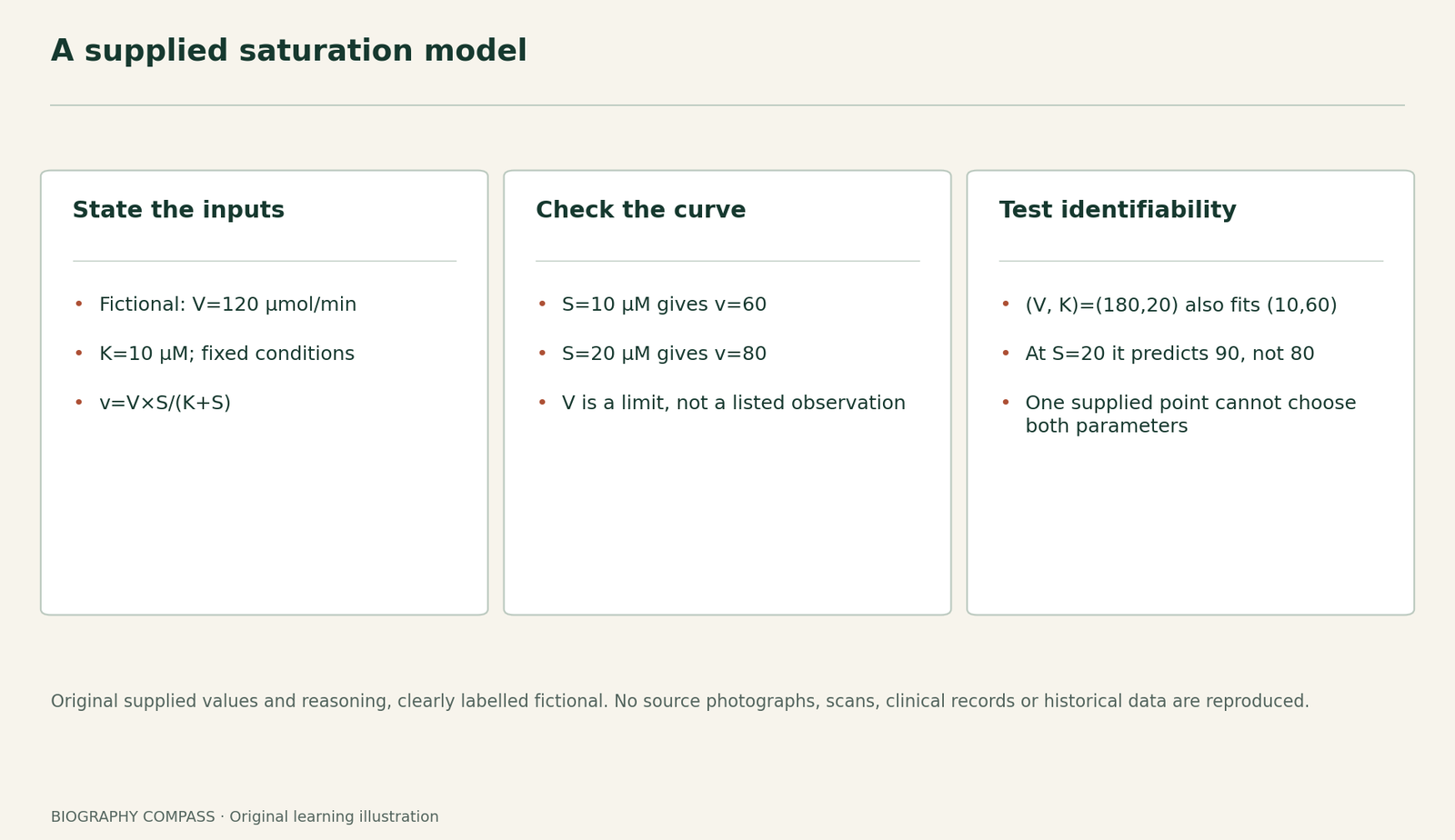
For this fictional example only, define v=V×S/(K+S). Let V=120 micromoles per minute, K=10 micromolar and S be a non-negative substrate concentration in micromolar. Keep the reaction volume and enzyme amount fixed. These are invented parameters, not measurements from Menten’s work. The equation is stipulated for the exercise; no product inhibition or changing enzyme activity is included.
K and S must have compatible concentration units so their sum and ratio make sense. V supplies the rate unit. At S=K, substitution gives v=V/2. That is an algebraic property of this model. It does not identify an unprovided microscopic binding mechanism or show that the same expression fits an actual assay.
Sources for this section: [2]
Calculate a curve without confusing its limit
At S=5, 10, 20 and 50 micromolar, the rates are 40, 60, 80 and 100 micromoles per minute. Doubling substrate from 10 to 20 raises the rate from 60 to 80, not to 120. In the stated expression, finite positive substrate gives a value below V; 120 is the limiting rate as substrate grows, not the largest value in the supplied four-point list.
A consistent unit change preserves the result. Writing K=0.000010 molar and S=0.000020 molar still gives 80 micromoles per minute. Changing S alone while leaving K numerically 10 would mix units and change the calculation’s meaning.
Sources for this section: [2]
Exercise: can one point determine both parameters?
Suppose all you retain is the invented observation S=10 and v=60. Compare the supplied pairs (V, K)=(120,10) and (180,20), using the same units. Do both pass this one-point test? Predict each rate at S=20 and explain what the comparison establishes.
Reference answer: 120×10/(10+10)=60 and 180×10/(20+10)=60. At S=20 the predictions separate: 80 versus 90. One point therefore does not select uniquely between these two parameter pairs. This finite comparison proves that insufficiency for the supplied example; it does not supply an uncertainty interval or choose an experimental design.
A useful report names the equation, units, supplied values and the distinction between an algebraic consequence and a biological inference. No drug potency, dose, patient response or actual kinetic parameter is estimated here.
Sources for this section: [2]
Continue the chronology
Related history guides
Biography context
Explore Canada and international research through connected lives
Connected biographies
People connected with these records
1879–1960
Maud Menten
Physician, biochemist and pathologistMenten combined biochemical research with a long career in pathology.Read biographyQuick answers
Common questions
- Is the largest listed rate automatically V?
- No. The largest supplied rate is 100; the stipulated limiting rate is 120.
- Does K alone establish binding affinity?
- No. This exercise supplies a rate expression and no microscopic binding model or binding data.
Primary and institutional sources
How this history was checked
Compare the selected records and their stated limits. The supplied example and reference answer are original learning material. This article was reviewed on 30 October 2026.