
The short answer
A physical interpretation may be compelling while relying on an observation made through a different experimental discipline. Keep both contributions visible.
Selected record and original analysis
Preserve the division of evidence
Read the stated model and observation separately.
| Question | Record or stipulated input | Interpretation |
|---|---|---|
| Separation | Agreement with one controlled response | A constraint among supplied models. |
| Interpretation | A physical account of splitting | Requires reasoning beyond a matching fraction pattern. |
| Version | Teaching transcription | Not a complete laboratory or publication archive. |
Chronology
A timeline of the turning points
Joint letter
Meitner and Frisch published the interpretation.
The joint letter’s evidence chain
Meitner and Frisch report Hahn and Strassmann’s inability to separate the activity from barium, while a radium-isotope control could be separated. They interpret the result through nuclear splitting and estimate the energy scale; the letter is not a direct measurement of every fragment’s energy.
The account connects chemistry and physics without making them identical. Naming the experimental contributors and the interpreting authors preserves the structure of the evidence rather than replacing it with a single-discoverer story.
Sources for this section: [1]
An original separation-pattern fixture
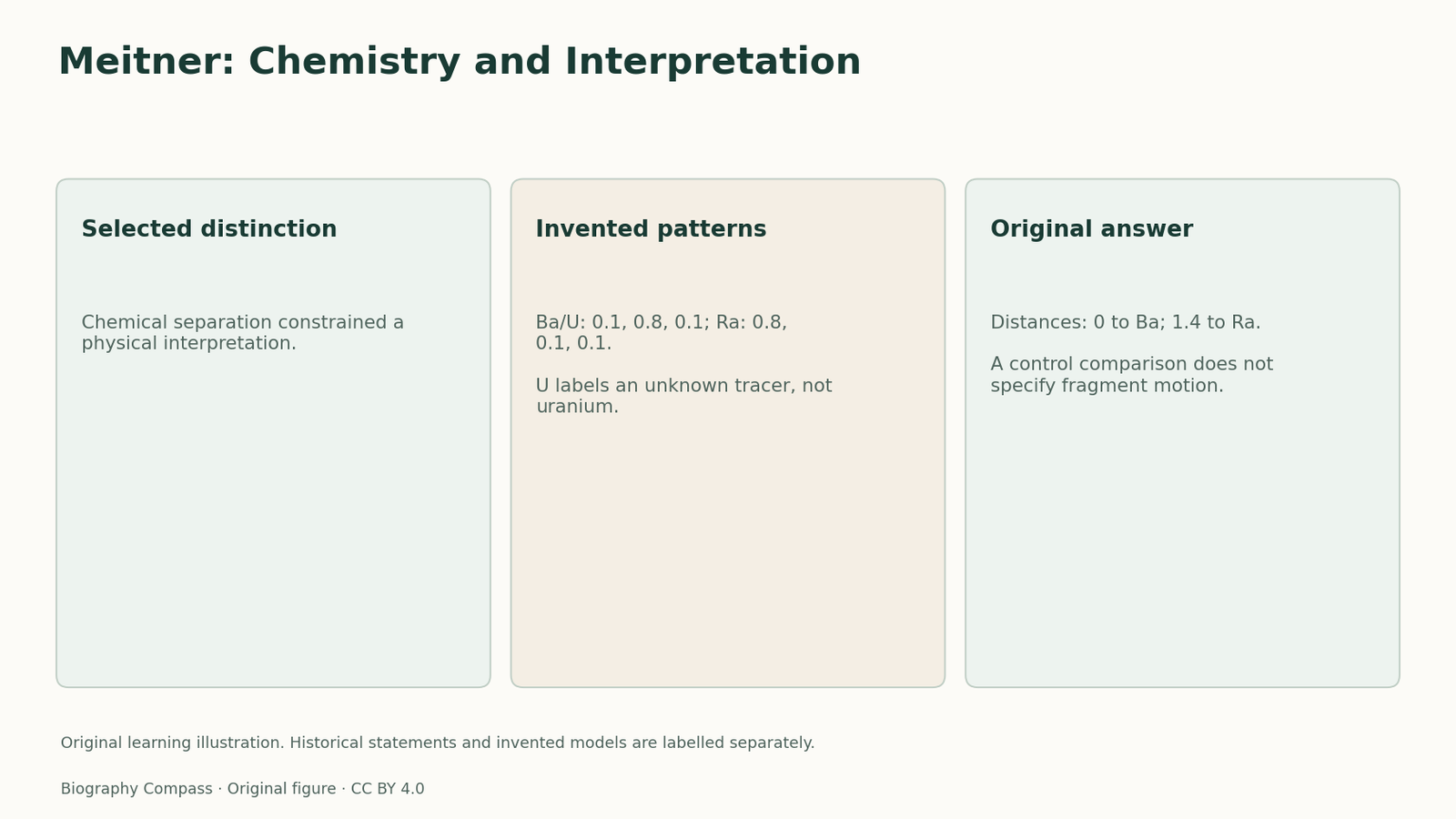
Invent three fractions whose normalised tracer patterns are Ba=(0.1, 0.8, 0.1), Ra=(0.8, 0.1, 0.1), and unknown U=(0.1, 0.8, 0.1). Here U is merely a label for the unknown tracer, not the chemical symbol for uranium. Assume the two known carrier responses were established under matched conditions.
Compute the sum of absolute component differences from the unknown to each carrier. Which of the two stipulated response models fits? Does this alone establish a unique chemical identity or show how a nucleus physically divided? No historical fractions or measured values have been copied.
Sources for this section: [1]
Reference answer: a constraint is not a complete mechanism
The distance to Ba is 0. The distance to Ra is |0.1−0.8|+|0.8−0.1|+|0.1−0.1|=1.4. Under the fixture’s matched-response assumptions, the unknown agrees with the Ba response and contradicts the specified Ra response.
This rules between those two supplied models. It does not exclude every unlisted species with a similar response. Nor do three separation fractions determine fragment trajectories or energy distributions. Those are different observables.
Return to the letter with that distinction in mind: the chemical result motivates and constrains the physical account, but the interpretation brings additional reasoning. The fixture illustrates the logic of a control comparison; it is not a reanalysis of the original chemistry.
Sources for this section: [1]
Dates and versions
The retained text is a teaching transcription of the letter, not a facsimile of the laboratory notebooks. A communication date and publication date need not be the same event. This study uses the publication’s year and makes no claim to have inspected the chemists’ original experimental records.
Sources for this section: [1]
Continue the chronology
Related history guides
Biography context
Explore Stockholm and Copenhagen through connected lives
Connected biographies
The working life behind the record
Quick answers
Common questions
- Is U the uranium concentration in this fixture?
- No. It is explicitly the label of an invented unknown tracer.
- Does a matching pattern uniquely identify every possible species?
- No. Only the two supplied response models have been compared.
Primary and institutional sources
How this history was checked
These selected records support the historical account. Invented inputs and their original reference answers are identified explicitly. This article was reviewed on 31 October 2026.